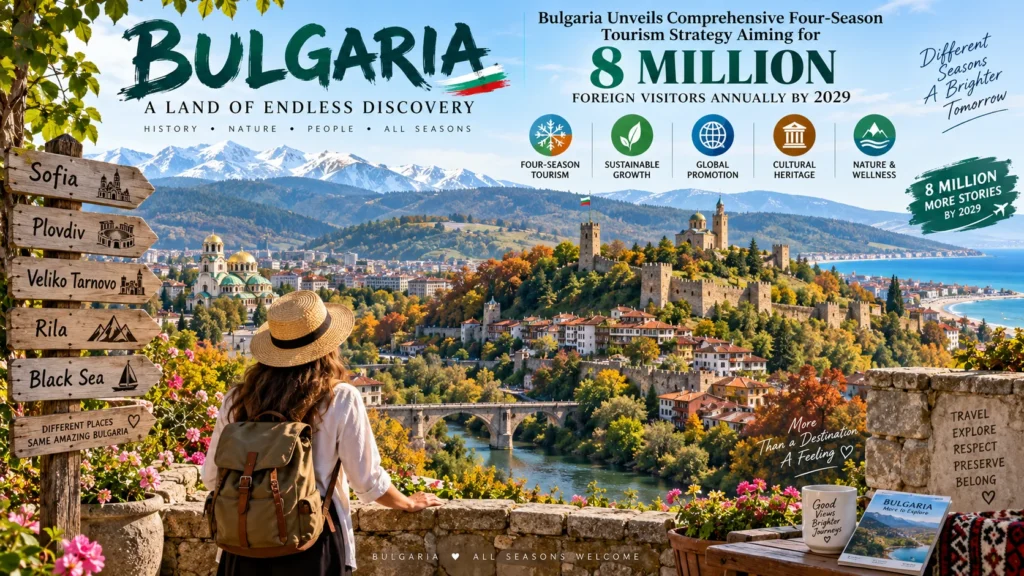
The Ministry of Tourism of the Republic of Bulgaria has formally introduced a strategic national tourism roadmap designed to double foreign arrivals and welcome eight million international visitors annually by 2029. Grounded in official statistical baselines that recorded 4,140,353 foreign tourist registrations in 2025—representing a 9.8 percent year-on-year increase—the strategic framework prioritizes targeted expansion across primary European and long-haul source markets. The nationwide initiative seeks to transform the Balkan country from a traditional summer beach retreat along the Black Sea into a competitive, year-round European travel hub centered on four-season cultural, thermal mineral spa, and mountain ski routes.
Strategic Expansion Beyond Black Sea Coastal Tourism
Bulgaria’s multi-year tourism framework transitions the national narrative toward interior provinces and year-round offerings. Official data published by the National Statistical Institute of Bulgaria confirms that total tourist volume reached 9,504,275 in 2025. This metric reflects strong domestic demand alongside expanding international interest in historic urban centers, natural balneological health resorts, and high-altitude mountain leisure zones.
The national roadmap to eight million annual foreign arrivals leverages Bulgaria’s complete integration into the Schengen Area for air and maritime transit. This regulatory alignment eliminates internal passport checks at major international air gateways in Sofia, Varna, and Burgas, facilitating streamlined travel across European markets.
Key Target Source Markets and Specialized Travel Segments
The official national strategy targets five primary source markets through tailored promotional campaigns and infrastructure enhancements:
Germany
As a leading European origin market, promotional drives focus on high-value cultural itineraries, hiking expeditions, and mineral spa retreats across Plovdiv, the Rila Monastery, and Pirin National Park.
Poland
Promotional campaigns emphasize active mountain holidays and cultural coastal tours. Strategy goals target expanding seasonal and year-round arrivals in Bansko, Borovets, Sozopol, and Nessebar.
Romania
High-density cross-border traffic from neighboring Romania is engaged through short-break heritage trips and winter sports packages in Veliko Tarnovo, Pamporovo, and regional northern border hubs.
Türkiye
Regional travel initiatives focus on cross-border culinary, shopping, and thermal spa excursions across southern municipal centers, including Svilengrad, Plovdiv, Hisarya, and Velingrad.
Japan and Long-Haul Markets
Marketing campaigns targeting premium long-haul travelers highlight UNESCO World Heritage circuits, Thracian archaeological routes, and traditional rose oil distilleries across the Kazanlak Rose Valley, Boyana Church, and Koprivshtitsa.
National Target Source Market and Regional Focus Matrix
The operational framework governing Bulgaria’s 2029 tourism growth targets pairs priority origin markets with specific regional destinations and primary travel segments:
Germany
Primary Travel Segment: Cultural touring, nature hiking, and thermal wellness
Priority Regional Destinations: Plovdiv, Rila Monastery, and Pirin National Park
Strategic Goal: Expanding long-stay cultural bookings and mountain trekking trips
Poland
Primary Travel Segment: Active mountain sports and coastal heritage tourism
Priority Regional Destinations: Bansko, Borovets, Sozopol, and Nessebar
Strategic Goal: Increasing charter flight connectivity and targeting 800,000 annual Polish visitors
Romania
Primary Travel Segment: Short-break heritage excursions and winter sports
Priority Regional Destinations: Veliko Tarnovo, Pamporovo, and Ruse border routes
Strategic Goal: Streamlining overland border transit and driving shoulder-season guesthouse stays
Türkiye
Primary Travel Segment: Cross-border culinary, shopping, and thermal spa travel
Priority Regional Destinations: Svilengrad, Plovdiv, Hisarya, and Velingrad
Strategic Goal: Promoting weekend leisure trips and regional balneological health centers
Japan
Primary Travel Segment: Long-haul heritage, rose oil production, and UNESCO circuits
Priority Regional Destinations: Kazanlak Rose Valley, Boyana Church, and Koprivshtitsa
Strategic Goal: Developing multi-city cultural itineraries and specialized tour group circuits
Cultural Crossroads, Mineral Springs, and Alpine Ski Valleys
Bulgaria’s national tourism appeal relies on its unique position at a cultural crossroads featuring Thracian, Roman, Byzantine, and Ottoman historical heritage. Plovdiv, recognized as one of Europe’s oldest continuously inhabited urban centers, features a preserved 2nd-century Roman amphitheater integrated into a historic National Revival quarter.
In addition to historic urban centers, Bulgaria maintains a vast thermal hydrological network comprising over 600 natural mineral springs. Balneological health centers in Velingrad, Hisarya, and Sandanski offer specialized mineral spa therapies rooted in ancient traditions. During the winter season, high-altitude mountain ranges like Rila and Pirin provide downhill skiing and winter sports infrastructure at Bansko, Borovets, and Pamporovo.
Practical Local Travel Logistics and Regional Rail Transit
Navigating Bulgaria’s diverse interior destinations is facilitated by modernizing public transit links and expanded regional flight corridors.
Airport Gateways and Schengen Entry Regulations
Sofia Airport functions as the main international entry hub for the national capital, Western Bulgaria, and primary ski resorts. Regional airports in Varna and Burgas handle seasonal and year-round flights serving the Black Sea coastline. Following Schengen integration for air and sea travel, passengers arriving from member states face no internal border controls, while non-EU visa-exempt travelers utilize standard ETIAS digital travel authorizations.
Regional Rail Connections
Travelers exploring mountain regions can utilize scenic rail corridors, including the historic Rhodope narrow-gauge railway connecting Septemvri to Dobrinishte near Bansko. Standard intercity passenger services operated by Bulgarian State Railways (BDZ) link Sofia Central Station with major regional centers, including Plovdiv and coastal transport hubs.
Sustainable Development and Regional Economic Distribution
Bulgaria’s transition toward eight million annual foreign visitors emphasizes environmental sustainability and heritage preservation. Infrastructure development in mountain regions is managed alongside strict conservation measures to safeguard old-growth pine forests and native wildlife in national parks.
By directing visitor traffic into rural interior municipalities such as Koprivshtitsa and Melnik, tourism revenues support the preservation of 19th-century timber architecture and traditional artisan trades. Distributing visitors across autumn wine harvests, spring rose blossoming periods, and winter ski seasons allows Bulgaria to prevent coastal overcrowding while ensuring sustainable economic growth across all regional communities.
For more travel news like this, keep reading Global Travel Wire