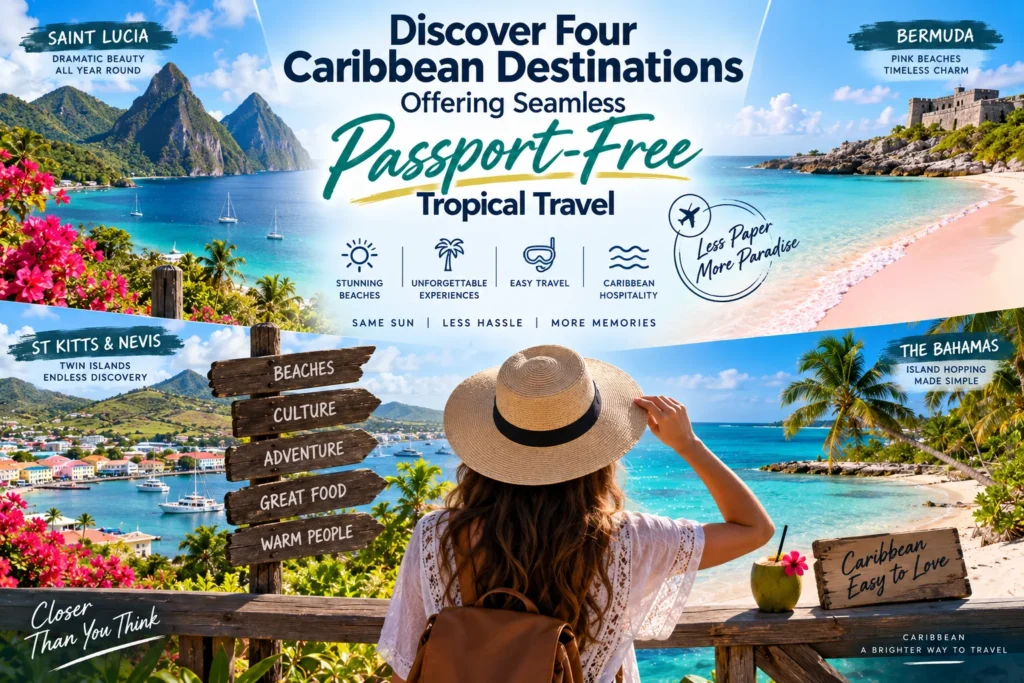
American travelers seeking sun-soaked beaches, turquoise waters, and vibrant island cultures can enjoy a Caribbean getaway without navigating international customs or securing a passport. Because Puerto Rico and the U.S. Virgin Islands operate as unincorporated U.S. territories, domestic travelers can board flights to these island destinations using standard domestic identification protocols.
This legal status eliminates foreign currency exchanges, complex customs declarations, and international travel documentation. For U.S. citizens and permanent residents, traveling to these four Caribbean islands provides a straightforward path to winter sunshine and coastal relaxation.
Puerto Rico: Diverse Coastal Landscapes, Rich History, and Easy Access
As the largest U.S. territory in the Caribbean, Puerto Rico offers an exceptional blend of urban history, tropical rainforests, and expansive white-sand coastlines. Most incoming visitors land at Luis Muñoz Marín International Airport (SJU) in San Juan, which serves as a major aviation hub with direct flight connections across the continental United States.
Travelers arriving in San Juan can explore the cobblestone plazas and historic fortification systems of Old San Juan, including the historic site of Castillo San Felipe del Morro. Urban beach corridors such as Condado Beach and Isla Verde offer immediate access to resort amenities and watersports. Beyond the capital region, visitors can hike through El Yunque National Forest—the only tropical rainforest managed by the U.S. Forest Service—or venture to off-coast islands like Culebra, home to the world-renowned Flamenco Beach.
St. Thomas: Premier Resort Facilities, Boating Corridors, and Duty-Free Shopping
St. Thomas serves as the primary gateway to the U.S. Virgin Islands, welcoming travelers through Cyril E. King Airport (STT). The island combines established tourism infrastructure with scenic coastal geography, making it a convenient base for resort stays, private boat charters, and island-hopping excursions.
Visitors to St. Thomas can swim in sheltered bays such as Magens Bay, Sapphire Beach, and Coki Beach, which feature calm waters ideal for family recreation and snorkeling. The historic capital of Charlotte Amalie offers duty-free shopping districts, historic Danish architecture, and harbor-front dining. The island’s central location within the archipelago allows day-trippers to easily navigate surrounding cays and marine reserves via local charter boats.
St. John: Protected National Parks, Pristine Snorkeling, and Secluded Bays
Located a short 20-minute passenger ferry ride from eastern St. Thomas, St. John presents a nature-focused retreat defined by protected terrestrial and marine ecosystems. Approximately two-thirds of the island is preserved as Virgin Islands National Park, limiting commercial resort development in favor of eco-villas, historic sites, and protected hiking trails.
The commercial center of Cruz Bay offers a relaxed waterfront atmosphere featuring local artisan shops, seafood establishments, and boutique accommodations. From Cruz Bay, visitors can access famous coastal sites within the national park, including Trunk Bay—celebrated for its underwater marked snorkeling trail—as well as Cinnamon Bay and Maho Bay, where shallow waters offer opportunities to view sea turtles and coral reefs.
St. Croix: Cultural Heritage, Expansive Coral Reefs, and a Relaxed Pace
St. Croix is the largest of the U.S. Virgin Islands, positioned south of St. Thomas and St. John. Served directly by Henry E. Rohlsen Airport (STX), the island offers a spacious layout characterized by historic sugar plantation ruins, distinct Danish colonial architecture, and diverse coastal terrain.
On the island’s eastern side, the historic town of Christiansted features a waterfront boardwalk and serves as the departure point for boat tours to Buck Island Reef National Monument. Buck Island protects one of the finest marine gardens in the Caribbean, offering managed underwater snorkeling paths. On the western coast, Frederiksted provides a quiet harbor environment anchored by a deep-water pier popular among scuba divers and marine photographers.
Practical Travel Identification and Logistics Guidelines
Before finalizing travel itineraries to Puerto Rico or the U.S. Virgin Islands, travelers should review current airport security and immigration rules established by federal authorities:
Federal REAL ID Identification Requirements
Under Transportation Security Administration (TSA) regulations, all adult domestic air travelers aged 18 and older must present a REAL ID-compliant driver’s license (marked with a star) or another acceptable federal photo credential, such as a U.S. passport card or military ID, at airport security checkpoints.
Regulatory Rules for Non-U.S. Citizens
Foreign passport holders, international tourists, and non-U.S. citizens must comply with standard U.S. entry rules. Entering Puerto Rico or the U.S. Virgin Islands requires the same valid international passport, ESTA authorization, or U.S. visa required for entry into the mainland United States.
Customs Inspection Protocols
While flights to Puerto Rico operate identically to domestic state-to-state travel, passengers returning from the U.S. Virgin Islands to the U.S. mainland pass through a U.S. Customs and Border Protection (CBP) pre-clearance checkpoint. U.S. citizens are not required to present a passport book at this checkpoint, but carrying a government-issued photo ID alongside a birth certificate is recommended to verify citizenship.
For more travel news like this, keep reading Global Travel Wire