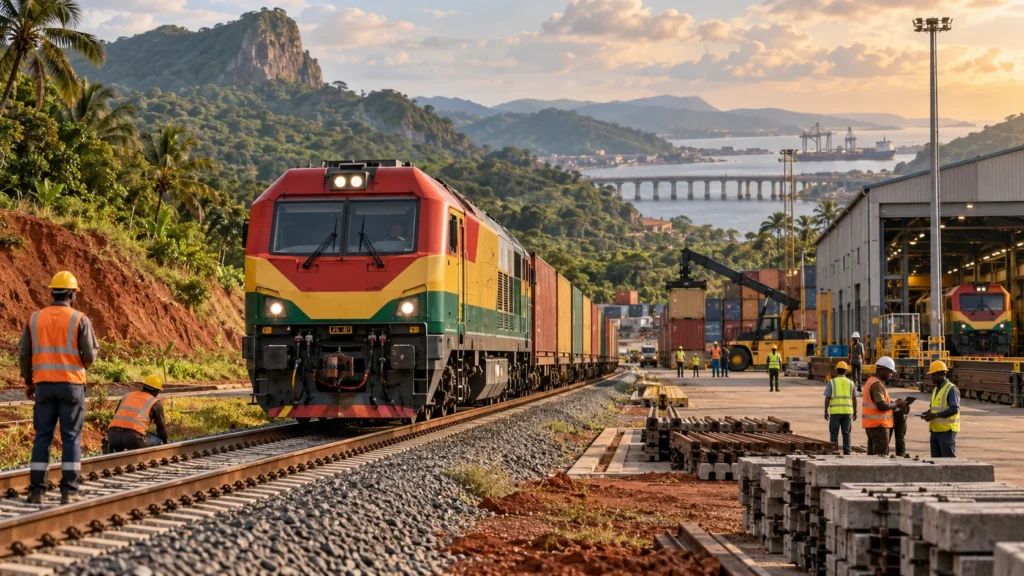
West Africa’s transportation network is reaching a transformative milestone as large-scale rail infrastructure investments accelerate regional connectivity, eco-tourism potential, and multi-modal transit across Guinea. Public authorities and international infrastructure partners have finalized a long-term, custom service agreement valued at over US$700 million to maintain the advanced locomotive fleet operating on the newly constructed TransGuinéen Railway corridor.
The multi-year service deal builds upon earlier locomotive acquisition contracts, bringing the total technology investment in the corridor’s rail fleet to more than US$1.2 billion. Beyond its foundational role in industrial logistics, the multi-user railway corridor is designed to serve as a vital passenger transport link, unlocking remote interior regions for domestic travel, cross-border trade, and cultural eco-tourism across West Africa.
Unlocking Interior Destinations Along the TransGuinéen Rail Network
Spanning more than 600 kilometers across the country, the TransGuinéen Railway establishes a high-capacity land bridge connecting the Atlantic coastal hub at Port de Morébaya through Forécariah, Kassa, and Nialinko, all the way to the interior Simandou region. Designed as a multi-user transport system, the national railway framework incorporates public passenger transport and general freight services alongside bulk resource transit.
For regional travel planners and international visitors, the opening of standard-gauge rail corridors represents a major shift in accessibility. Historically, navigating West Africa’s inland geography required long journeys across difficult terrain. The introduction of high-efficiency passenger transit provides a safe, reliable, and comfortable travel alternative across Guinea’s four distinct geographical regions:
Maritime Coastal Hubs: Streamlining travel connections between coastal port facilities, historic maritime communities, and urban entry points.
Forest and Mountain Eco-Corridors: Opening direct rail access to pristine highland landscapes, nature reserves, and eco-tourism lodges in the interior regions.
Regional Cultural Centers: Connecting rural communities along the rail line, enabling cultural exchange, heritage tourism, and local market access.
Cross-Border Transit Networks: Enhancing regional integration across neighboring West African states by establishing modern logistical and passenger connections.
By linking isolated inland communities directly to coastal transport hubs, public authorities are establishing the structural foundation for sustainable rural tourism and expanded domestic travel.
Advanced Rail Technology and Regional Capability Development
Operating heavy-haul passenger and commercial trains through complex mountainous terrain and severe seasonal temperature shifts requires state-of-the-art locomotive engineering. The TransGuinéen fleet utilizes advanced 4,500-horsepower diesel locomotives specifically built for high fuel efficiency, extreme thermal durability, and high operational reliability.
The US$700 million customized services agreement provides comprehensive operational support to guarantee fleet availability over the long term. Key components of the technical partnership include:
Integrated Fleet Maintenance: Delivering scheduled maintenance, parts management, and major component overhauls to maintain continuous passenger and freight schedules.
Real-Time Remote Diagnostics: Utilizing advanced digital monitoring systems to track locomotive performance and prevent operational delays along the 600-kilometer line.
Local Skills and Workforce Training: Establishing technical instruction programs and partnerships with Guinean businesses to build local engineering expertise and create long-term technical jobs.
Technology Transfer: Supporting national capacity goals by transferring advanced rail management practices directly to public infrastructure agencies.
Government officials emphasized that integrating international technological standards aligns with the country’s broader strategic vision to partner with world-class engineering firms while developing national workforce capabilities.
Multi-User Rail Infrastructure as a Catalyst for Economic and Tourism Growth
The development of the TransGuinéen Railway is managed under a strategic public-private partnership structure via the Compagnie du TransGuinéen (CTG). The joint venture brings together the national government holding a 15% state equity stake alongside international industrial partners holding the remaining shares. Under national concession terms, all rail lines, port facilities, and transit stations are structured to operate under a multi-user access model.
This collaborative public-private framework ensures that multi-billion-dollar infrastructure investments deliver broad societal benefits beyond industrial transport. By guaranteeing passenger access and non-mining freight movement, the government is utilizing heavy-haul rail corridors to diversify the national economy, lower domestic travel costs, and stimulate regional hospitality sectors.
As technical maintenance teams begin implementing fleet support programs, the long-term outlook for passenger mobility and regional travel across West Africa continues to strengthen. The modernization of Guinea rail infrastructure travel reflects a growing commitment across the continent to build resilient, high-speed transport corridors that connect communities, foster economic independence, and welcome global travelers to explore diverse natural destinations.
For more travel news like this, keep reading Global Travel Wire