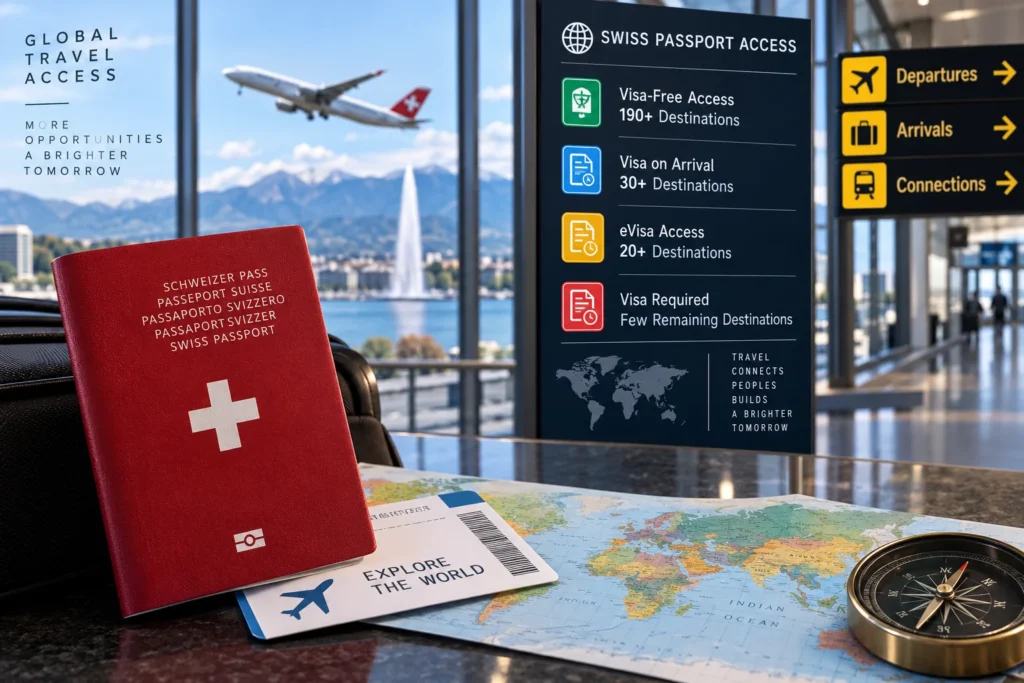
International travel freedom remains a cornerstone of global tourism, influencing how seamlessly citizens navigate foreign borders for leisure, business, and cultural exchanges. A comprehensive analysis of global passport travel access shows that while European travel documents consistently rank among the most powerful worldwide, holding a top-tier passport does not eliminate all entry formalities.
Statistical evaluations released by Passport Reports, an independent research platform monitoring international border policies, highlight the distinction between visa-free privileges, electronic travel authorizations, and advance entry visas. For travelers holding Swiss citizenship, global mobility remains exceptionally strong, though specific destinations across Europe, Asia, Africa, and the Americas continue to enforce tailored visa protocols.
Swiss Passport Performance Across International Travel Corridors
The analysis places Switzerland ninth in global passport travel access rankings, granting holders streamlined entry to 119 destinations completely visa-free. An additional 54 countries permit entry through visa-on-arrival mechanisms or simplified digital clearances, while 25 destinations maintain traditional advance visa application requirements.
Within European travel corridors, Swiss citizens benefit from complete freedom of movement and entry privileges across 44 European states without requiring a standard visa. However, specific regional destinations maintain distinct administrative protocols:
United Kingdom Transit: Travelers entering the United Kingdom must obtain an Electronic Travel Authorisation prior to arrival.
Eastern European Access: Specific non-EU destinations, including Russia, mandate a formal visa or visa-on-arrival clearance prior to entry.
Intercontinental Routes: Destinations across North America, South America, the Gulf Cooperation Council states, and the Caribbean remain broadly accessible through combination frameworks of visa-free access, electronic travel authorizations, or border-issued visas.
Across global geographic regions, regional access rates for Swiss passport holders vary. Oceania leads with an overall access rate of nearly 93% through combined visa-free and electronic authorization options. Asia and the Middle East maintain access rates of 82% and 82.4% respectively, followed by Central Asia at 80% and Africa at 72.2%.
European Standings and Comparative Global Passport Strengths
While Switzerland maintains a high position on the global stage, it ranks 13th among 47 European nations evaluated in regional mobility metrics. European Union member states—including Spain, Luxembourg, Belgium, France, Italy, Germany, Greece, and several Nordic nations—occupy higher positions due to bilateral visa agreements that slightly expand their total visa-free destination count.
On the broader global index, Singapore holds the highest overall ranking, offering its citizens visa-free access to 129 destinations. The United Arab Emirates follows closely in second position with 128 visa-free destinations. At the opposite end of the mobility spectrum, nations such as Afghanistan, Syria, and select states across North Africa and Central Asia face severe travel constraints, with Afghan passport holders having visa-free access to only three countries worldwide.
These comparative metrics demonstrate that while high-ranking European passports offer near-universal access across major economies, international travel access reflects complex bilateral diplomacy rather than uniform open-border policies.
Asymmetric Entry Policies and Switzerland’s Hospitality Index Ranking
A notable finding in the international border report is the asymmetry between the travel access granted to Swiss citizens abroad and the entry regulations Switzerland applies to incoming foreign visitors. In global hospitality metrics—which measure how openly a nation admits foreign citizens without advance visas—Switzerland ranks 92nd out of 199 countries surveyed.
This structural gap means that nationals from several countries that welcome Swiss tourists without advance visa requirements must apply for a formal Schengen visa before entering Switzerland. Federal migration authorities apply strict entry controls aligned with unified European Schengen border regulations, prioritizing security protocols, financial verification, and entry tracking over automatic visa reciprocity.
Independent mobility platforms emphasize that understanding these nuanced entry requirements is essential for international tour operators, corporate travel planners, and independent travelers. As global travel policies continue to integrate digital entry permits, biometrics, and electronic travel authorizations, monitoring updated government announcements remains vital for seamless cross-border mobility.
For more travel news like this, keep reading Global Travel Wire