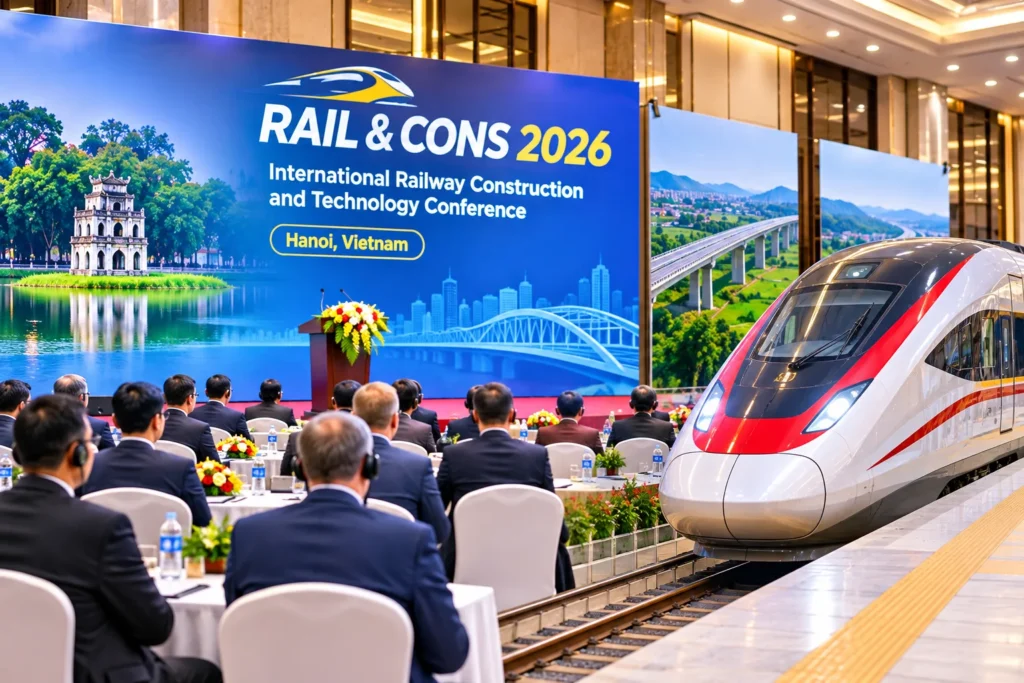
Vietnam’s capital is set to host a landmark gathering of international engineering corporations, transport planners, and infrastructure developers as the Railway and Infrastructure Industry Week, designated as RAIL & CONS 2026, opens at the Vietnam National Exhibition Center in Hanoi. Running from November 11 to 13, the three-day convention brings together three specialized international expos: the Vietnam International High-Speed Rail & MetroTrans and Engineering Technology Expo (VRME 2026), the Construction Machinery and Mining Equipment Exhibition (CONMAC VIETNAM 2026), and the Clean Energy and Civil Engineering Technology Exhibition (CET 2026).
Organized under the auspices of the Vietnam Society of Civil Engineers in partnership with Camel Events, the industrial showcase spans approximately 10,000 square meters of exhibition floor space. The trade assembly convenes over ten multinational engineering conglomerates alongside more than 100 domestic and foreign brands. Together, these participants are demonstrating rolling stock, automated train control systems, and heavy civil construction machinery essential for modernizing passenger transport across the nation.
Catalyzing National Tourism Connectivity Through High-Speed Rail
The timing of RAIL & CONS 2026 aligns with Vietnam’s prioritized national transportation roadmap, which centers on constructing the North-South high-speed rail artery and expanding metropolitan transit systems in Hanoi and Ho Chi Minh City. Modern railway systems play a transformative role in regional visitor dispersal, connecting international aviation gateways with scenic coastal provinces, cultural heritage regions, and rural eco-tourism corridors.
By providing rapid, low-carbon passenger transit between northern, central, and southern tourism clusters, high-speed rail development is projected to reshape domestic travel itineraries. The transition from road-heavy travel to high-speed rail networks reduces long-distance journey times, relieves highway congestion, and lowers emissions, aligning directly with national sustainable tourism directives.
The integration of transit-oriented development models around passenger hubs is transforming railway terminals into multi-functional destinations. Under official transport-oriented urban planning frameworks, railway stations are engineered as integrated lifestyle centers incorporating hotels, pedestrian plazas, regional craft markets, and retail spaces, enabling travelers to access hospitality amenities directly upon arrival.
Cutting-Edge Rolling Stock and Transit Engineering on Display
Across the VRME 2026 and CET 2026 exhibition halls, global manufacturers are showcasing advanced solutions tailored to intercity high-speed lines and municipal mass transit routes. Exhibited technologies feature modern electric multiple unit trainsets, precision-engineered wheelsets and bogies, and ballastless rail track structures designed for stable, quiet passenger operations.
Prominent international transport corporations presenting their systems include CRRC, China Railway Signal & Communication, DB Systemtechnik, Shenzhen Metro Group, CASCO, RSIC, Jiangsu Railteco, Wuxi Jinxin, and vibration-isolation specialist GERB. These entities are demonstrating automated train supervision, automatic train protection, and communication-based train control systems that ensure maximum operating safety and high-frequency dispatch schedules.
In addition to passenger rolling stock, the CONMAC VIETNAM 2026 exhibition highlights heavy civil machinery required to construct complex rail routes traversing Vietnam’s diverse topography. Exhibitors including Sunhunk Group, Nanfang Ventilator, Vitravico, and Shinelink Industries are presenting tunnel ventilation equipment, long-span bridge erection mechanisms, and heavy transport carriers. Leading Vietnamese industrial producers, including the Hoa Phat Group, YSCM Global, and Prime Solution, are actively participating to integrate domestic steel fabrication and construction capabilities into the international rail supply chain.
Policy Conventions and Strategic Transit-Oriented Development
Beyond the exhibition pavilions, RAIL & CONS 2026 features high-level technical conferences and policy workshops addressing strategic hurdles in rail project execution. Government transport officials, scientific advisors, and municipal authorities are convening across five distinct program pillars to evaluate investment mobilization, technology transfer, and supply chain localization.
The professional agenda addresses foundational infrastructure topics:
On November 11, ministerial and academic sessions examine engineering technologies for high-speed rail bridges, viaducts, and mountain tunneling, alongside capital financing structures for major corridors.
On November 12, expert panels evaluate workforce development, digital railway telecommunications integration, and transit-oriented development frameworks to capture land value around major passenger interchanges.
On November 13, commercial programs culminate in bilateral business-to-business networking sessions and the Startup-Cons Innovation Challenge finals, linking project contractors with innovative technology startups and engineering consultants.
These structured dialogues offer municipal planners and transport ministries actionable blueprints for integrating rail lines with broader regional tourism networks.
Transforming the Future of Travel and Regional Mobility
The modernization of passenger rail networks represents a cornerstone of Vietnam’s long-term economic resilience and destination competitiveness. As international travelers increasingly prioritize eco-friendly journey options, comfortable overland transit corridors offer compelling alternatives to short-haul domestic flights.
By convening global engineering leaders, rolling stock innovators, and domestic civil contractors, RAIL & CONS 2026 accelerates the technological foundations required to turn Vietnam’s ambitious railway vision into operational reality. The resulting modern passenger rail corridors will provide seamless transit across the country, linking ancient cultural capitals, protected biosphere reserves, and vibrant coastal cities through safe, sustainable, and interconnected rail journeys.
For more travel news like this, keep reading Global Travel Wire