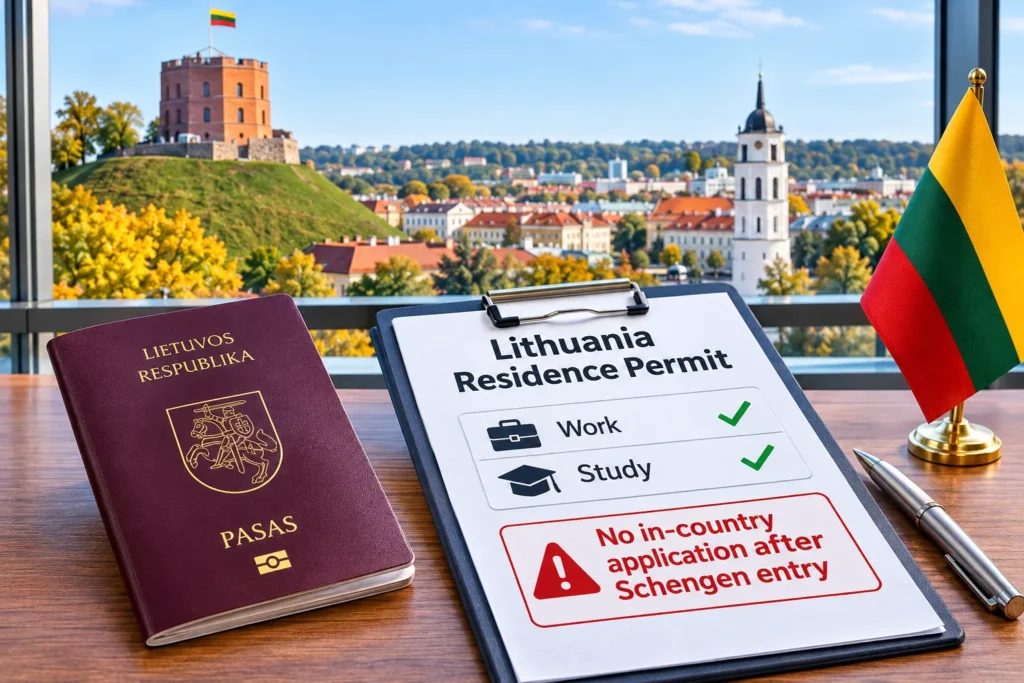
Official immigration directives issued by the Migration Department under the Ministry of the Interior of the Republic of Lithuania have established new filing parameters for foreign nationals seeking temporary residence permits. Under regulatory amendments that took effect on 1 November, foreign visitors residing in Lithuania on standard short-stay Schengen visas or national visas issued by other sovereign states are no longer permitted to lodge in-country applications for ordinary employment or first-cycle bachelor’s degree programmes.
The administrative restructuring redefines where and how third-country nationals can submit initial residence petitions. While lawful entry into the Schengen area remains governed by standard visa codes, possession of a visitor visa no longer confers the procedural right to transition into long-term employment or undergraduate study from within Lithuanian territory. The Migration Department emphasizes that the measure is not an outright prohibition on foreign students or international workers, but rather an operational enforcement directing non-qualifying applicants to submit their files through authorized external service providers situated abroad.
Permitted In-Country Status Conditions and Exclusions
Under the official regulatory framework published by the Migration Department, foreign citizens physically present in Lithuania can only submit in-country applications for ordinary work or undergraduate university admission if they hold an established lawful status recognized by the state.
Official migration notices identify four qualifying circumstances that permit domestic lodgement:
Holding a valid temporary residence permit previously issued by the Republic of Lithuania.
Holding a valid national (D) visa issued directly by the Republic of Lithuania.
Holding a valid residence permit issued by another European Union member state or Schengen associated country.
Residing lawfully under an authorized visa-free regime established by bilateral or European Union agreements.
The Migration Department explicitly distinguishes between national visas and short-stay Schengen visas. A Schengen short-stay visa issued by Lithuanian diplomatic missions does not equate to a national visa, nor does an entry visa issued by another member nation grant domestic filing privileges. Foreign nationals who entered under short-stay tourist, business, or visitor visas must complete their residence permit applications through designated external processing centers overseas before traveling to the country for work or study purposes.
Specific Exemptions for Highly Qualified Specialists and Permit Renewals
The newly enforced filing limitations specifically target ordinary employment categories and first-cycle undergraduate academic programs. Official provisions maintain clear exemptions for specialized professional tiers and existing permit holders.
Highly qualified employment—commonly recognized under European Union Blue Card criteria and national executive specialist registries—remains eligible for standard in-country submission procedures for foreign nationals lawfully present in Lithuania. Authorities note that classification as highly qualified employment depends entirely on statutory salary thresholds, professional qualifications, and designated occupational codes registered with the Employment Service, rather than discretionary employer descriptions.
Furthermore, foreign citizens currently holding a valid Lithuanian temporary residence permit may continue to apply for regular renewals or amendments of their permits within the country. Migration guidelines stipulate that applications for the amendment or renewal of an existing permit should be lodged well in advance of expiration, utilizing the official Lithuanian Migration Information System (MIGRIS) portal.
International Processing Hubs and External Service Networks
For prospective applicants who do not satisfy the domestic lodgement conditions, applications must be routed through Lithuania’s official external service provider network. Applicants must schedule appointments, register biometric data, and present original civil documentation through authorized overseas centers operated by VFS Global.
Simultaneously, the Ministry of Foreign Affairs and the Migration Department announced geographic reconfigurations across their international intake infrastructure. Effective from 1 November, regular external service provider processing for Lithuanian temporary residence permits and national visas ceased operations across centers located in Kazakhstan, Kyrgyzstan, Uzbekistan, and Bosnia and Herzegovina. Official consular notices clarify that while long-term residence permit intake has ended in those specific facilities, the acceptance of short-stay Schengen visa applications through those regional centers remains operational and unaffected.
Diplomatic missions continue to caution prospective travelers that short-stay Schengen visas do not confer employment rights in Lithuania. Under statutory labor amendments, third-country nationals must possess a valid residence permit or national work authorization prior to engaging in commercial employment. Using a visitor visa to bypass official consular processing channels abroad carries substantial legal risks, including entry refusals, application cancellations, and potential entry bans across the Schengen area.
Institutional Compliance for Employers and Universities
Lithuanian public institutions, universities, and commercial enterprises must align their international recruitment and admission schedules with the revised administrative deadlines. Academic bodies inviting international students for bachelor’s studies are advised to communicate filing procedures early, ensuring admitted candidates have sufficient time to book appointments and receive formal residence decisions through overseas hubs before academic terms commence.
Similarly, corporate employers submitting digital mediation letters via the MIGRIS platform must verify the prospective employee’s lawful immigration status. If an invited candidate resides on a visitor visa, employers cannot designate a domestic migration branch for document submission. Both applicants and sponsoring entities are urged to verify procedural guidance exclusively through verified announcements on the official Migration Department portal to ensure full compliance with Lithuanian immigration law.
For more travel news like this, keep reading Global Travel Wire