The future of global travel is undergoing a fundamental structural transition. At InnoTrans 2026 in Berlin, public transportation pioneer Hitachi Rail officially launched its landmark industry study, Mobility Reimagined. The comprehensive analysis features strategic contributions from top executive authorities across the technology, manufacturing, and academic sectors. The report projects that by 2050, isolated transportation modes will fully integrate into connected, intelligent mobility networks.
This digital transition directly impacts international tourism, where seamless visitor transport, reduced urban congestion, and low-carbon infrastructure are becoming baseline requirements for major destinations. Based on detailed surveys and operational assessments involving dozens of global industry leaders across North America, Europe, and Asia, the report outlines how passenger travel will become completely continuous, automated, and personalized over the coming decades.
Five Key Findings Shaping the Future of Passenger Travel
The study highlights five core operational shifts that will dictate how international visitors, commuters, and long-distance travelers move within and between global cities:
Modes Replaced by Integrated Systems: Individual transport modes such as cars, buses, and trains are dissolving into single, interconnected smart mobility systems. Single-ticket, multi-modal journeys will allow international tourists to navigate complex urban transit networks effortlessly.
Rail Serves as the Sustainable Backbone: Heavy and high-speed rail networks represent the primary high-capacity solution capable of handling rapid global urbanization and rising tourist arrivals without increasing carbon emissions.
Artificial Intelligence Drives Operational Efficiency: The most immediate benefits of artificial intelligence will manifest behind the scenes, improving network performance, energy consumption, and timetable reliability through predictive maintenance and real-time traffic management.
Digital Twins and Physical AI Enable Real-Time Optimization: Modern transport operators are adopting virtual modeling and physical AI to simulate passenger flows, predict equipment wear, and dynamically adjust transit schedules during peak tourism seasons.
Governance Must Keep Pace with Digital Innovation: Technological capabilities are advancing faster than regulatory frameworks. The complete realization of future transport networks depends as much on updating policy and cross-sector partnerships as it does on digital breakthroughs.
Industry leaders emphasize that future mobility ecosystems will rely heavily on connecting real-time data with physical infrastructure to build transit networks that are resilient against climate impacts and sudden demand spikes.
Enhancing the Tourist Experience Through Seamless Journeys
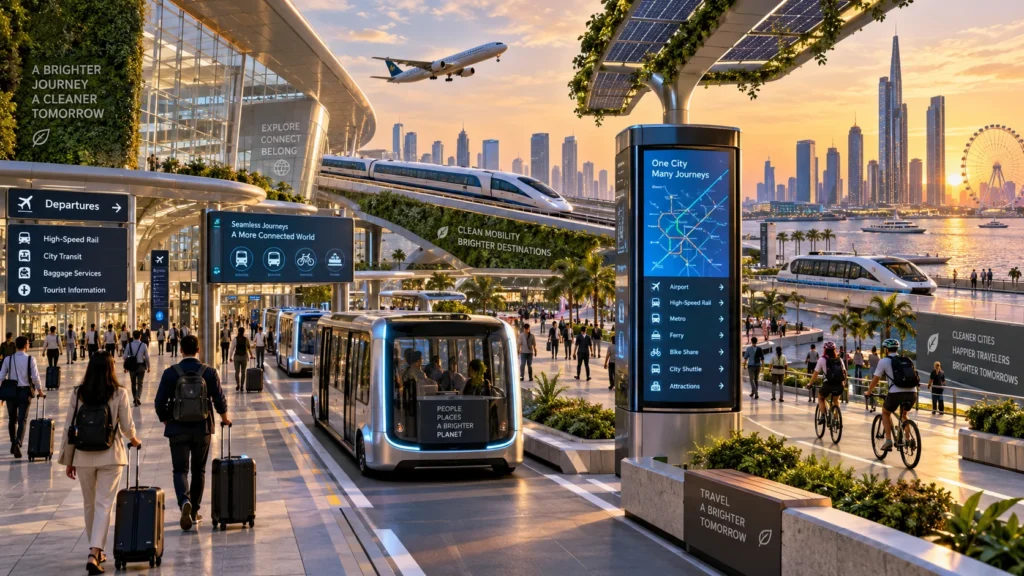
For the tourism and travel industry, the transition toward unified smart mobility systems eliminates long-standing travel friction points. End-to-end transport architectures will allow international visitors to step off an aircraft and move seamlessly onto high-speed rail, regional transit, or autonomous urban shuttles using a single digital identity or payment platform.
By utilizing edge computing and real-time data integration, public transit authorities can monitor passenger density at key tourist landmarks, automatically dispatching additional capacity to prevent crowding. Furthermore, predictive digital systems minimize sudden network breakdowns, ensuring high-frequency, reliable service for visitors on strict travel itineraries.
The shift also supports global sustainability goals established by national tourism boards. As cities seek to reduce municipal carbon footprints, high-capacity electrified rail systems backed by artificial intelligence offer a clear pathway toward zero-emission urban and intercity travel.
Public-Private Collaboration Drives Long-Term Infrastructure Readiness
The research underscores that achieving fully autonomous, interconnected travel by 2050 requires immediate collaboration between public transport authorities, private technology providers, and urban planners. Transport operators are increasingly partnering with global enterprise software leaders to modernize legacy rail signaling, digitalize fleet management, and upgrade passenger information displays.
Public investments in smart mobility systems serve a dual purpose: improving daily quality of life for resident populations while elevating destination competitiveness in the global leisure and business travel markets. Destinations equipped with reliable, automated transit options naturally attract higher volumes of international conferences, major sporting events, and leisure travelers.
As cities confront growing urban populations and accelerating climate targets, integrating physical rail infrastructure with advanced digital intelligence provides a scalable foundation for global mobility. The future of travel relies on connected data ecosystems that make every stage of the journey safer, faster, and environmentally sustainable.
For more travel news like this, keep reading Global Travel Wire