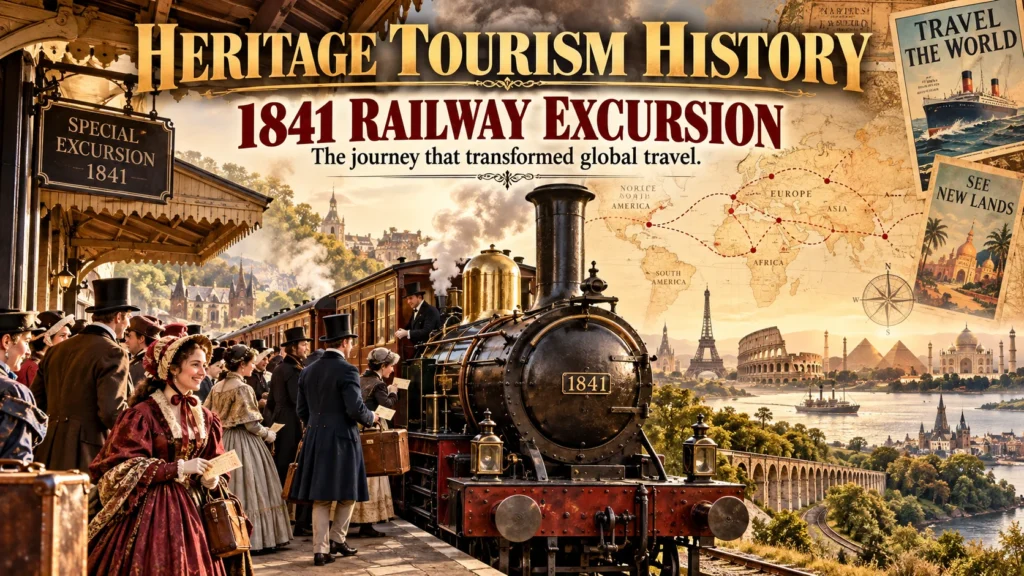
Modern leisure travel and structured holiday itineraries are integral components of global economic life, yet the concept of organized mass tourism originated from a singular short-distance rail journey in Victorian England. On July 5, 1841, a chartered passenger train departed Campbell Street Railway Station in Leicester bound for Loughborough, carrying nearly 500 passengers. Organized by Thomas Cook, a former cabinet-maker and Baptist missionary, this 11-mile journey is recognized in heritage tourism history as the foundational precursor to the modern commercial package tour.
The initial excursion was not conceived as a commercial venture. Cook, an active participant in the regional temperance movement, arranged with the Midland Counties Railway to secure chartered group transport for campaign members attending an anti-alcohol rally. Passengers paid a fixed price of one shilling each, which covered return rail travel, basic refreshments, and event organization. This milestone demonstrated that newly developed steam-powered railway infrastructure could democratize regional transit, opening recreational mobility to working-class populations previously excluded from leisure travel.
Evolution of the Package Holiday Model
Following the success of the Leicester-to-Loughborough excursion, Cook expanded his travel operation from local society outings to commercial regional itineraries. Throughout the 1840s and 1850s, he refined the structured tour framework, negotiating negotiated block rates with railway operators and hotel providers to establish bundled travel packages.
Key administrative and operational innovations introduced during the expansion of early commercial tourism included:
Mass Transportation Partnerships: Establishing structured ticketing agreements with regional rail lines to lower individual passenger costs through guaranteed group volume.
The Great Exhibition Excursion (1851): Coordinating travel and accommodation logistics for over 150,000 visitors attending London’s landmark international exposition, solidifying mass transit feasibility.
Continental European Expansion (1855–1860s): Launching grand circular tours across mainland Europe, introducing fixed-price travel coupons that covered transit, dining, and hotel lodgings.
Financial Travel Instruments: Introducing standardized circular notes—early precursors to modern traveler’s cheques—to facilitate secure international currency exchanges for tourists abroad.
By the late 19th century, organized travel had expanded globally, featuring round-the-world itineraries and managed excursions across North America, Europe, and Asia.
Socioeconomic Factors and the Rise of Mass Tourism
While the 1841 rail excursion laid the structural blueprint for tour operations, widespread international leisure travel developed gradually over the following century. Archival records from international tourism research bodies indicate that full-scale mass tourism accelerated primarily in the post-World War II era, supported by macro-economic changes, statutory paid leave entitlements, rising disposable income, and commercial aviation advancements.
Historical archives preserved by public heritage organizations and regional museum collections highlight that early railway excursions transformed public perception of personal travel. Travel shifted from an exclusive privilege reserved for wealthy elites or scientific explorers to a structured leisure activity accessible to broad socio-economic demographics.
Today, the city of Leicester is recognized in UK national heritage archives as the birthplace of organized popular tourism, commemorated by historical monuments and public museum exhibits documenting the evolution of global transit networks. The foundational principles established during the 1841 Leicester-to-Loughborough journey—bundled pricing, managed logistics, and group transport—continue to define the modern global tourism industry.
For more travel news like this, keep reading Global Travel Wire