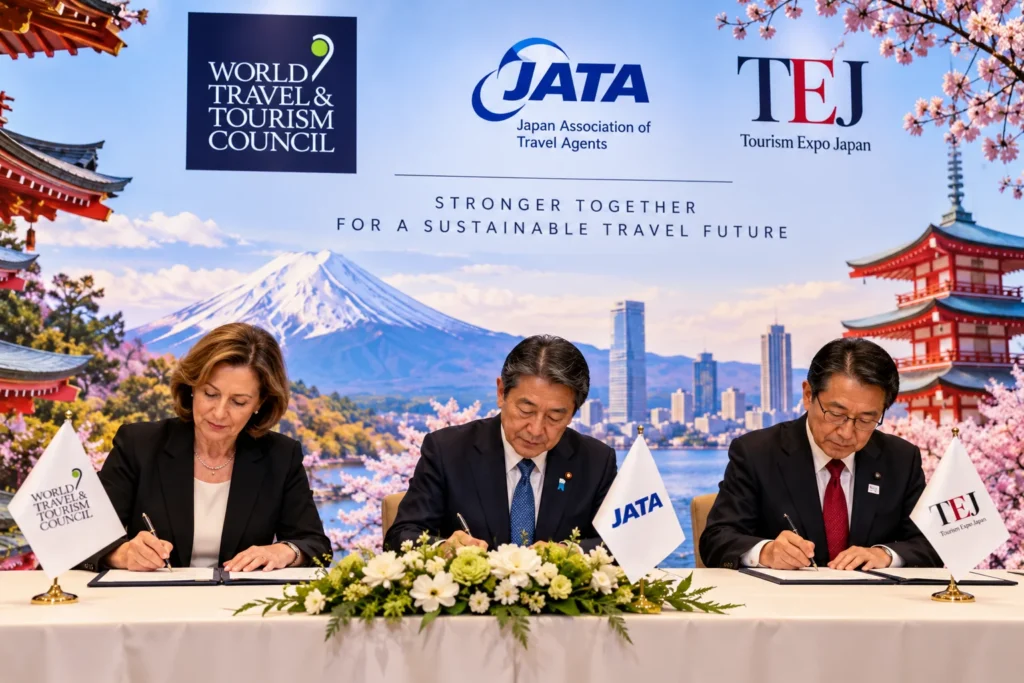
The World Travel & Tourism Council, the Japan Association of Travel Agents, and the Tourism EXPO Japan Executive Committee have formally established a strategic alliance to enhance Japan’s international presence within the global travel and tourism sector. Through the signing of a landmark Memorandum of Understanding, the three organizations have agreed to cooperate on digital innovation, market intelligence sharing, joint research initiatives, and international destination management practices.
This tripartite agreement reflects a shared commitment to strengthening public-private sector collaboration, accelerating technology adoption across transit and hospitality systems, and fostering long-term sustainable growth for regional and urban destinations across Japan.
Economic Momentum and International Visitor Metrics
Official Economic Impact Research compiled by global travel authorities highlights Japan’s position as one of the world’s premier tourism economies. Sector statistics underscore the substantial economic contribution of travel and tourism to the national economy:
Gross Domestic Product Impact: The travel and tourism sector generated $343.1 billion for Japan’s national economy, representing 8.1 percent of total GDP and establishing Japan as the fifth-largest tourism economy globally.
Sector Growth Rate: Annual sector growth reached 4.6 percent, significantly outpacing the broader national economic expansion rate of 1.1 percent over the same reporting period.
International Visitor Expenditure: Inbound international travelers spent $63.3 billion, elevating Japan to the world’s seventh-largest market for international visitor spending—up from 15th position in 2019. This represents an 8.8 percent year-on-year increase and a 74.9 percent surge compared to pre-pandemic baseline figures.
The rapid growth in inbound tourism is supported by robust transport infrastructure, expanded global flight connectivity, and targeted promotional initiatives managed by state tourism authorities.
Digital Transformation and Destination Stewardship
Under the terms of the newly established agreement, the alliance will focus on driving digital transformation across travel operations. The framework prioritizes the deployment of artificial intelligence, automated processing systems, and smart destination management tools to enhance operational efficiency, address labor capacity challenges, and elevate the overall visitor experience.
In addition to technological integration, the partnership emphasizes comprehensive destination stewardship. As international visitor arrivals continue to expand, national tourism stakeholders, regional government authorities, and local travel management organizations are establishing balanced framework policies to ensure tourism development aligns with community interests, environmental conservation goals, and cultural heritage preservation.
Key Strategic Initiatives under the Strategic MoU
The agreement sets out several core operational pillars to guide future cooperation between domestic Japanese organizations and international travel networks:
Research and Intelligence Exchange: Joint sharing of market trends, economic reports, and evidence-based tourism data to inform policy decisions and private sector investments.
Event Integration and Global Forums: Participation by international representatives at Tourism EXPO Japan to elevate the event’s global profile, alongside Japanese representation at international travel summits.
Regional Destination Management: Stronger coordination with prefectural and municipal destination management organizations to promote lesser-known regional destinations and balance tourist flows across the country.
This strategic alignment reinforces Japan’s commitment to advancing sustainable, tech-enabled, and inclusive travel development on the global stage.
For more travel news like this, keep reading Global Travel Wire