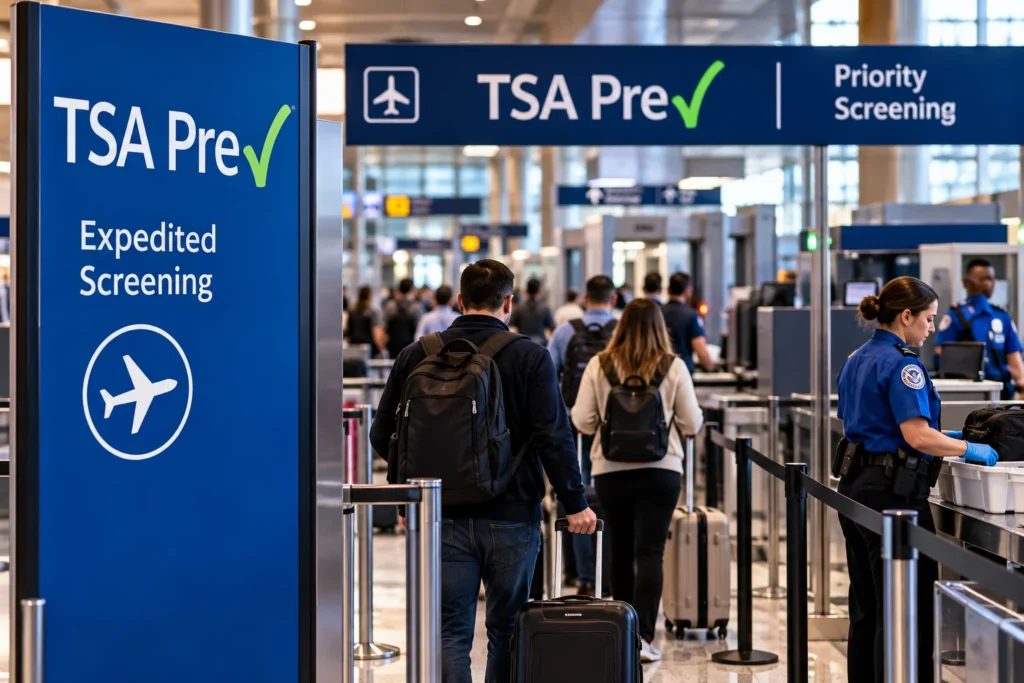
The Department of Homeland Security has reversed an earlier administrative directive that sought to temporarily suspend the Transportation Security Administration’s PreCheck expedited security screening program due to federal funding lapses.
Following an official policy update issued shortly after the initial shutdown command, federal security authorities confirmed that expedited screening lanes will remain accessible to domestic passengers across major American airports. The sudden pivot provides critical relief to the commercial aviation sector and millions of enrolled air travelers as national transportation infrastructure faces operational headwinds.
Immediate Operational Impact across Major Airports
The brief period between the initial announcement and the policy reversal created temporary disruption across several high-volume domestic transportation hubs. Early on Sunday morning, specialized security checkpoints reported localized closures at major facilities, including Los Angeles International Airport and St. Louis Lambert International Airport.
Similarly, international arrival operations experienced brief disruptions as Global Entry processing kiosks encountered temporary suspensions across key entry points such as Boston Logan International Airport, Austin-Bergstrom International Airport, and international preclearance locations including Vancouver International Airport.
Following updated guidance sent directly to local airport authorities, security management officials have been instructed to maintain operational PreCheck checkpoints wherever staffing levels allow. Federal authorities confirmed that personnel availability will be monitored on a location-by-location basis, allowing field directors to dynamically allocate resources based on real-time passenger volumes.
Strategic Reallocation of Security Screening Resources
To preserve front-line screening capacity for general passenger lines without halting trusted traveler initiatives, federal agency leadership enacted immediate adjustments to administrative support procedures. Under the updated directive, routine courtesy escorts previously provided for members of Congress and other VIP delegations have been fully suspended nationwide.
By eliminating specialized escort details, leadership aims to redeploy hundreds of trained security officers back to primary checkpoint screening lanes. Agency officials noted that directing these human resources toward core operations remains the most effective strategy for managing passenger flow, reducing queue times, and upholding mandatory aviation safety standards during times of constrained operational budgets.
Public Statements from Federal Security Leadership
The swift policy adjustments followed public statements from top government officials outlining the operational pressures facing national transportation security during severe budget constraints.
In an initial public declaration addressing resource constraints, Department of Homeland Security Secretary Kristi Noem emphasized the government’s responsibility to prioritize baseline operations: “TSA and CBP are prioritizing the general traveling population at our airports and ports of entry and suspending courtesy and special privilege escorts.”
In a subsequent official statement confirming the continuation of expedited screening services for the general public, a Transportation Security Administration spokesperson clarified the agency’s adaptive strategy: “At this time, TSA PreCheck remains operational with no change for the traveling public. As staffing constraints arise, TSA will evaluate on a case-by-case basis and adjust operations accordingly.”
Broader Travel Industry Context and Weather Disruptions
The operational uncertainty surrounding airport security screening coincided with severe weather challenges across the national airspace network. A severe winter storm system impacting large portions of the country led to the cancellation of more than 7,000 commercial flights within a 48-hour window, stranding thousands of passengers and creating significant operational backlogs for major air carriers.
The decision to maintain PreCheck screening lanes is viewed as a vital safeguard against further gridlock at security checkpoints, especially as airport authorities prepare for the upcoming spring break travel season. Maintaining trusted traveler programs allows pre-vetted passengers to pass through checkpoints with reduced screening times, thereby preventing dangerous overcrowding in airport concourses and main terminal lobbies.
Simultaneously, federal disaster management authorities confirmed that non-disaster response initiatives under the Federal Emergency Management Agency have been temporarily paused to focus exclusively on active emergency response efforts related to severe winter weather events nationwide.
Outlook for Commercial Air Travel
While Global Entry processing operations continue to undergo site-by-site evaluations by Customs and Border Protection officers, domestic TSA PreCheck services remain fully integrated into daily terminal operations. Passengers enrolled in trusted traveler programs are advised to verify real-time airport checkpoint status through official airport administration portals before departing for their flights.
Federal transportation agencies continue to evaluate daily staffing levels across all commercial airports to ensure that essential aviation safety protocols remain uncompromised throughout the ongoing funding negotiations.
For more travel news like this, keep reading Global Travel Wire