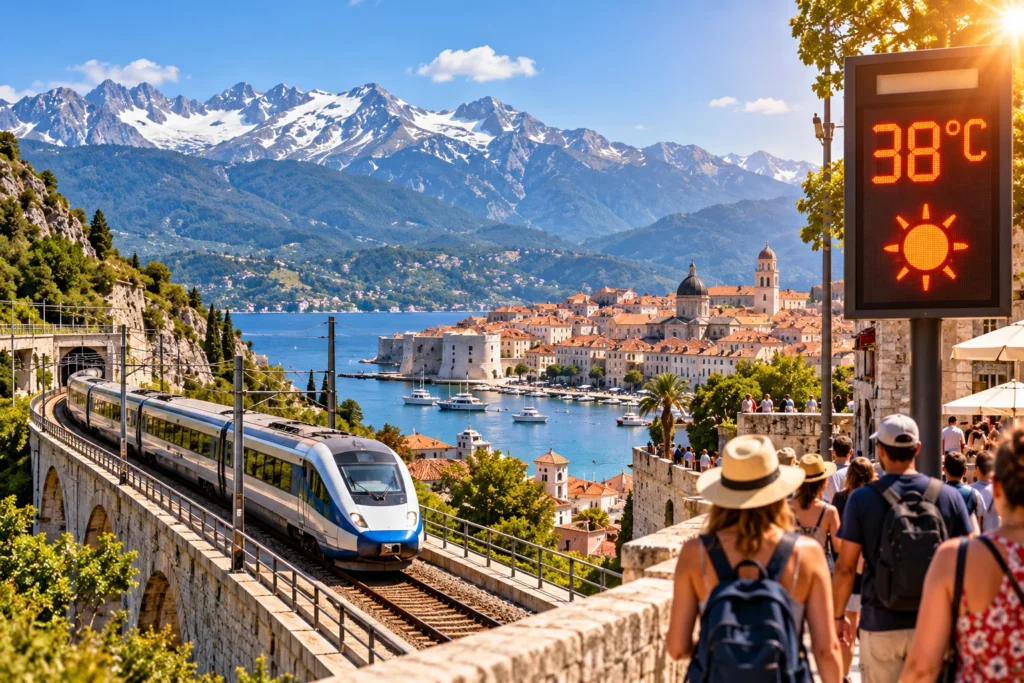
Official findings released by the European Centre for Medium-Range Weather Forecasts through the Copernicus Climate Change Service confirm that a record 52 percent of the European landmass experienced very strong heat stress during the summer of 2026. Defined as environmental conditions where real-feel temperatures exceed 38 degrees Celsius, the extreme heat exposure reached unprecedented geographical coverage, prompting European destinations, municipal leaders, and national tourism authorities to accelerate structural climate adaptation measures.
According to verified statistical modeling, 80 percent of the continent faced strong heat stress—temperatures feeling higher than 32 degrees Celsius—for a recorded peak duration of 41 days throughout the summer months. As weather volatility directly impacts traveler itineraries, regional transportation networks, and seasonal public health frameworks, global travel destinations are re-evaluating baseline visitor infrastructure to ensure sustainable tourism operations under shifting climate conditions.
Climate Monitoring Services Track Historic Heat Index Patterns
The European climate service recorded the summer of 2026 as the third-warmest on record across the entire continent and the warmest single summer season in recorded history for Western Europe. The environmental tracking service documented four of the top ten most intense European heatwaves during this single summer period.
Samantha Burgess, Climate Lead at the European Centre for Medium-Range Weather Forecasts, highlighted the unusual spatial footprint and duration of the thermal anomalies across public briefings: “One of the things that stands out for 2026 is that the heat was not only remarkable for its intensity, but also for its geographical extent. Summer 2026 demonstrated how heat stress is becoming both more widespread and more persistent.”
The persistent heat stress was compounded by low precipitation levels, resulting in severe hydrological deficits. Official river flow monitoring recorded the lowest seasonal levels since comprehensive tracking commenced in 1992. By late August, drought conditions had expanded across nearly 50 percent of the European continent, presenting operational challenges for river cruise networks, agricultural tourism supply chains, inland water management, and energy generation facilities essential for seasonal cooling infrastructure.
Public Safety Initiatives and Destination Resilience Strategies
In response to extended periods of excessive heat, government ministries and municipal tourism boards across Southern and Central Europe are transitioning from ad-hoc emergency measures toward permanent climate-resilient urban development. State health departments and regional emergency management agencies have begun deploying localized real-time heat warning systems, establishing climate shelters within urban cultural districts, and altering operational schedules for famous historical sites to mitigate risks for international visitors.
These initiatives focus on protecting public health while preserving core visitor experiences during seasonal high-density periods. Measures include:
Expanding shadowed canopy structures and green infrastructure along major visitor corridors to reduce urban heat island effects.
Extending nighttime opening hours for outdoor heritage parks, archaeological zones, and national cultural monuments.
Installing high-density drinking water networks and public cooling stations across metropolitan centers and transport hubs.
Re-routing daytime walking tours toward shaded district paths and indoor air-conditioned municipal museums.
Shifting Seasonal Patterns and Travel Behavior
Official visitor arrival metrics compiled across regional statistics offices demonstrate early operational adjustments in response to changing summer weather patterns. Tourism boards across Northern Europe and the Baltic regions reported heightened international arrivals during the peak summer months, as travelers increasingly seek moderate temperatures across coastal and highland regions.
Simultaneously, classic Mediterranean and Southern European destinations are experiencing an intentional expansion of their traditional shoulder seasons. Official regional tourism statistics show notable growth in spring and autumn bookings, reflecting a structural transition toward year-round travel models. Destination marketing organizations are adapting campaign calendars to position shoulder-season travel as the prime window for active exploration, cultural tourism, and outdoor leisure.
Long-Term Infrastructure and Policy Standards
National transport ministries and civil aviation authorities across Europe are similarly evaluating critical infrastructure tolerance to ensure operational continuity during high-heat events. Official policy guidelines emphasize structural enhancements for railway tracks, runway pavement resilience, and energy grid stability to support continuous high-capacity air conditioning systems across major airport terminals and high-speed rail hubs.
By integrating rigorous environmental data from verified climate monitoring services, European tourism boards and urban planners aim to safeguard visitor safety, protect natural eco-tourism sites from drought risks, and maintain the long-term economic sustainability of the European travel sector.
For more travel news like this, keep reading Global Travel Wire