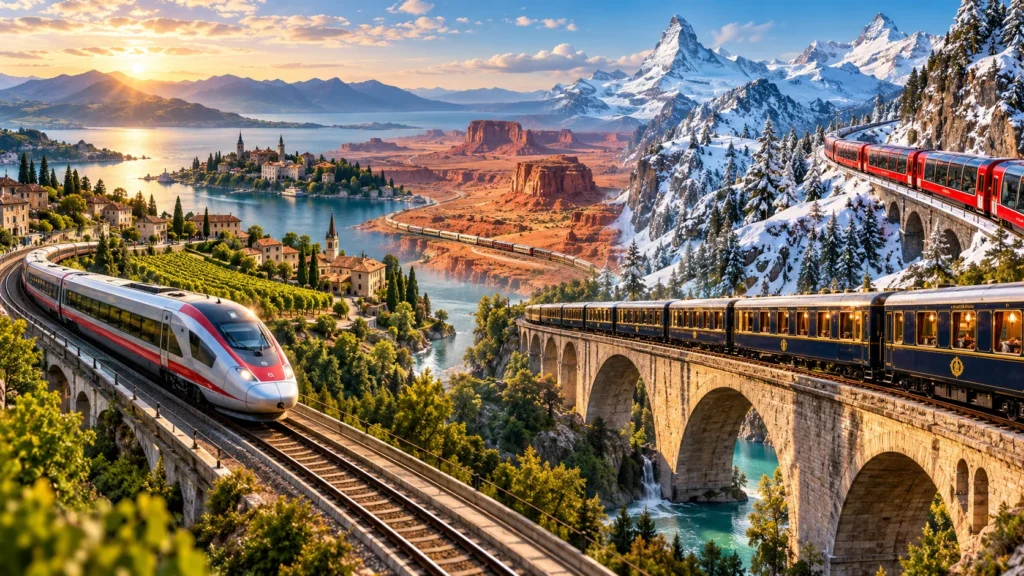
When it comes to passenger transportation, civil engineers and regional planners have consistently defied geographical limitations. High alpine passes, deep river valleys, and dense urban centers have sparked extraordinary rail solutions. Across the globe, transit authorities are deploying groundbreaking technology, sustainable energy, and bold engineering designs to navigate challenging environments.
For international travelers and rail enthusiasts, exploring these unconventional transit lines offers an unforgettable perspective on regional innovation. From solar-powered mountain climbs in South America to dual-mode road-rail vehicles in East Asia, these unique train journeys redefine modern public transit.
Argentina’s High-Altitude Solar Train of the Quebrada
Located in the high-altitude landscapes of Argentina’s Jujuy province, the Solar Train of the Quebrada stands out as a global leader in green tourism development. Running along the UNESCO World Heritage-listed Quebrada de Humahuaca valley, this 100% solar-powered electric train offers a clean, low-carbon way to explore high-altitude indigenous communities.
The lightweight, eco-friendly rail vehicles utilize advanced battery technology powered by regional solar parks. Operating at an elevation of more than 2,000 meters above sea level, the train connects historic towns including Volcán, Tumbaya, and Purmamarca—home to the famous Hill of Seven Colors.
Designed specifically for sustainable tourism, the scenic route allows visitors to travel quietly through delicate mountain ecosystems without generating direct greenhouse emissions. The project demonstrates how renewable energy integration can preserve cultural heritage while expanding rural transit accessibility.
Germany’s Suspended Railway: The Historic Wuppertal Schwebebahn
Urban rail design reaches new heights in North Rhine-Westphalia, Germany, where the Wuppertal Schwebebahn operates as the world’s oldest electric elevated suspension monorail. In continuous operation since 1901, this iconic suspended railway carries passengers elevated 8 to 12 meters above the Wupper River and municipal streets.
Engineers designed the suspended monorail over a century ago to overcome the narrow, winding topography of the Wupper River valley, where traditional ground tracks were geographically impossible. Carriages hang from a single steel rail supported by 486 overhead steel frames spanning 13.3 kilometers.
Serving 20 stations across Wuppertal, the Schwebebahn remains a vital component of local public transportation, moving more than 80,000 daily commuters alongside international tourists. It stands as a timeless masterclass in urban space optimization and industrial engineering.
Japan’s Dual-Mode Vehicle: The Bus That Transforms into a Train
In Tokushima and Kochi prefectures on Shikoku Island, Japan, the Asa Coast Railway operates one of the most versatile transit innovations in modern history: the Dual-Mode Vehicle (DMV). Looking like a standard passenger minibus, this hybrid craft can seamlessly transition from driving on rubber tires along coastal highways to running on steel wheels over traditional train tracks.
The vehicle enters a dedicated changeover station where hydraulic steel wheels lower from the undercarriage onto rail lines in roughly 15 seconds. Powered by a fuel-efficient engine, the DMV operates as a train along rural railway corridors before switching back to bus mode to serve local town stops, hospitals, and seaside stations.
This dual-mode operational model offers an efficient transit solution for rural, aging populations, drastically reducing maintenance costs compared to heavy passenger trains while maintaining critical transportation links for regional residents and travelers.
Ecuador’s Engineering Marvel: The Devil’s Nose Zig-Zag Railway
High in the Andes mountains, Ecuador’s historic Trans-Andean railway features one of the most daring railway feats ever constructed: the Nariz del Diablo (Devil’s Nose) passage. To overcome a near-vertical wall of rock between Alausí and Sibambe, engineers carved a dramatic switchback rail system directly into the mountain face.
To negotiate the sheer 500-meter descent, the train moves forward past a track switch, reverses direction down a steep, narrow ledge, and then switches track again to move forward along the next mountain terrace. This clever zig-zag maneuvering allows the train to gain or lose elevation safely without exceeding maximum gradient limits.
Restored as an iconic cultural tourism experience, the route provides travelers with breathtaking views of deep Andean ravines and regional cloud forests while highlighting the historic ingenuity of mountain rail construction.
Southeast Asia’s Bamboo Railways: Rural Engineering Ingenuity
In rural regions of Cambodia, local communities developed an informal, highly creative transit system known locally as the norry, or bamboo train. Originally built using leftover track laid during early infrastructure expansion, these lightweight platforms are constructed from bamboo, powered by small gasoline engines, and mounted on steel wheel axles.
Operating along regional branch lines, bamboo trains allow rural farmers, goods traders, and eco-tourists to travel between remote agricultural villages. When two bamboo trains meet on a single track, the lighter platform is quickly disassembled by hand, set off the rails to let the other pass, and rapidly reassembled in minutes.
While official government modernization projects continue to upgrade national heavy rail corridors, preserved bamboo train circuits remain popular cultural heritage attractions, showcasing community adaptability and informal transport resourcefulness.
The Future of Alternative Rail Travel
From high-tech hybrid vehicles in East Asia to century-old suspended monorails in Europe, unconventional railways prove that transit design is far from one-size-fits-all. As global travel priorities shift toward sustainability, accessibility, and heritage preservation, these extraordinary transportation systems highlight how engineering creativity continues to connect communities across the world’s most complex landscapes.
For more travel news like this, keep reading Global Travel Wire