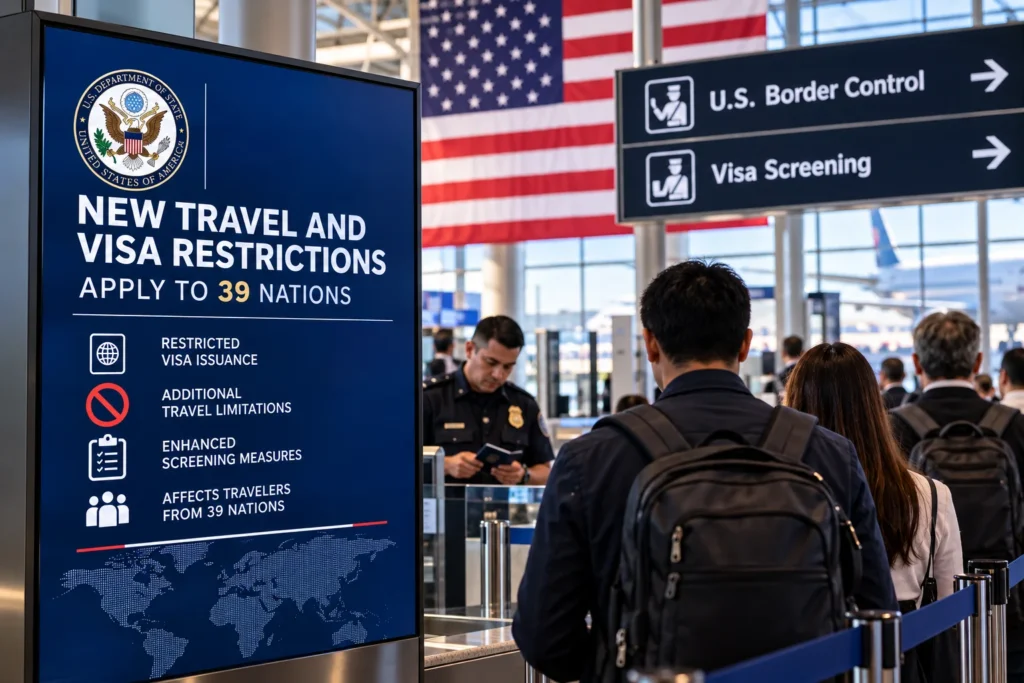
The United States government has implemented wide-ranging travel and visa entry measures affecting citizens of 39 countries across the globe. Official executive directives confirm that consular offices have fully suspended visa issuance for nationals from 19 countries, while applying targeted partial visa suspensions to applicants from an additional 19 nations.
The executive policy, enacted under Presidential Proclamation 10998, officially took effect at 12:01 a.m. Eastern Standard Time on January 1, 2026. Official statements from the U.S. Department of State identify national security evaluations, screening protocols, and public safety risk assessments as the core reasons for updating international travel clearance rules.
Official diplomatic notifications confirm that foreign nationals subject to the proclamation who were outside the United States and did not hold a valid entry visa as of the effective date cannot obtain new visa clearance through consular posts overseas.
Full Visa Suspensions Across Designated Countries
Under the provisions of Proclamation 10998, consular officers are directed to halt all immigrant and nonimmigrant visa processing for citizens of 19 designated nations. This complete suspension applies across all standard entry categories, including leisure travel, business visits, educational studies, and permanent residency immigrations.
Nations subject to the full entry suspension include:
Africa: Burkina Faso, Chad, Republic of the Congo, Equatorial Guinea, Eritrea, Mali, Niger, Sierra Leone, Somalia, South Sudan, and Sudan.
Middle East & Asia: Afghanistan, Burma (Myanmar), Iran, Laos, Libya, Syria, and Yemen.
Americas: Haiti, along with individuals presenting travel documents issued or endorsed by the Palestinian Authority.
Foreign diplomatic representatives clarify that visa applications submitted by individuals from these specified territories will remain unissued while the executive order remains active.
Scope of Partial Visa Restrictions and Exemptions
For a separate list of 19 nations, the U.S. State Department has implemented partial visa suspensions. These restrictions specifically target nonimmigrant visitor visas (B-1/B-2 tourist and business travel), student and exchange visitor visas (F, M, and J classifications), as well as all categories of permanent immigrant visas.
Nations subject to partial visa suspensions include:
Americas & Caribbean: Antigua and Barbuda, Cuba, Dominica, Saint Kitts and Nevis, Saint Lucia, Saint Vincent and the Grenadines, and Venezuela.
Africa: Angola, Benin, Burundi, Côte d’Ivoire, Gabon, Ghana, Nigeria, Rwanda, Tanzania, and Togo.
Europe & Central Asia: Georgia and Montenegro.
Certain specialized nonimmigrant employment classifications, such as temporary specialty occupation visas, may remain eligible for processing under reduced validity windows, subject to strict consular review.
Official government notices emphasize specific statutory exemptions to the travel restrictions:
Existing Visa Holders: Visas lawfully issued prior to January 1, 2026, remain valid and are not subject to revocation under the proclamation.
Lawful Permanent Residents: Current U.S. green card holders and legal permanent residents are fully exempt from the travel prohibitions.
Dual Nationals: Individuals holding dual citizenship who travel using a valid passport issued by a non-restricted country remain eligible for U.S. entry clearance.
Diplomatic & International Personnel: Accredited diplomats, government officials, and representatives to international organizations maintain standard entry privileges.
Operational Guidance for International Travelers
The U.S. State Department advises affected travelers to review official diplomatic portals for real-time consular updates. While administrative petitions and family sponsorship filings may still be submitted to domestic immigration agencies, consular posts overseas will hold final visa issuances in reserve until relevant national security criteria are satisfied or further policy updates are issued by the executive branch.
For more travel news like this, keep reading Global Travel Wire