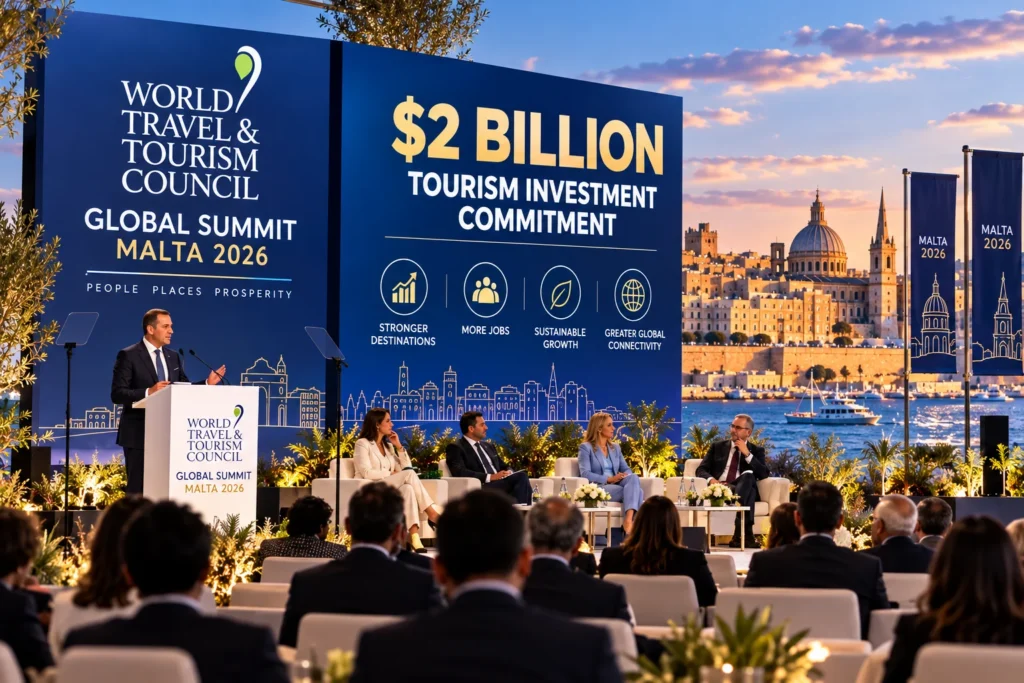
International confidence in Malta’s economic trajectory reached a major milestone during the opening of the 26th World Travel & Tourism Council (WTTC) Global Summit in Valletta. Private-sector members of the global tourism body announced a collective $2 billion investment commitment directed toward Malta’s travel, hospitality, and infrastructure sectors.
The announcement reflects strong alignment between global travel corporate leaders and the Maltese government’s long-term economic development strategy.
Official statements from international tourism leadership emphasize that convening global private-sector decision-makers directly in host destinations turns high-level policy dialogue into tangible economic development and long-term capital deployment.
Accelerating Capital Deployment and Destination Growth
More than 1,000 international delegates, including over 200 chief executive officers and senior tourism executives alongside government representatives, gathered in Valletta for the summit. The event brings together key decision-makers across civil aviation, hotel development, travel technology, and destination management.
Unlike standard promotional travel fairs focused solely on leisure visitor arrivals, the summit serves as a strategic platform connecting international corporate capital with national tourism infrastructure objectives.
Key operational focus areas for the private-sector investment commitment include:
Hospitality Infrastructure expansion: Modernizing accommodation facilities and expanding boutique lodging capacity across the Maltese archipelago.
Sustainable Destination Management: Supporting green building initiatives and energy-efficient tourism operations in historical corridors.
Technology and Connectivity: Investing in digital guest experience platforms and transport network integration to manage visitor density efficiently.
Gaining direct access to such a concentrated group of international corporate decision-makers represents a transformative commercial opportunity for Malta’s long-term destination competitiveness.
Public-Private Collaboration Drives Confidence
Official releases from the summit highlight the importance of public-private partnerships in building resilient national travel economies. While the WTTC functions as an international trade body rather than a direct funding institution, its corporate member network possesses the financial resources and operational expertise required to execute large-scale commercial developments.
Statements from WTTC executive leadership confirmed that the $2 billion private-sector commitment serves as a strong endorsement of Malta’s economic stability, heritage preservation efforts, and forward-looking tourism governance.
By aligning global corporate investment with national development priorities, Malta continues to strengthen its position as a leading Mediterranean destination for sustainable travel, employment generation, and economic innovation.
For more travel news like this, keep reading Global Travel Wire