The latest global mobility data released for October 2026 confirms significant shifts in international access, with Singapore maintaining its position as the world’s most powerful passport. Evaluating travel freedom across global destinations, the standard index highlights a growing distinction in international border access for citizens worldwide.
According to official mobility records compiled from international aviation data, passport strength correlates directly with regional stability, diplomatic agreements, and bilateral open-border arrangements. As governments continue expanding cross-border partnerships, global mobility metrics demonstrate the clear advantage enjoyed by citizens of highly connected nations.
Singapore Dominates Global Travel Access
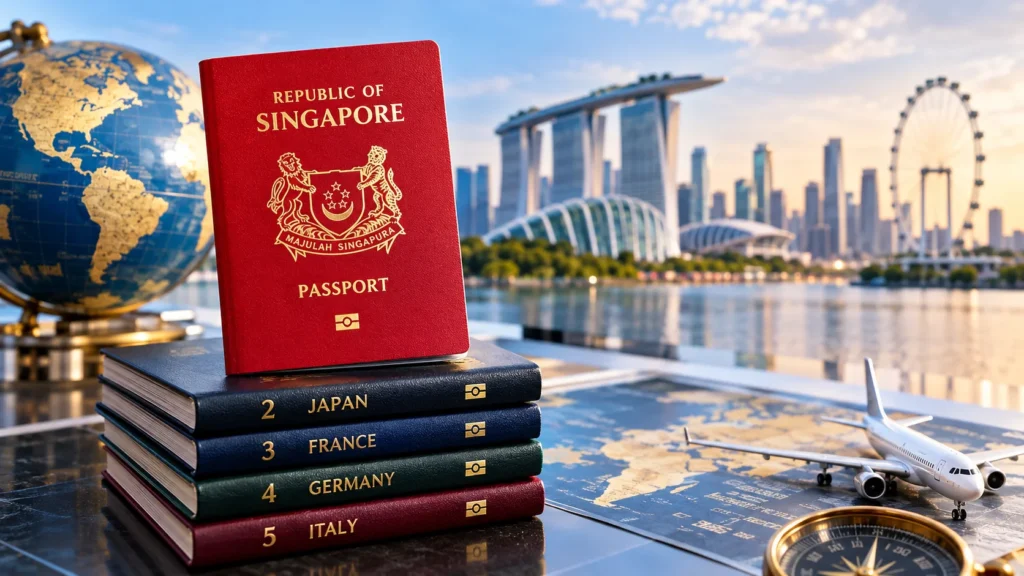
Singapore holds the top position in global mobility, granting its passport holders seamless entry to 193 travel destinations without requiring a pre-arranged visa. This score reflects extensive international diplomacy and ongoing visa-waiver agreements established by the government.
The top rankings emphasize Asia’s robust diplomatic ties and strong international relations, which facilitate movement for both business and leisure travel across multiple continents.
Asia and Europe Secure Upper Tier Rankings
Sharing the second spot, Japan, South Korea, and the United Arab Emirates provide visa-free entry to 188 destinations each. The inclusion of the United Arab Emirates in the upper tier underscores years of active diplomatic engagement and strategic visa liberalization policies.
Sweden secures the third spot with access to 187 destinations. A broad coalition of European countries follows closely in fourth place with access to 186 locations, including Belgium, Denmark, Finland, France, Germany, Ireland, Italy, Luxembourg, Netherlands, Norway, and Spain.
Austrian, Greek, Maltese, Portuguese, and Swiss passports rank fifth, offering frictionless entry to 185 destinations worldwide.
Full Top 10 Global Passport Rankings
The top ten tier reflects global diplomatic strength and border access:
Rank 1: Singapore (193 destinations)
Rank 2: Japan, South Korea, United Arab Emirates (188 destinations)
Rank 3: Sweden (187 destinations)
Rank 4: Belgium, Denmark, Finland, France, Germany, Ireland, Italy, Luxembourg, Netherlands, Norway, Spain (186 destinations)
Rank 5: Austria, Greece, Malta, Portugal, Switzerland (185 destinations)
Rank 6: Hungary, Malaysia, Poland, United Kingdom (184 destinations)
Rank 7: Australia, Canada, Czechia, Latvia, New Zealand, Slovakia, Slovenia (183 destinations)
Rank 8: Croatia, Estonia (182 destinations)
Rank 9: Liechtenstein, Lithuania (181 destinations)
Rank 10: Iceland, United States (180 destinations)
Understanding Visa-Free Scores and Global Access
In international travel metrics, a visa-free score measures the total number of destinations a passport holder can enter without securing a traditional visa prior to departure. This calculation includes destinations offering standard visa-free entry, visa on arrival (VoA), and Electronic Travel Authorization (eTA) programs.
High mobility rankings provide international travellers with significant benefits, minimizing administrative delay, reducing travel overhead costs, and allowing flexible movement across global transit hubs. Official tourism statistics confirm that nations with higher passport power consistently experience stronger outward tourism flows and greater participation in international business conferences.
As global immigration policies evolve, governments prioritize bilateral access agreements to boost economic collaboration, strengthen international trade, and support civil tourism exchanges. Official updates to global passport rankings highlight the dynamic nature of international relations and the expanding possibilities for global travelers.
For more travel news like this, keep reading Global Travel Wire