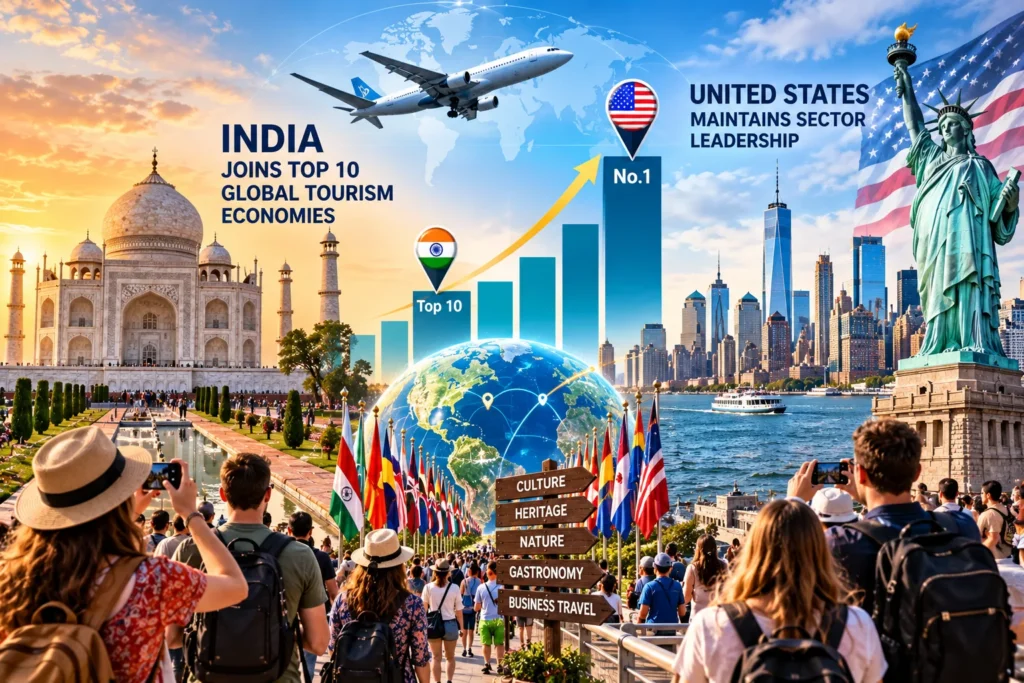
The global travel and tourism sector has demonstrated notable economic resilience, with major national markets recording substantial financial contributions to overall domestic output. Official economic indicators compiled by the World Travel and Tourism Council show that the United States maintains its position as the world’s largest tourism economy, generating $2.63 trillion in sector valuation. China follows in second place with an economic contribution of $1.75 trillion, driven by strong domestic travel demand and accelerating international visitor numbers.
Highlighting significant long-term growth across emerging markets, India officially secured the 10th spot among global travel markets. Generating a direct and indirect economic contribution of $263.6 billion, the South Asian nation’s tourism industry continues to expand as a vital driver of national employment, infrastructure investment, and regional economic development.
Top Global Tourism Markets by Economic Impact
The world’s leading travel destinations showcase diverse economic models, balancing high-spending international arrivals, robust domestic passenger volumes, and sustained infrastructure investments across transportation and hospitality networks.
The leading national travel and tourism economies by total financial contribution include:
United States: $2.63 trillion – Maintaining market leadership through strong domestic travel, corporate travel expenditure, and international long-haul arrivals.
China: $1.75 trillion – Accelerating rapidly via visa-free transit expansion, high-speed rail connectivity, and high-volume regional tourism.
Germany: $566.2 billion – Anchored by strong European cross-border travel, business event travel, and cultural tourism infrastructure.
United Kingdom: High-yield market supported by historic heritage sites, major urban event calendars, and international transit hubs.
Japan: Expanding regional inbound travel, supported by competitive currency dynamics and cultural tourism programs.
India: $263.6 billion – Securing 10th position globally, powered by rising domestic consumer spending, cultural tourism programs, and nationwide aviation expansion.
European economies, including Germany and the United Kingdom, along with mature Asian destinations like Japan, continue to hold major shares of global travel spending, serving as primary anchors for international passenger movement and hospitality investments.
India Tourism Sector Growth and Economic Drivers
India’s inclusion among the world’s top 10 tourism economies reflects structural growth across domestic travel networks and targeted public policy initiatives. Ministry of TourismFocus Keyword Identified: Global Tourism Economy
Meta Description: India ranks 10th in the global tourism economy with $263.6B, while the US leads worldwide travel sector rankings with a $2.63T economic contribution.
India Ranks Among Top 10 World Largest Tourism Economies as Global Travel Expansion Accelerates
The global travel and tourism sector has demonstrated robust resilience and economic output, with official international tourism benchmark data confirming India’s position as the 10th largest tourism economy worldwide. Driven by surging domestic travel demand, cultural heritage infrastructure investments, and expanding international air route connectivity, India’s travel and tourism sector contributed $263.6 billion to the national economy in 2025.
The latest global economic evaluation highlights the critical role of travel and tourism as a major engine of gross domestic product growth, employment creation, and infrastructure development across both established western markets and rapidly expanding Asian travel hubs.
While mature markets in North America and Western Europe continue to generate significant overall revenue, emerging Asian economies—led by China and India—are expanding their market share through large-scale regional transport investments, digital visa facilitation, and modernized hospitality networks.
Top 10 Tourism Economies Worldwide by Total Financial Contribution
Official research compiled by international travel bodies highlights a clear hierarchy among the world’s leading travel markets. The United States continues to hold the top position globally, generating a massive $2.63 trillion travel and tourism economy that significantly leads second-placed China, which recorded an economic contribution of $1.75 trillion.
The primary ranking of the world’s top 10 tourism economies includes:
United States: $2.63 Trillion
China: $1.75 Trillion
Germany: $566.2 Billion
United Kingdom: $500+ Billion
Japan: Major Asia-Pacific Hub
France: Top European Destination Hub
Italy: Major Cultural & Heritage Market
Mexico: Leading Americas Resort Destination
Spain: High-Yield European Gateway
India: $263.6 Billion
Germany secured third place globally with a $566.2 billion travel sector output, supported by high-yield business travel, international trade fairs, and robust intra-European leisure corridors. The United Kingdom and Japan round out the top five global markets, benefiting from strong long-haul arrivals and high-spending international transit traffic.
Key Drivers Fueling India Tourism Sector Growth
India’s entry into the top 10 global travel economies reflects structural reforms and targeted infrastructure investments designed to capitalize on both internal mobility and international arrivals. Key factors propelling India’s growth trajectory include:
Domestic Rail and Aviation Expansion: Modernization of national rail corridors, alongside the regional connectivity scheme expanding operational airports into tier-two and tier-three cities, has made heritage and spiritual destinations accessible to millions of domestic travelers.
Cultural and Heritage Preservation: Strategic investments in cultural corridor development, UNESCO World Heritage site management, and eco-tourism zones have diversified the national tourism portfolio beyond traditional golden triangle routes.
MICE Infrastructure Development: Purpose-built convention centers and state-of-the-art exhibition venues in major urban centers have positioned India as an emerging hub for international business conferences, trade summits, and global travel expos.
Digital Travel Integration: Universal digital payment platforms, streamlined e-visa systems for over 160 nations, and digitized transit booking systems have significantly reduced operational travel friction for international visitors.
Official tourism statistics indicate that domestic tourism remains the primary foundation of India’s overall sector valuation, providing consistent demand across hospitality, transport, and local artisanal supply chains throughout all seasonal cycles.
Long-Term Outlook for International Travel Infrastructure
The global travel sector is projected to maintain strong growth rates over the coming decade, driven by rising disposable incomes across Asia-Pacific markets, increased fleet deliveries for commercial air carriers, and expanding international route partnerships.
Government travel ministries worldwide continue to prioritize sustainable tourism frameworks that balance economic growth with environmental conservation and community development. As international connectivity expands and cross-border travel becomes increasingly seamless, high-growth markets like India are well-positioned to advance further up global travel economy rankings.
For more travel news like this, keep reading Global Travel Wire