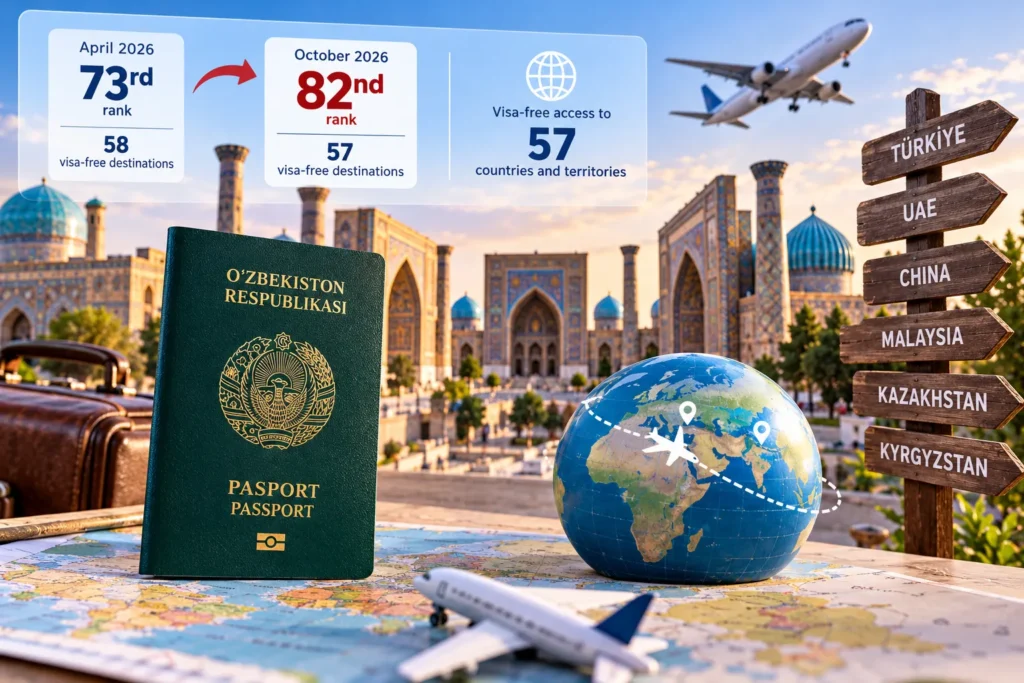
Uzbekistan has reportedly fallen to 82nd position in the October 2026 Henley Passport Index, marking a nine-place decline from its 73rd position in April. The updated figures supplied for the ranking indicate that Uzbek passport holders can visit 57 countries and territories without obtaining a visa before departure.
The reported decline places Uzbekistan alongside Burkina Faso and Togo, highlighting the country’s position within an increasingly competitive international travel environment.
Singapore continues to lead global passport mobility, while Afghanistan remains at the bottom of the ranking.
The development draws attention to the relationship between visa regulations, diplomatic agreements and international tourism accessibility.
For Uzbek travellers, passport mobility remains an important consideration when planning overseas holidays, business journeys and family visits.
Uzbekistan Passport Ranking Falls Nine Places in 2026
The reported October ranking represents a noticeable change in Uzbekistan’s international travel position.
The country occupied 73rd place in April 2026 before dropping to 82nd in the latest figures provided.
Uzbekistan now reportedly shares its position with Burkina Faso and Togo, whose passports offer comparable international travel access.
However, a decline in ranking does not necessarily indicate that nine destinations have withdrawn visa-free privileges.
Passport rankings measure countries against one another. Consequently, improvements elsewhere can influence a nation’s overall position even when its own travel access changes minimally.
The official ranking page available during verification displayed Uzbekistan in 79th position with access to 58 destinations. Therefore, the reported October figures of 82nd place and 57 destinations require confirmation against the updated official dataset.
Nevertheless, the reported movement illustrates the importance of monitoring international visa agreements and changes in global mobility.
Visa-Free Travel Remains Important for Uzbek Tourists
Visa-free travel simplifies international tourism by reducing administrative requirements before departure.
According to Uzbekistan’s Ministry of Foreign Affairs, Uzbek citizens benefit from visa-free arrangements with several international destinations.
These include Kazakhstan, Kyrgyzstan, Malaysia, Türkiye, China and the United Arab Emirates.
Such agreements support tourism exchanges, business travel and regional connectivity.
Travellers can often organise short international visits without completing conventional embassy visa applications.
However, visa-free entry does not eliminate all immigration requirements.
Destination authorities may still require valid passports, confirmed accommodation, onward tickets or evidence of sufficient financial resources.
Permitted stays also vary depending on individual bilateral agreements.
Travellers should therefore review official destination requirements before booking international journeys.
Singapore Maintains Leadership in Global Passport Mobility
Singapore remains the leading country in the Henley Passport Index, reflecting its extensive international travel agreements.
The supplied October figures place Singapore at 193 accessible destinations, compared with Afghanistan’s 22 destinations.
Earlier official 2026 figures listed Singapore at 192 destinations, demonstrating how published access totals can change between ranking updates.
Singapore’s leading position highlights the advantages of extensive international mobility arrangements.
Its passport holders can access a substantial number of destinations without conventional advance visa applications.
By comparison, citizens of countries with more restrictive travel access often face additional documentation, processing costs and application requirements.
These differences can influence international holiday planning, business mobility and the accessibility of overseas destinations.
How the Henley Passport Index Measures Global Travel Freedom
The Henley Passport Index evaluates the international travel access available to holders of ordinary passports.
Its methodology uses aviation travel information from the International Air Transport Association alongside additional verification.
The index covers 199 passports and 227 travel destinations.
Countries receive scores based on destinations accessible without obtaining a conventional visa before travel.
Eligible visa-on-arrival arrangements and certain electronic travel authorisations are included.
However, destinations requiring government-approved electronic visas before departure generally do not qualify for visa-free scoring.
Countries with identical accessibility scores share the same ranking position.
These measurements help explain differences in international mobility, although they do not evaluate every aspect of tourism accessibility.
Air connectivity, transportation costs and destination-specific regulations also influence travellers’ experiences.
Uzbekistan’s Tourism Development Creates Opportunities for International Cooperation
Uzbekistan continues to position itself as an important cultural tourism destination in Central Asia.
Historic cities including Samarkand, Bukhara and Khiva attract visitors interested in Silk Road heritage, architecture and cultural experiences.
The country has also introduced entry facilitation measures for international visitors.
Official government information confirms visa-free arrangements for nationals of numerous countries, alongside electronic visa services for eligible travellers.
These policies primarily support inbound tourism by simplifying access for foreign visitors.
However, welcoming international tourists and improving outbound passport mobility are separate policy objectives.
Additional reciprocal visa agreements could potentially strengthen travel opportunities for Uzbek citizens.
Greater regional connectivity and cooperation with international tourism partners may also support cross-border visitor movements.
International Tourism Mobility Depends on Stronger Visa Cooperation
Passport accessibility remains an important component of international tourism development.
Simplified entry arrangements can encourage shorter holidays, regional tourism exchanges and international business participation.
For airlines and tourism businesses, accessible travel regulations can help reduce uncertainty during customer booking decisions.
However, improvements in passport rankings depend on changes in entry arrangements and the relative performance of other countries.
Uzbekistan’s reported October ranking decline demonstrates the continuing importance of diplomatic cooperation and travel facilitation.
Future agreements could provide additional opportunities for Uzbek citizens to explore overseas destinations.
As international tourism evolves, visa policies and passport mobility will remain significant factors shaping global travel opportunities.