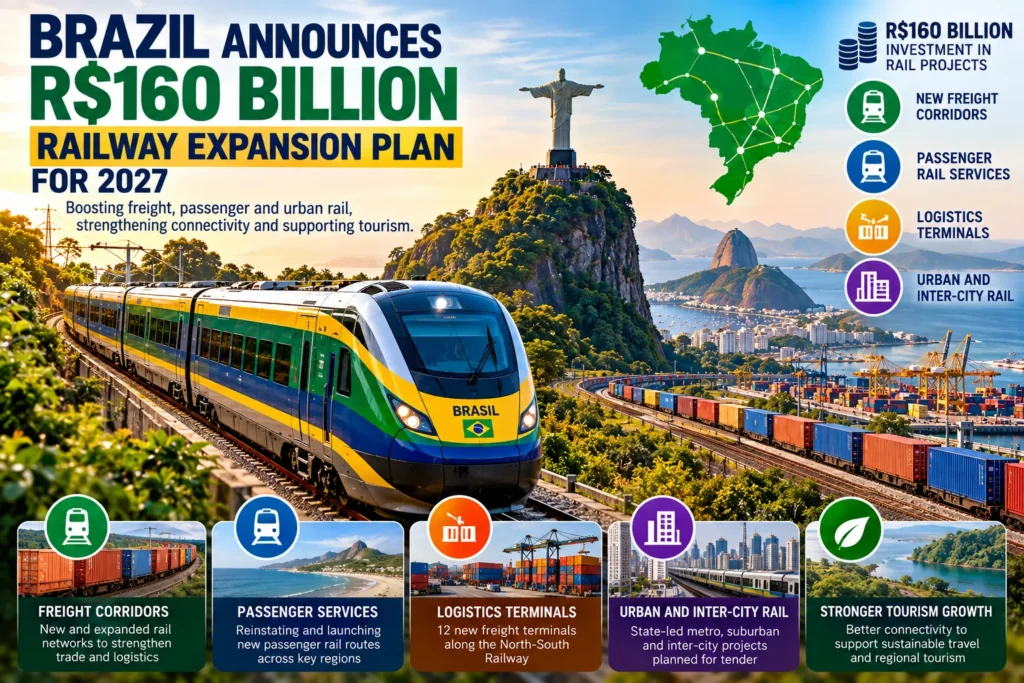
Brazil has unveiled an ambitious R$160 billion railway investment programme for 2027, targeting the expansion of freight transportation, the rehabilitation of underused railway corridors and opportunities for passenger rail development. The initiative could strengthen regional connectivity and create new possibilities for sustainable domestic tourism.
Transport Minister George Santoro presented the programme at the B3 Stock Exchange in São Paulo on 15 October 2026.
The railway portfolio includes 18 projects, comprising eight concessions, nine public calls for railway authorisations and a permanent offering involving terminals and underutilised infrastructure.
The rail investment forms part of a broader R$262.6 billion transport programme, which also covers 11 highway projects.
The government’s strategy aims to attract private investment while improving transportation capacity, economic integration and access to important regional markets.
For Brazil’s tourism sector, renewed passenger railway services could eventually provide additional transport choices between cities and regional destinations.
Brazil Targets R$160 Billion in Railway Investment During 2027
The Brazilian Ministry of Transport has outlined one of the country’s major railway concession programmes for the coming year.
The 18-project portfolio seeks to expand private participation in railway construction, rehabilitation and operations.
Government-backed financing mechanisms will help improve the commercial viability of selected investments.
These measures include public guarantees, government contributions and specialised financing arrangements involving the Brazilian Development Bank, BNDES.
Authorities have also commissioned railway studies covering approximately 28,000 kilometres since 2023.
The programme is designed to address longstanding infrastructure limitations while encouraging greater competition among transport operators.
However, the announcement identifies projects for future procurement rather than confirming that construction or passenger operations have already begun.
New Railway Corridors to Strengthen Brazil’s Regional Connectivity
Several proposed concessions focus on constructing major freight railway corridors.
The Southeast Railway Ring, also known as EF-118, would improve connections involving Rio de Janeiro and Espírito Santo.
The government has identified the corridor as a priority, with tender documentation expected during 2026.
Other planned developments include the East-West Corridor, integrating railway infrastructure across important agricultural and industrial regions.
The Ferrogrão project would establish a major freight connection between Mato Grosso and Pará.
A northern extension of the North-South Railway is also under consideration, strengthening links towards Belém.
These developments primarily target commercial freight rather than passenger tourism.
Nevertheless, improved logistics can indirectly support destination investment, hospitality construction and regional economic development.
Passenger Railway Proposals Could Open New Tourism Opportunities
Passenger rail development represents another important aspect of Brazil’s wider railway strategy.
Government infrastructure studies have examined potential services between São Luís and Itapecuru Mirim in Maranhão.
Another proposed connection would link Fortaleza with Sobral in Ceará.
A third corridor under evaluation would connect Brasília with Luziânia in Goiás.
These routes could strengthen regional mobility if viable passenger services are eventually approved.
The Ministry’s planning documents have identified the São Luís–Itapecuru Mirim corridor at approximately 116 kilometres.
The Fortaleza–Sobral corridor extends approximately 240 kilometres, while Brasília–Luziânia covers around 62 kilometres.
However, the projects remain subject to commercial evaluation, infrastructure requirements and regulatory decisions.
No confirmed passenger launch dates or ticketing arrangements have been announced under the October investment programme.
Historic Railway Routes Could Return Through Private Investment
Brazil is also seeking greater private participation in rehabilitating underused and abandoned railway infrastructure.
The Ministry of Transport has introduced a public authorisation framework intended to revive railway corridors that currently lack regular operations.
Approximately 10,000 kilometres of underutilised railway infrastructure have been identified as potential opportunities.
Under the model, interested companies could develop proposals for restoring railway assets and introducing commercially viable services.
Some corridors may eventually support passenger operations, tourism trains or mixed transportation activities.
Others will remain focused on freight transportation.
The approach provides an opportunity to assess how existing railway infrastructure could serve changing regional economic needs.
It also allows private companies to evaluate projects before committing to long-term investment.
North-South Railway Logistics Development Gains Momentum
Brazil’s North-South Railway remains central to efforts to strengthen domestic freight connectivity.
The government is considering additional logistics terminals and associated infrastructure to improve cargo handling and regional distribution.
These facilities would support links between agricultural production areas, industrial markets and international ports.
Expanded logistics capacity could help reduce bottlenecks affecting commercial transportation.
For tourism businesses, more efficient distribution networks may improve access to equipment, construction materials and imported products.
However, freight terminal development should not be confused with new passenger railway stations.
The immediate objectives involve strengthening commercial logistics and improving the competitiveness of Brazilian transportation infrastructure.
Sustainable Rail Tourism Could Benefit From Better Infrastructure
Railway investment creates potential opportunities to diversify transportation across Brazil’s extensive territory.
Currently, the country has limited regular long-distance passenger railway services compared with its highway and aviation networks.
New passenger connections could eventually provide alternatives for selected domestic journeys.
Rail services may also encourage visitors to explore destinations beyond established tourism gateways.
Maranhão, Ceará and Goiás offer diverse cultural, historical and natural attractions that could benefit from improved accessibility.
However, tourism outcomes will depend on railway frequency, affordability, travel times and integration with local transportation systems.
Environmental benefits would also vary according to train technology, passenger demand and the transportation modes replaced.
Brazil Railway Expansion Signals Long-Term Transport Transformation
The government’s October announcement represents a significant commitment to modernising Brazil’s transport infrastructure.
The proposed R$160 billion railway portfolio combines new construction, concession restructuring and the rehabilitation of existing assets.
It also creates opportunities to examine passenger railway services within a transport system historically dominated by roads.
Successful implementation will depend on financing, regulatory approvals, investor participation and the completion of detailed project studies.
For the tourism industry, the most significant long-term opportunity lies in developing practical passenger services that connect regional destinations.
If the planned investments progress, Brazil could strengthen national mobility while supporting economic development and more diversified transportation choices.
The 2027 railway programme therefore marks an important planning milestone, with its ultimate impact on tourism depending on which projects advance from proposals into operating services.