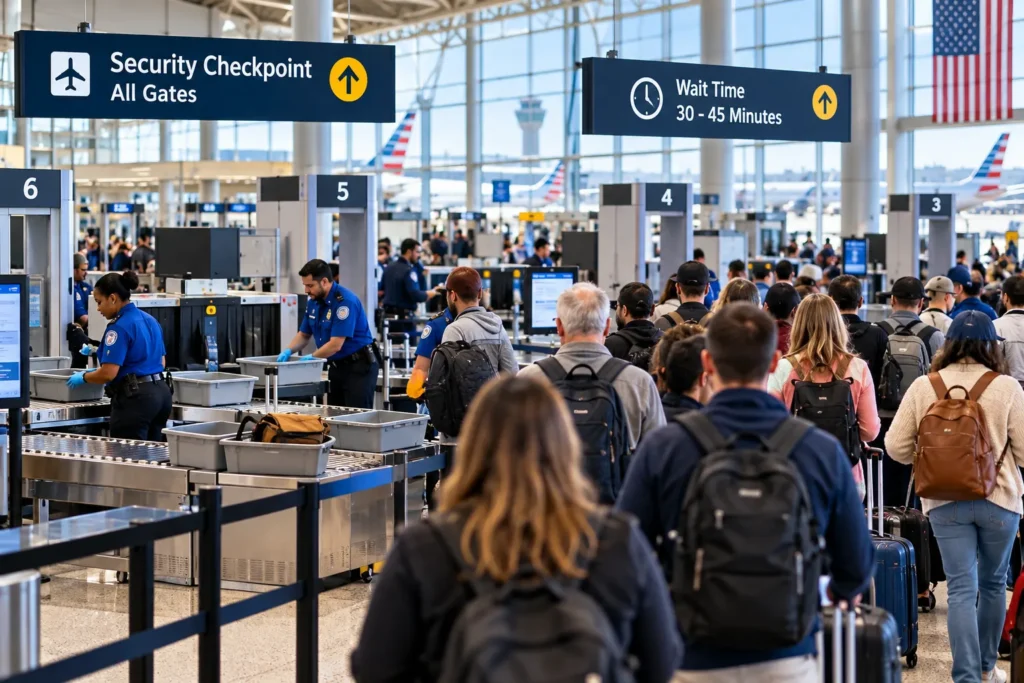
Travelers passing through major aviation hubs across the United States are encountering extended screening queues at security checkpoints as high seasonal passenger volumes coincide with federal transportation workforce constraints. Official statements from federal aviation agencies and transportation authorities confirm that checkpoint processing times have expanded significantly at multiple major airports, resulting in missed connections and operational bottlenecks during one of the busiest travel periods of the year.
Airport screening operations in key metropolitan gateways—including Houston, New Orleans, Atlanta, and Charlotte—have registered prolonged wait periods during peak morning and afternoon departure windows. Federal homeland security representatives confirm that processing delays at select high-volume hubs have reached several hours, prompting aviation authorities to urge passengers to allow substantial extra time before scheduled departures.
Passenger Volumes Reach Record Seasonal Levels
The surge in security checkpoint wait times coincides with record-breaking passenger traffic across the domestic network. Official projections from major aviation industry trade organizations estimate that US airlines will transport approximately 171 million passengers throughout the March-to-April travel window. This represents a four percent increase over the previous year, averaging nearly three million travelers departing daily across commercial airports nationwide.
The volume of spring holiday travel has placed extraordinary operational demand on airport infrastructure:
High Daily Throughput: Daily passenger counts consistently approach three million travelers at peak times, taxing screening capacity.
Hub Concentration: Major transfer hubs in the Southeast and South-Central regions are recording the highest density of departing and connecting flights.
Systemwide Interdependence: Delays at major origin airports create downstream flight crew schedules and aircraft rotation disruptions across smaller regional facilities.
Airlines and airport operators have deployed additional customer service personnel to terminal landside areas to assist travelers navigating extended queue formations.
Checkpoint Operational Capacity and Program Adjustments
To manage screening throughput under reduced workforce staffing, transportation security managers are continually evaluating checkpoint configurations on a case-by-case basis. At several affected airports, officials have temporarily consolidated screening lanes or restricted dedicated expedited lanes to maintain baseline safety protocols across all active passenger streams.
Official announcements outline specific operational adjustments taking place across major security checkpoints:
Lane Consolidation: Security checkpoints are operating at reduced lane capacity during non-peak hours to concentrate available screening officers during primary departure waves.
Dynamic PreCheck Operations: While expedited screening services remain operational where feasible, local leadership retains authority to adjust PreCheck lane availability based on terminal passenger traffic and staffing allocations.
International Traveler Screening: Trusted traveler customs enrollment programs experience temporary operational adjustments, requiring returning international passengers to utilize standard processing lanes.
Federal security administrators emphasize that while operational adjustments are being made to move lines as efficiently as possible, screening safety standards and luggage inspections remain fully enforced without compromise.
Economic Impacts and Strategic Recommendations for Travelers
Prolonged airport delays carry broader economic implications for the commercial aviation sector and destination economies. Historical statistics compiled by tourism trade associations show that multi-day transportation bottlenecks and widespread flight delays incur billions of dollars in lost productivity, airline rescheduling costs, and hospitality revenue declines.
Airport executives and airline representatives advise passengers flying during the peak spring travel window to take clear preparatory steps:
Early Terminal Arrival: Travelers are strongly advised to arrive at departure terminals at least three hours prior to domestic flights and up to four hours prior to international departures.
Digital Check-In and Baggage Clearance: Utilizing mobile boarding passes and checking baggage online helps minimize landside wait times before reaching security screening queues.
Real-Time Monitoring: Passengers should regularly check official airport websites and airline mobile applications for real-time updates on checkpoint wait times and gate assignments.
As public sector leadership and aviation stakeholders work toward resolving administrative constraints, travel authorities reiterate that passenger patience and thorough preparation remain essential for navigating security screening queues during high-density travel periods.
For more travel news like this, keep reading Global Travel Wire