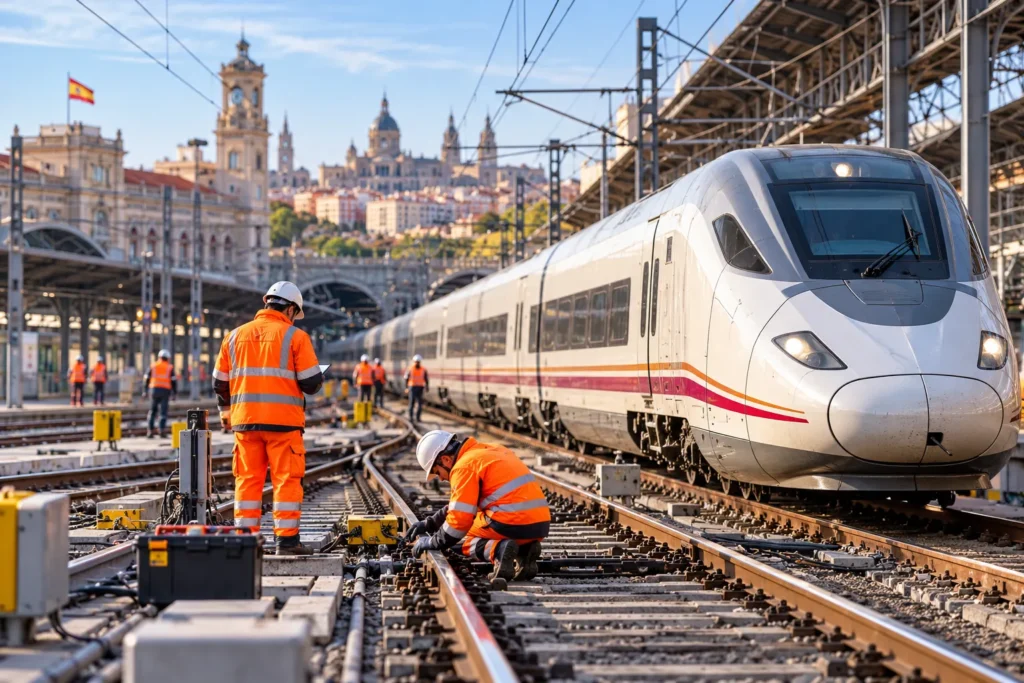
Spain’s expansive high-speed railway system, a cornerstone of the nation’s domestic travel connectivity and visitor economy, is facing comprehensive operational reviews following severe signaling disruptions and collisions along vital transit routes. The Ministry of Transport and Sustainable Mobility, alongside railway infrastructure administrator Adif and state operator Renfe, have initiated emergency oversight protocols to address critical technical failures affecting key tourist arteries, most notably the Madrid-Seville high-speed corridor.
Crucial Rail Arteries Face Scrutiny Across Southern Travel Corridors
The Madrid-Seville line, celebrated as the historic foundation of Spain’s bullet-train network since its inaugural launch in 1992, represents one of the busiest passenger routes in Europe. Transporting millions of holidaymakers and business travelers annually between the capital and the cultural centers of Andalusia, the corridor connects landmark destinations including Cordoba, Seville, and Malaga.
Official reports from the Ministry of Transport confirm that a major automated signaling breakdown occurred on the southern network, halting multiple high-speed convoys mid-transit. Among the affected services was a commercial passenger unit carrying 147 passengers, which was forced to stop near open agricultural land while central dispatchers evaluated track conditions. Disruption to automatic speed-control and train-protection systems prompted infrastructure authorities to shift into manual dispatch protocols across several dozen kilometers of track, an operational change that has now become the central focus of official inquiries.
Government transport authorities noted that when automated signaling mechanisms malfunction, safety guidelines require strict containment measures to prevent track conflicts. Official investigations conducted by the Railway Accident Investigation Commission (CIAF) are focusing on the precise communication sequences between regional control stations and locomotive operators. Safety specialists are examining the mechanical reliability of automatic track braking alongside human dispatch procedures to determine how moving convoys were directed through obstructed rail sectors.
Supporting Sustainable Mobility and Passenger Trust in Spanish Tourism Infrastructure
Over the past three decades, Spanish tourism infrastructure has positioned high-speed electric rail as the primary ecological alternative to domestic aviation and private road transport. According to official tourism data published by the National Statistics Institute (INE) and national tourism board Turespaña, Spain welcomes tens of millions of international holidaymakers each year, with a significant proportion relying on sustainable passenger rail to explore historical cities and Mediterranean coastal areas.
With more than 3,900 kilometers of high-speed track operational across the Iberian Peninsula, Spain maintains one of the largest high-speed rail footprints globally. The network connects major hubs such as Barcelona, Valencia, Madrid, and Seville with high-frequency rolling stock operated by multiple competing passenger carriers. However, rapid growth and the liberalization of passenger services have heightened demands on underlying physical assets, electronic switches, and overhead catenary installations.
Regional administrations and government tourism boards have reiterated the necessity of unwavering safety assurances to protect passenger confidence. Rail travel remains vital to dispersing visitor spending away from coastal beach enclaves into inland cultural centers that rely heavily on punctual and safe transit connections. Transport ministry statements have emphasized that structural safety assessments will be expanded across all main high-speed lines to ensure passenger transit standards remain completely uncompromised.
National Investigations and Systemic Railway Modernization
In response to the operational failures, the Ministry of Transport announced immediate technical audits across high-speed signaling equipment, communication relays, and automatic train-protection components. Independent technical teams have been deployed to analyze telemetry recordings, emergency radio logs, and track sensors to establish precise systemic vulnerabilities.
Official government communications outline a commitment to complete institutional transparency. Authorities confirmed that legal frameworks, operational protocols, and traffic control rules will undergo modernization to prevent manual communication overrides from causing hazardous situations when automated signals experience localized electrical or software faults.
Simultaneously, infrastructure authority Adif has accelerated diagnostic checks across older track alignments. While newer high-speed connections incorporate modern European Rail Traffic Management Systems (ERTMS), legacy sections of the earliest high-speed tracks, including sections of the Madrid-Seville alignment, utilize older speed-signaling technology that requires rigorous maintenance schedules and frequent component replacement. Technical teams have been instructed to conduct overnight track assessments, update electrical substations, and replace aging fiber and signal links to minimize unexpected service suspensions.
Long-Term Outlook for High-Speed Passenger Transit
Spain’s commitment to rail travel remains an essential pillar of the country’s national decarbonization commitments and regional mobility strategies. State agencies emphasize that high-speed trains continue to offer one of the statistically safest and most environmentally responsible transportation modes available across Europe.
Government officials and tourism planners are coordinating closely to ensure that service continuity is maintained while modernization upgrades proceed. Emergency response procedures are being revised, with enhanced training programs mandated for traffic controllers, dispatch personnel, and locomotive drivers.
As independent investigative bodies assemble their final reports, national authorities maintain that structural upgrades, system redundancies, and stringent operational regulations will form the foundation for restoring passenger peace of mind. By prioritizing robust technological oversight, Spain aims to reinforce the security of its high-speed rail network and ensure that sustainable travel continues to support national tourism and regional mobility safely.
For more travel news like this, keep reading Global Travel Wire