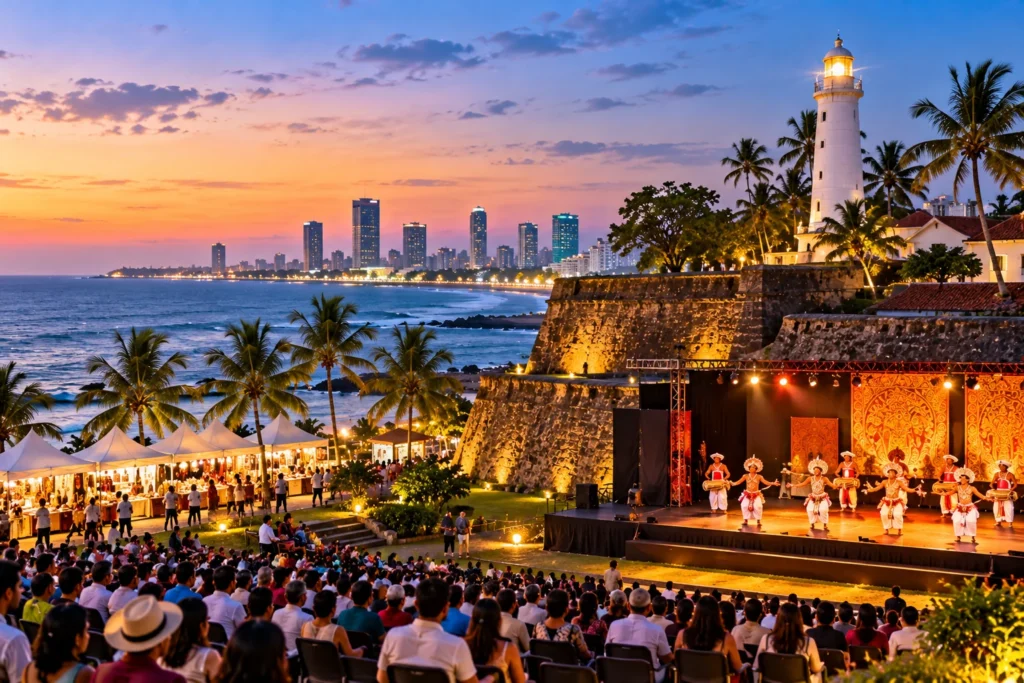
Official government communications released by the Ministry of Foreign Affairs, Foreign Employment and Tourism confirm that Cabinet Minister Vijitha Herath has engaged with internationally celebrated musical artist and producer DJ Snake alongside a delegation of international performers in Colombo. The ministerial meeting coincided with the execution of the multi-day Senter Music Festival staged across the reclaimed waterfront grounds of Port City Colombo. During the official exchange, ministerial leadership conveyed state appreciation to the artists for staging high-profile international productions in the commercial capital, emphasizing that large-scale musical spectacles are an increasingly vital instrument for elevating national visibility, supporting creative youth enterprise, and diversifying inbound travel revenues.
Government representatives formally extended invitations to the international delegation to experience the country’s natural landscapes, historic cultural monuments, and traditional hospitality during personal return journeys. Official ministerial statements underlined that the national administration has adopted a focused policy objective to establish Sri Lanka as a primary South Asian hub for global entertainment tourism, live performing arts festivals, and major international conferences. By creating a transparent and welcoming environment for international event organizers, production managers, and private investors, state authorities plan to accelerate tourist footfall, enhance hotel occupancies, and generate dynamic entrepreneurial avenues for domestic professionals across hospitality and live event management.
Strategic Role of Port City Colombo and Modern Infrastructure
A central foundation supporting this promotional transition is the ongoing expansion of modern venue infrastructure centered at Port City Colombo. Conceived under dedicated statutory governance as an international service center and special economic zone, the waterfront precinct provides purpose-built spaces designed to accommodate large-scale international gatherings. With extensive outdoor coastal event venues, planned integrated resorts, and modern urban planning standards, the zone provides event managers with the spatial and logistical capacity required to host complex international entertainment productions safely.
Public policy declarations from the Ministry of Tourism affirm that combining modern commercial enclaves like Port City Colombo with rich cultural heritage circuits allows the destination to appeal to high-spending global demographics. Historically recognized primarily for wildlife safari expeditions, coastal beaches, and ancient cultural heritage triangles, the island is deliberately expanding its portfolio to encompass modern music, creative arts, and professional exhibitions.
Minister Herath highlighted that developing the entertainment sector serves a dual socio-economic objective: while expanding global tourism arrivals, it simultaneously builds an active creative economy that engages local youth. Government frameworks prioritize mentorship programs, technical audio-visual training, and artistic collaborations that empower domestic artists to participate in international productions.
Sustained Performance Across International Tourist Arrivals
The government’s strategic push into international entertainment tourism comes amid sustained momentum recorded in national travel indices. Official statistical reports published by the Sri Lanka Tourism Development Authority document that the island nation welcomed more than 2.36 million international tourist arrivals across the preceding annual operating cycle, generating approximately 3.2 billion dollars in official travel receipts. This performance established a post-pandemic benchmark and underscored the resilience of the national hospitality ecosystem.
Official monthly visitor monitoring for the current operating period indicates that inbound travel volume has maintained strong performance, recording 1.69 million international visitor arrivals through the end of the third operating quarter. Regional proximity markets continue to provide the largest volume of travelers, with India maintaining its role as the leading source market by supplying over 437,000 visitors during the first nine months. Concurrently, outbound markets across China, the United Kingdom, Australia, and Western Europe have demonstrated stable growth, supported by expanded direct air connectivity and simplified electronic entry visa arrangements.
Tourism authorities emphasize that hosting marquee global performers creates strong marketing outreach across social networks and international media channels. This high-profile exposure reaches younger, mobile travelers who frequently plan short-haul weekend getaways or combined vacation packages around headline cultural festivals and musical tours.
Economic Diversification and Youth Enterprise Development
State development agencies view entertainment tourism as a high-yield economic catalyst capable of driving direct spending across numerous interconnected sectors. Beyond ticket sales and festival passes, international events stimulate commercial demand across municipal boutique hotels, culinary establishments, local transport providers, and independent retail districts.
The official ministerial briefing underscored the vital necessity of providing structured platforms for the younger generation to express creative skills. By encouraging global talent to perform alongside domestic musicians, choreographers, and stage designers, state institutions aim to cultivate an internationally competitive local talent pool. Educational and cultural ministries are coordinating with tourism authorities to create formalized workshops and internship tracks attached to major state-sanctioned entertainment productions.
Furthermore, tourism planners are designing event frameworks that encourage concertgoers to explore regional attractions beyond the metropolitan boundaries of Colombo. Tailored itineraries guide arriving visitors toward scenic interior railway circuits, coastal surfing reserves in the Southern Province, and heritage monuments in the Central Highlands, ensuring that economic benefits generated by metropolitan events distribute evenly across provincial host communities.
Coordinated Public Governance and Future Event Pipeline
To ensure the seamless execution of international productions, the Ministry of Tourism is working in coordination with municipal transport bodies, immigration authorities, and public security agencies. Government directives aim to minimize procedural delays for incoming international production crews, streamline customs procedures for specialized sound and stage hardware, and maintain world-class security standards across public entertainment hubs.
By establishing dependable administrative protocols and transparent event hosting guidelines, public authorities are positioning the nation to compete directly with established event destinations across Southeast Asia and the Middle East. Government ministers reiterate that attracting world-renowned artists reinforces international investor confidence and projects an image of stability and vitality.
As the Ministry of Tourism and the Sri Lanka Tourism Development Authority advance forward planning for upcoming travel seasons, integrating contemporary entertainment with timeless cultural assets remains a central policy priority. Through collaborative initiatives linking global artists, regional promoters, and state institutions, Sri Lanka continues to build an energetic destination profile that welcomes international visitors to experience both world-class entertainment and exceptional cultural heritage.
For more travel news like this, keep reading Global Travel Wire