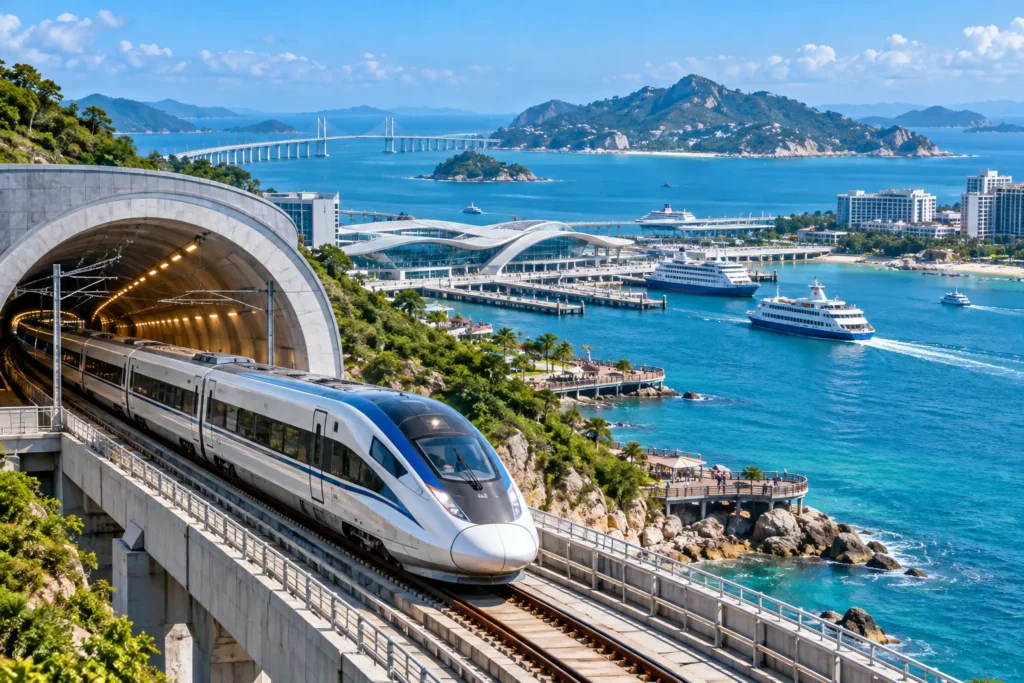
Official infrastructure announcements and state railway project releases confirm major engineering progress on the Yongzhou Railway line, connecting the coastal manufacturing hub of Ningbo with the island archipelago of Zhoushan in East China’s Zhejiang Province. The project is centered on the excavation of the Jintang undersea tunnel, an engineering undertaking measuring 16.18 kilometers in total length with an 11.21-kilometer shield-driven subsea section. Recognized by national transport authorities as the world’s longest undersea high-speed railway tunnel, the project achieved key milestones as domestically engineered super-large-diameter tunnel boring machines advanced toward their designated underwater docking point deep beneath the seabed.
The subsea alignment represents an unprecedented civil engineering venture, designed to withstand water and soil pressures that exceed standard underground rail construction parameters. Construction authorities from China Railway 14th Bureau Group confirmed that the customized tunnel boring machine “Yongzhou,” possessing a 14.57-meter excavation diameter and equipped with 308 heavy-duty alloy cutters, has traversed more than 4,000 meters from the Ningbo entry portal. Operating up to 93 meters below the seabed, the machine has completed approximately 83 percent of its required excavation distance, advancing toward an underwater meeting point where it will join its companion boring shield, “Dinghai,” advancing from the Zhoushan portal.
Slashing Transit Times Across the Yangtze River Delta Corridor
The primary objective of the Yongzhou Railway is establishing a rapid passenger transport link connecting the mainland high-speed network to Zhoushan, ending the archipelago’s status as the only prefecture-level city in Zhejiang Province without passenger railway services. Official transit planning projections indicate that upon commencement of commercial operations, high-speed rail journeys between Ningbo and Zhoushan will take approximately 26 minutes, compared to highway bus and private vehicle journeys that frequently take between 90 minutes and two hours.
Regional transport authorities emphasize that the line will dramatically reduce travel times across the wider Yangtze River Delta economic megalopolis. Intercity bullet trains will permit direct rail connections between the provincial capital of Hangzhou and Zhoushan in approximately 77 minutes, enabling tourists, corporate delegates, and weekend leisure travelers from Shanghai, Nanjing, and surrounding metropolitan hubs to access island destinations without transferring to coastal ferries or navigating congested maritime expressway bridges.
By eliminating long-standing geographic transit bottlenecks, provincial tourism planners project an immediate surge in regional weekend travel demand. The integrated transport network establishes an efficient passenger circuit linking historic cultural landmarks in Ningbo and Hangzhou with the pristine marine environments, sandy coastal bays, and sacred mountain reserves of the Zhoushan archipelago.
Unlocking Island Tourism Assets and Pilgrimage Circuits
Zhoushan holds some of the most culturally significant and ecologically protected coastal tourism assets in East China, anchored by Mount Putuo, renowned internationally as one of the four sacred Buddhist mountains of China. Every year, millions of cultural tourists, spiritual pilgrims, and international travelers journey to Mount Putuo and the neighboring Shengsi and Dongji island chains.
Currently, access to these island reserves depends on maritime vessel departures subject to seasonal weather fluctuations, fog delays, and coastal typhoon suspensions. The introduction of high-speed passenger rail through an all-weather subsea tunnel corridor guarantees reliable, year-round access for visiting delegations and leisure travelers. Cultural tourism bureaus anticipate that dependable intercity rail connections will allow tour operators to organize seamless, high-yield cultural touring circuits that combine continental historical relics with traditional island heritage.
Furthermore, municipal tourism releases indicate that local administrations across Zhoushan are modernizing shoreside hospitality infrastructure, luxury resort facilities, and eco-friendly island trail networks ahead of the railway’s official commissioning. Upgrades are prioritized around major tourist transit stations to facilitate immediate passenger transfers to eco-friendly electric bus lines, island ferry terminals, and designated maritime recreation centers.
Engineering Innovation and Marine Ecology Protection
The technical achievements surrounding the Jintang tunnel underscore a historic shift in domestic high-end manufacturing. Engineering reports confirm that the tunnel boring machines utilize advanced automated monitoring arrays, transmitting real-time operational diagnostics covering cutterhead torque, hydraulic oil pressures, and shield ring stability to technical teams on the surface. These systems allow project engineers to analyze complex subsea geological formations containing mixed layers of soft soil and full-face hard granite with compressive strengths reaching 240 megapascals.
Environmental monitoring agencies and marine fisheries bureaus have coordinated closely with construction teams to implement strict environmental safeguards throughout the coastal zone. Because the tunnel route intersects the bustling Jintang Channel—a primary international maritime navigation channel serving the world-class deep-water port of Ningbo-Zhoushan—shield-driven subsea excavation ensures uninterrupted surface vessel navigation while preventing disruptions to delicate marine ecosystems, protected fisheries, and coastal tidal reserves.
Long-Term Regional Economic and Hospitality Impact
Provincial socioeconomic master plans designate the Yongzhou Railway as a vital catalyst for the Yangtze River Delta’s integrated tourism and services economy. Beyond stimulating leisure journeys, the line is positioned to expand business travel, maritime conference bookings, and international industrial expos centered on marine science, green shipping logistics, and seafood processing.
As tunnel boring operations advance toward their scheduled rendezvous beneath the seabed, public sector bodies continue to synchronize destination marketing strategies across East China. By combining advanced domestic engineering, sustainable subsea transit design, and rich island heritage, the Yongzhou Railway is establishing a transformative infrastructure model that will redefine high-speed rail tourism across coastal China.
For more travel news like this, keep reading Global Travel Wire