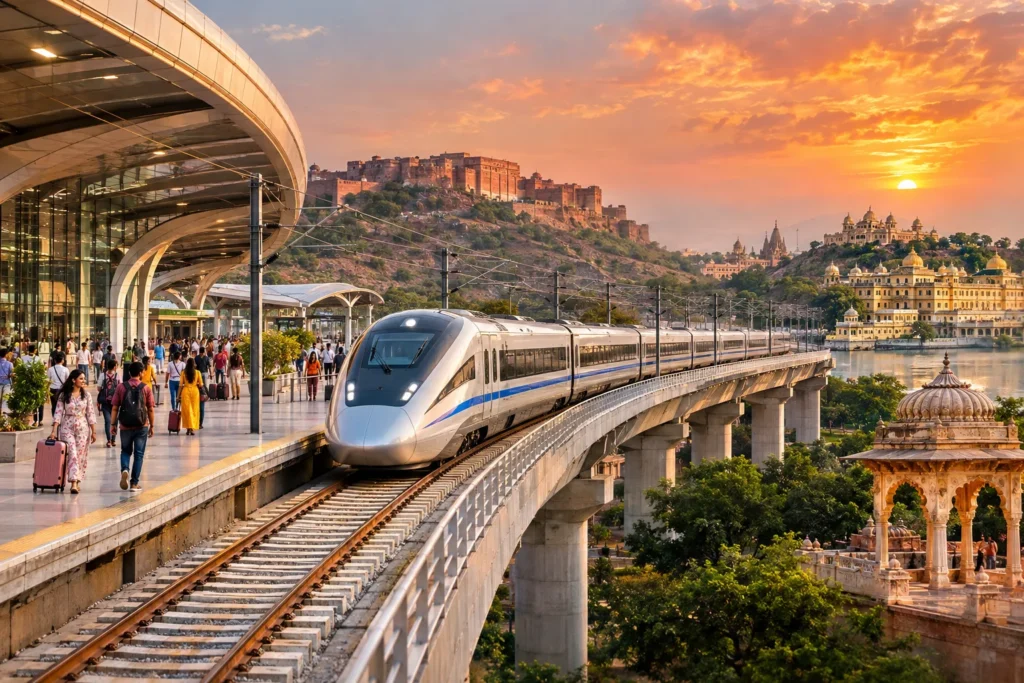
Official announcements from the Ministry of Railways confirm that the Government of India has approved the northern corridor of the national bullet train network, setting the foundation for an unprecedented transformation of passenger transit and cultural tourism across northern and eastern regions of the country. Formally disclosed by Union Minister for Railways Ashwini Vaishnaw during an official address in Varanasi, the comprehensive high-speed rail alignment will originate in the national capital of Delhi and extend through prominent industrial, heritage, and spiritual centers across Uttar Pradesh, Bihar, and West Bengal before reaching Assam. The strategic infrastructure undertaking is engineered to drastically reduce intercity transit durations, linking historically significant destinations into a unified high-speed transport grid.
The alignment establishes a direct high-speed line through major cultural and pilgrimage hubs, including Agra, Kanpur, Lucknow, Ayodhya, Prayagraj, Varanasi, Patna, and Siliguri, culminating at Guwahati. By integrating high-density population centers with internationally renowned cultural landmarks, the corridor is positioned to redefine domestic excursion habits, optimize multi-city travel for international voyagers, and stimulate regional leisure and hospitality economies.
Slashing Journey Times Across World Heritage and Cultural Corridors
The primary operational advantage of the approved northern corridor lies in the compression of transit times between major cities. Official technical projections released by railway authorities indicate that travel from Delhi to Agra will be reduced to just 59 minutes once commercial operations commence. Currently, journey times between the capital and the city of the Taj Mahal range from two to three hours by express passenger train and highway expressway. The sub-one-hour transit capability is expected to revolutionize single-day excursion travel for both domestic tourists and inbound international travelers.
Further along the network, high-speed services are projected to connect Delhi to Kanpur in approximately one hour and 45 minutes, while the journey to the state capital of Lucknow will take approximately two hours and 12 minutes to two hours and 21 minutes. Passengers traveling between Delhi and the ancient spiritual city of Varanasi will complete the journey in approximately three hours and 35 minutes, compared to standard express journeys that currently require between eight and fourteen hours. Travel between Lucknow and Varanasi is estimated to require just one hour and 21 minutes, while transit between Varanasi and Prayagraj will take roughly 33 minutes.
On the eastern extension of the corridor, the high-speed link will transform long-haul connectivity between the national capital and Northeast India. The journey between Delhi and Siliguri—the gateway to Darjeeling and the Himalayan tourism circuit—will be cut from conventional 20-hour railway routes to approximately six hours, opening rapid overland transit to northern West Bengal and Assam.
Unlocking Pilgrimage Circuits and Experiential Heritage Tourism
Northern India holds some of the world’s most visited spiritual and historical monuments, anchored by the Mughal architectural wonders of Agra, the sacred ghats of the Ganges River in Varanasi, and the newly developed temple complexes of Ayodhya. Under current transport patterns, travelers navigating the classic golden triangle or sacred pilgrimage circuits face multi-day logistical planning involving highway transfers, regional airport connections, and overnight rail journeys.
State tourism development boards and urban development directorates anticipate that bullet train operations will permit the creation of seamless multi-destination itineraries. Visitors will have the ability to explore monument complexes in Agra during the morning, proceed directly to Ayodhya or Lucknow for midday cultural programs, and arrive in Varanasi in time for evening rituals along the riverfront.
The reliable, all-weather scheduling of high-speed passenger rail will also mitigate common seasonal travel disruptions in northern India, such as heavy winter fog delays that routinely disrupt civil aviation schedules and conventional railway timetables across the Indo-Gangetic plains. Municipal authorities across Uttar Pradesh are aligning tourism master plans to expand tourist welcome amenities, heritage walking paths, and clean public transit links surrounding designated high-speed rail terminals.
Domestic Manufacturing and Broad-Based Economic Multipliers
The Ministry of Railways emphasized that the entire engineering architecture of the northern corridor will be executed under national self-reliance frameworks. Structural components from foundational pillars to heavy bridge girders will be fabricated and erected domestically, utilizing Indian engineering talent, skilled technicians, and industrial manufacturing capacity.
Union railway authorities underlined that the project is structured to make high-speed passenger rail universally accessible rather than an exclusive transit mode. Official tariff policies are planned to remain highly economical and competitive, offering ticket price structures substantially below prevailing domestic airline fares to ensure that middle-income households, students, and family travelers can regularly utilize the network.
Beyond direct transit benefits, state economic planning departments anticipate substantial economic multiplier effects for traditional craft clusters and small-scale industries located along the alignment. Artisans specializing in Varanasi silk weaving, Lucknow chikan embroidery, Agra leatherwork and marble inlay, and regional culinary arts will gain immediate access to high-spending consumer markets in metropolitan hubs. Rapid intercity accessibility will support local enterprise development, generate hospitality employment, and attract institutional investments in boutique lodging, convention centers, and eco-friendly tour operations.
Long-Term Horizon for National Transport Modernization
The sanctioning of the northern bullet train corridor represents a central milestone in the long-term expansion of sovereign high-speed passenger infrastructure. While detailed station alignments, land survey schedules, and official construction milestones will be formalized in forthcoming departmental notifications, the executive approval provides clear policy direction for modernizing intercity transport.
By linking historic heritage sites, sacred pilgrimage centers, and commercial hubs through advanced rail engineering, the northern bullet train corridor is poised to become an engine of sustainable tourism growth. The initiative bridges deep-rooted cultural tradition with modern passenger infrastructure, ensuring North India remains a globally competitive, easily accessible destination for generations of travelers.
For more travel news like this, keep reading Global Travel Wire