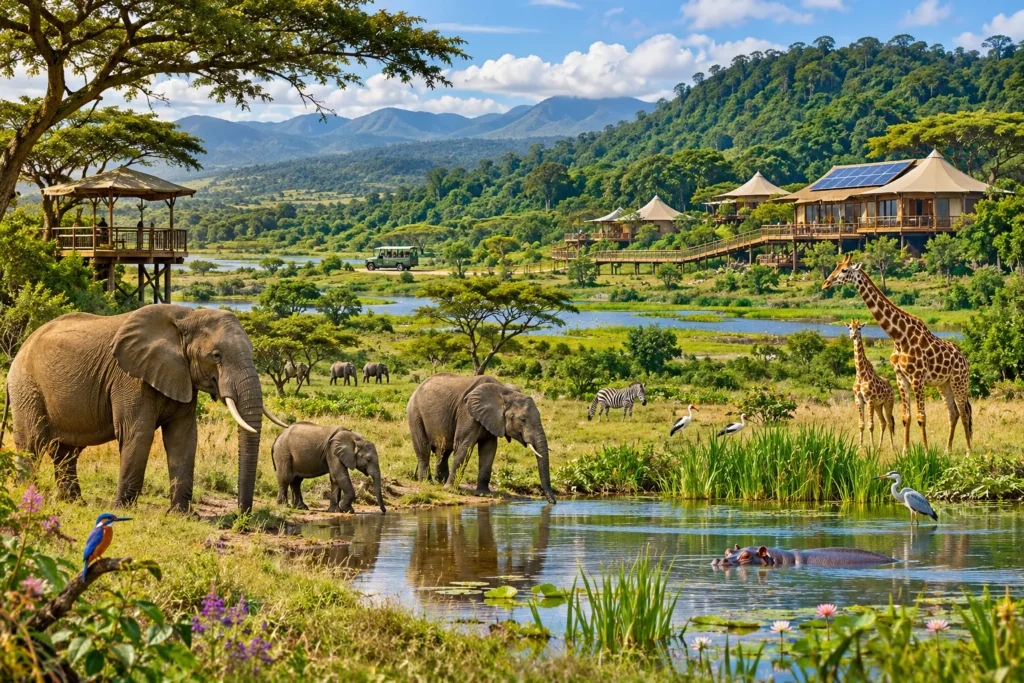
Official multilateral declarations and summit proceedings from the United Nations Biodiversity Conference in Yerevan, Armenia confirm that international wildlife protection and biodiversity financing are receiving an unprecedented financial injection. A major commitment of 100 million dollars has been formally allocated by the Bezos Earth Fund to anchor the newly established 500 million dollar Species Recovery Alliance, a coalition of nine founding conservation entities formed to intervene on behalf of the world’s most vulnerable flora and fauna. The multilateral framework is designed to prevent irreversible extinctions, rehabilitate degraded wilderness biomes, and directly preserve natural habitats that form the core foundation of international ecotourism destinations worldwide.
Global conservation bodies, led by the International Union for Conservation of Nature, report that more than 49,500 animal and plant species currently face critical extinction threats on official conservation inventories. The newly established alliance specifically focuses on the three highest-risk categories—critically endangered, endangered, and extinct in the wild—which collectively encompass over 31,000 species globally. By providing sustained capital over multi-year cycles, the initiative addresses chronic funding gaps that frequently jeopardize long-term ecological rehabilitation and protected park administration.
Safeguarding Global Wildlife and Nature-Based Tourism Ecosystems
The expansion of targeted conservation finance carries immediate positive implications for wildlife sanctuaries, national parks, and community-led conservation conservancies that depend on nature-based travel economies. Pristine ecological reserves in biodiversity hotspots such as Madagascar, Australia, Central America, and Southeast Asia rely heavily on viable animal populations to sustain ethical safari circuits, bird-watching expeditions, and indigenous community guide programs.
According to official operational parameters established by the alliance, funding disbursements will be distributed directly to frontline conservation groups and regional park authorities. Priority interventions include specialized captive breeding and wild reintroduction programs, intensive habitat restoration, the eradication of damaging invasive species, and wildlife disease surveillance. Progress and ecological outcomes will be formally benchmarked using the IUCN Red List and the IUCN Green Status of Species, ensuring that recovered populations can thrive naturally in their native wilderness ecosystems.
Sustainable tourism authorities emphasize that living wildlife forms the primary economic asset for rural communities adjacent to national parks. When endangered species recover, ecological resilience improves, attracting high-value, low-impact international travelers whose spending finances local ranger salaries, school construction, and anti-poaching surveillance networks. The initiative complements earlier conservation projects, including the 200 million dollar Phoenix Species Project developed in partnership with Re:wild, which focuses on targeted recovery interventions for 100 critically endangered species across 30 nations, including Madagascar’s golden-crowned sifaka and Australia’s elusive night parrot.
Bridging Sovereign Finance Deficits and Enhancing Inter-Governmental Action
The private-sector financing rollout comes during an urgent reassessment of global public conservation financing. Under international accords established at the 2022 United Nations Biodiversity Conference in Montreal, sovereign governments agreed to mobilize 200 billion dollars annually by 2030 to reverse global nature loss. However, official multilateral monitoring reports indicate that public funding flows currently remain far below target thresholds, creating acute operational shortages across public nature reserves and marine protected areas.
To reinforce public commitments alongside philanthropic capital, seventeen sovereign governments have launched the Coalition of Action to Recover Endangered Species during ministerial proceedings in Armenia. Working in coordination with sovereign environmental ministries, the public-private alignment seeks to ensure that conservation goals established under national biodiversity strategies are matched by practical field operations.
Environmental directors note that establishing secure, long-term funding streams is essential because wildlife population recovery requires decades of consistent management. Unplanned funding interruptions frequently result in the resurgence of illegal poaching, habitat encroachment, and localized species collapse, wiping out years of hard-won conservation gains and degrading the tourism value of vulnerable ecological landscapes.
Long-Term Horizon for Protected Parks and Sustainable Travel
The injection of dedicated recovery capital provides essential stability to global ecological corridors and national parks confronting escalating environmental pressures. The 100 million dollar commitment represents a continuing distribution from a larger 10 billion dollar philanthropic pledge dedicated to nature conservation and climate action, with approximately 2.4 billion dollars already disbursed across forest protection, marine reserves, and urban greening initiatives.
As international travelers increasingly seek responsible travel experiences that contribute directly to ecological preservation, collaborative funding models between governments, non-governmental organizations, and private conservation foundations will define the future of nature tourism. By stabilizing fragile ecosystems and returning endangered species to self-sustaining population levels, the global initiative ensures that the world’s most remarkable biodiversity sanctuaries remain protected for scientific discovery, ecological balance, and future generations of nature travelers.
For more travel news like this, keep reading Global Travel Wire