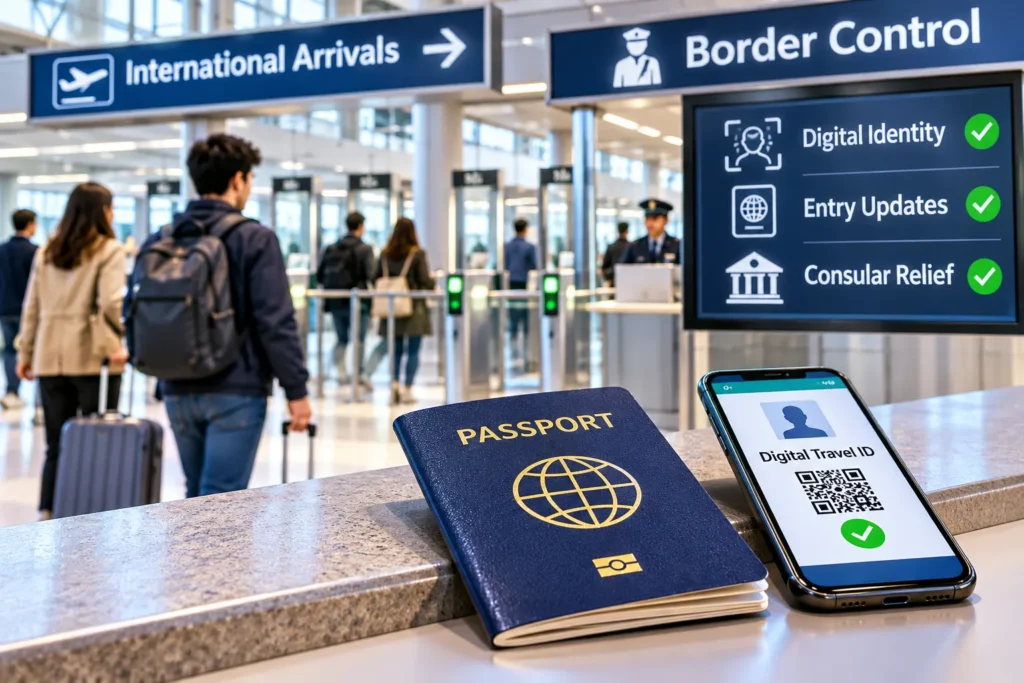
Official notices from diplomatic missions, civil aviation authorities, and immigration departments indicate significant operational adjustments designed to facilitate cross-border traveler mobility. As governments modernize entry requirements through biometric border infrastructure and automated verification systems, consular authorities are simultaneously resolving documentation hurdles for diaspora and dual-national travelers. In Australia, recent official updates from the High Commission of India and the Australian Department of Home Affairs illustrate this two-fold approach: offering structured administrative relief for Overseas Citizen of India document holders while advancing digital passenger declaration technology across international gateway airports.
Consular Fee Waiver Announced for Overseas Citizen of India Records
Diplomatic notices published by the High Commission of India in Canberra confirm a limited-period exemption for travelers required to update their Overseas Citizen of India documentation. Under statutory consular guidelines, registered cardholders must re-upload updated personal particulars and foreign passport numbers each time a new nationality passport is issued, traditionally within ninety days of acquisition. Failure to submit updated details after the statutory timeframe previously triggered an administrative late penalty of 43 Australian Dollars, or 25 United States Dollars.
Under the temporary relief directive implemented from 1 November through 31 December 2026, the consular service has officially waived this late penalty for fresh and eligible pending update applications. Consular officials clarify that while the financial penalty is temporarily removed, the underlying statutory obligation to update passport records on the designated digital portal remains mandatory.
Furthermore, administrative directives clarify that applicants who previously paid the late fee prior to the waiver window are not entitled to retrospective refunds. For international travelers carrying new foreign passports while their digital portal submissions remain under processing, official border guidance advises presenting the physical Overseas Citizen of India card alongside both the expired and current passport books at airline check-in desks and border inspection checkpoints to avoid transit delays.
Phasing in Biometric Check-In and Digital Travel Declarations
Parallel to consular record updates, border management authorities in Australia are accelerating the transition toward paperless international arrivals. The Australian Department of Home Affairs and border management agencies have initiated the progressive rollout of the digital Australia Travel Declaration, designed to replace the legacy orange paper Incoming Passenger Card across all international international air terminals by 2027.
The modernized platform permits inbound international travelers and returning residents to submit customs, quarantine, and biosecurity disclosures digitally via authenticated mobile interfaces up to seventy-two hours prior to departure. Official statements highlight that digital pre-clearance substantially reduces terminal congestion, accelerates passenger flow through primary inspection zones, and integrates with automated SmartGate biometric corridors.
Aviation and border management authorities confirm that biometric verification—utilizing automated facial comparison algorithms linked to electronic chip passports—will continue expanding across departure and arrival terminals. Despite the rapid integration of digital credentials and paperless mobile forms, public security directives caution that international travelers must continue carrying physical government-issued passports. Biometric boarding gates and digital arrival platforms rely on physical passport microchips for cryptographic authentication, sovereign identity verification, and emergency fallback procedures.
Official Statistical Projections for Trans-Oceanic Visitor Flows
Statistical reports published by Tourism Australia and the Australian Bureau of Statistics underline the economic significance of streamlined travel documentation and border digitization. Inbound passenger arrivals from primary long-haul markets, including the Indian subcontinent, Southeast Asia, North America, and the United Kingdom, represent vital sources of tourism expenditure, academic mobility, and visiting-friends-and-relatives travel.
Official visitor survey benchmarks show that international travelers from the diaspora segment consistently register longer-than-average durations of stay, averaging between three to six weeks per visit. These long-duration trips distribute tourism expenditure across regional towns, regional hospitality providers, and domestic aviation networks beyond capital cities. Streamlining passport update procedures and removing administrative friction at international borders directly protects these valuable travel corridors as bilateral flight capacity expands between Australia and major global hubs.
Practical Guidelines for International Travelers Ahead of Upcoming Deadlines
Government authorities and consular representatives encourage international travelers to review their documentation validity well in advance of departure windows. For individuals holding dual-status documentation or foreign citizenship credentials, completing digital record synchronization through authorized consular portals before the 31 December cutoff ensures that records remain compliant without incurring future penalties.
Simultaneously, travelers planning cross-border itineraries through 2027 are advised to verify that their electronic machine-readable passports possess at least six months of remaining validity from scheduled travel dates. By monitoring verified consular notices and adopting digital arrival declarations prior to boarding, international travelers can navigate transitioning border protocols with greater efficiency, ensuring dependable, seamless transit across global and regional airports.
For more travel news like this, keep reading Global Travel Wire