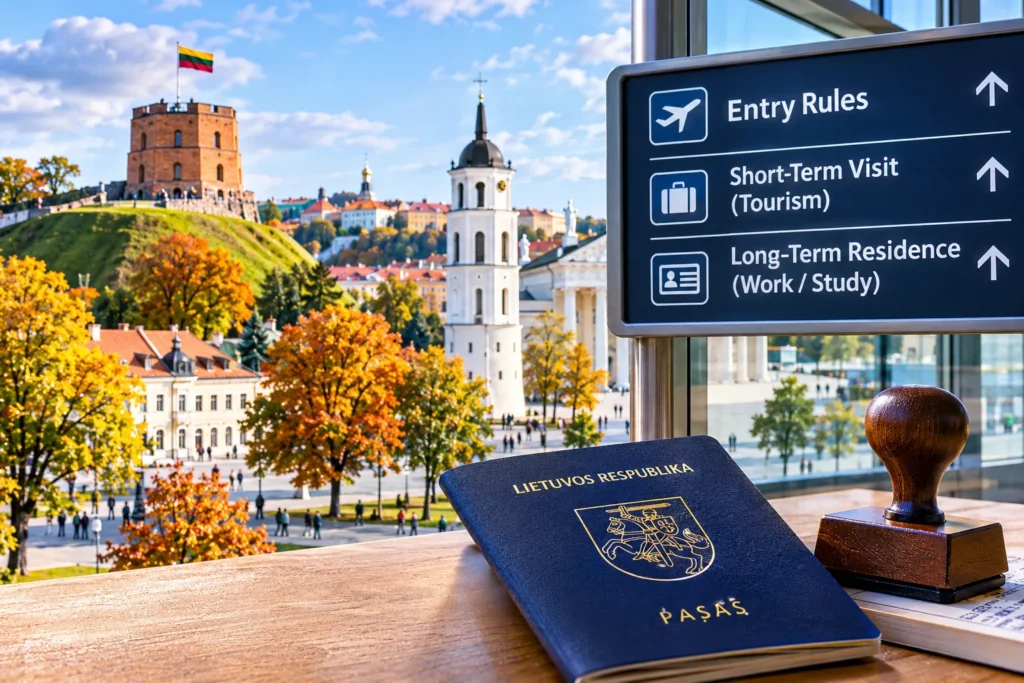
Official updates issued by the Migration Department under the Ministry of the Interior of the Republic of Lithuania establish clear procedural boundaries between temporary leisure or business visits and domestic residence applications. Under the regulatory framework implemented on 1 November 2026, foreign nationals arriving on short-stay Schengen visas can no longer transition directly into ordinary employment or first-cycle university programmes by applying from within the country. The policy clarification reinforces the distinct purpose of Schengen visitor credentials, safeguarding the integrity of standard travel pathways while directing prospective workers and undergraduate students through authorized overseas consular channels.
Clear Distinction Between Visitor Visas and Long-Term Permits
Statutory notices published by Lithuanian consular and migration authorities underscore that standard Schengen visas are intended strictly for tourism, family visits, cultural exchanges, and short-term commercial transit. Under Schengen travel regulations, foreign nationals are authorized to remain across member states for up to 90 days within any rolling 180-day window. Official ministry statements emphasize that holding a visitor visa does not grant the right to undertake standard local employment or circumvent established pre-departure vetting procedures.
According to published guidelines from the Migration Department, individuals lawfully present in Lithuania may submit direct applications for temporary residence permits only if they meet specific baseline conditions. Permitted categories include holders of a valid Lithuanian temporary residence permit, individuals possessing a Lithuanian national type D visa, holders of a residence permit issued by another European Union or Schengen member state, and foreign nationals enjoying lawful visa-free entry arrangements. A Schengen short-stay visa, whether issued by Lithuanian diplomatic missions or any other Schengen state, no longer serves as an eligible document for lodging ordinary employment or bachelor’s degree applications within the country.
Impact on International Visitor Mobility and Cross-Border Travel
Lithuania’s tourism and hospitality leadership monitors immigration administration to maintain predictable travel environments for genuine holidaymakers and corporate delegations. Lithuania Travel, the national tourism development agency operating under the Ministry of the Economy and Innovation, regularly promotes historic urban corridors in Vilnius, maritime heritage in Klaipeda, and seasonal wellness retreats in Druskininkai and Birstonas. Official statistical compilations confirm that hundreds of thousands of international travelers visit the Baltic nation annually, benefiting from streamlined airport border controls, standardized electronic processing, and well-regulated urban transit.
Government travel directives reassure legitimate international visitors that tourism travel is entirely unaffected by the new filing restrictions. Foreign travelers arriving for sightseeing, festivals, architectural tours, and leisure stays continue to experience routine Schengen entry procedures at international airports and land frontiers. The administrative restriction applies solely to the procedural conversion of visitor status into long-term labor or basic undergraduate residency, preventing the misuse of tourism visas as makeshift immigration mechanisms.
Realigned Overseas Filing Networks and Consular Guidance
For international applicants seeking employment or academic enrollment, official announcements point directly to authorized overseas submission centers. Long-term residence permit requests must be initiated through the digital Lithuanian Migration Information System, known as MIGRIS, and lodged in person at accredited external service provider centers situated in the applicant’s country of legal residence.
In coordinated foreign mission releases, Lithuanian consular authorities clarified network adjustments across external service hubs. Starting 1 November 2026, routine temporary residence and national visa document intake ceased at specific partner centers in Kazakhstan, Kyrgyzstan, Uzbekistan, and Bosnia and Herzegovina. The consular notifications expressly clarify that these regional closures apply specifically to long-term residency documentation, whereas the processing of short-term Schengen visas for leisure, private travel, and business visits continues through authorized service centers in the region.
Consular advisories warn international travelers that commercial agencies offering local conversion guarantees inside Lithuania provide misleading counsel. Foreign visitors are advised to identify approved filing locations and category permissions via verified government portals before committing financial resources to travel or tuition.
Targeted Exceptions for Highly Qualified Specialists and Permit Renewals
The Migration Department has defined precise exceptions within its statutory announcements. Highly qualified employment candidates, such as European Union Blue Card applicants with certified advanced credentials and qualifying remuneration, retain the ability to submit applications while lawfully present in Lithuania. Similarly, individuals holding valid work-based temporary residence permits with fewer than six months remaining before expiration continue to process routine renewals within national territory under established administrative timelines.
Official guidelines instruct educational institutions and commercial employers to verify that incoming candidates hold the correct documentation prior to arrival. Sponsoring enterprises must submit required digital mediation letters through the centralized MIGRIS platform, ensuring that invited personnel utilize authorized overseas pathways and enter the country with appropriate national visas or valid residence cards.
Reinforcing Predictable Tourism and Border Administration
By establishing explicit demarcations between visitor entry and long-term relocation, Lithuanian authorities are aligning domestic border management with broader European Union migration policies. The clear enforcement of visa conditions protects international travelers from legal uncertainty, maintains fair standards across the domestic labor market, and preserves the primary purpose of tourism gateways.
As international tourist arrivals and cultural exchanges continue across the Baltic states, Lithuania’s verified administrative procedures ensure that short-stay guests enjoy seamless access to cultural sites, heritage landmarks, and leisure infrastructure under protected, transparent travel standards.
For more travel news like this, keep reading Global Travel Wire