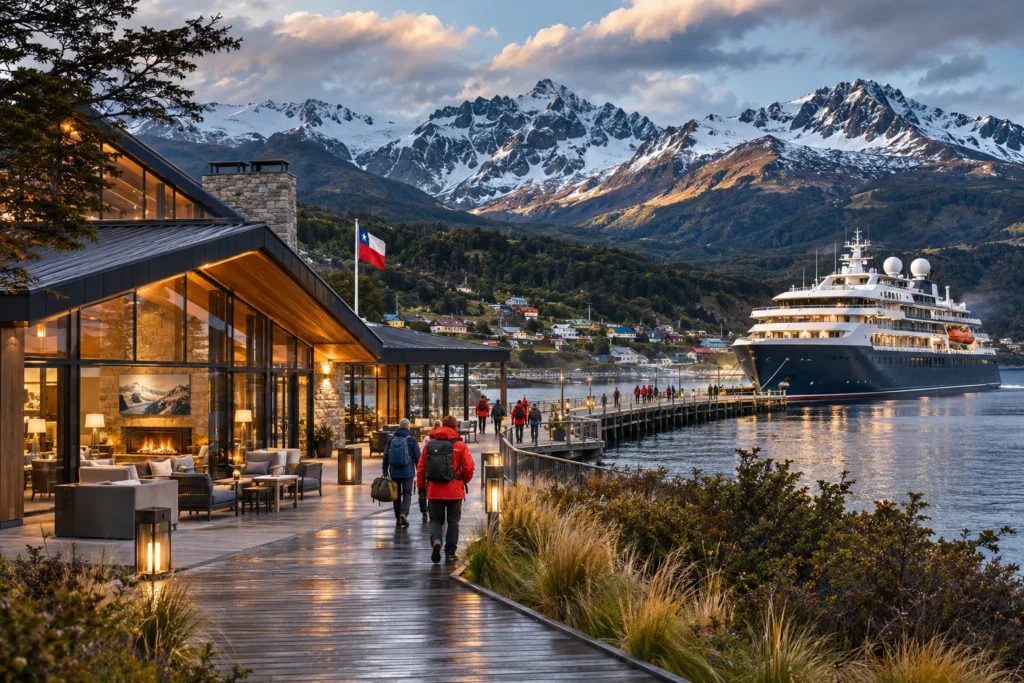
Official announcements from Chilean maritime administrators, municipal authorities, and international expedition operators confirm the inauguration of a major hospitality landmark at the southern edge of the Americas. Located on Navarino Island in Chile’s Magallanes and Chilean Antarctica Region, The Cormorant at 55 South has opened its doors in Puerto Williams, establishing what maritime records describe as the southernmost hotel development on Earth. The completion of the 150-room luxury property marks an operational milestone for high-end expedition cruising, creating a dedicated terrestrial hub designed to streamline passenger journeys heading toward the Antarctic Peninsula.
The formal opening ceremony on November 5 brought together Chilean national and regional representatives, regional tourism officials, community leaders, and cruise line executives to commemorate the joint undertaking. Built in partnership with a consortium of Chilean private investors, the hotel represents an integrated approach to polar travel by linking dedicated air corridors, shore accommodations, and expedition vessel movements under a unified hospitality framework.
Architectural Heritage and Regional Craftsmanship
According to official project declarations, The Cormorant at 55 South was engineered specifically to harmonize with the sub-Antarctic landscape of southern Patagonia. The property’s 150 accommodations were manufactured utilizing specialized modular construction techniques before being transported across the southern Andes to their permanent setting along the Beagle Channel. The visual design emphasizes local timber textures, thermal building systems, and expansive panoramic glazing that frames the surrounding virgin forests and waterways.
The property’s name pays homage to the native cormorant, a coastal seabird deeply intertwined with the marine ecology and indigenous heritage of Tierra del Fuego and the Yaghan cultural tradition. Inside, public areas feature permanent artistic commissions created by Chilean sculptors and artisans, illustrating the geology, marine life, and cultural history of the remote archipelago. Dining facilities, including the signature restaurant Latitude 55 and the central lounge Bar Sur, highlight native Patagonian ingredients, regional agricultural traditions, and certified Chilean wines, anchoring the visitor experience directly in the domestic environment.
In addition to restful accommodations, the hotel provides curated wilderness excursions on Navarino Island, including guided shoreline walks along Seno Lauta, cultural museum visits, and sheltered sea kayaking along the Beagle Channel, ensuring that expedition passengers engage meaningfully with the destination prior to embarkation.
Strategic Integration of Polar Air and Sea Logistics
The primary function of the newly opened establishment is to support dedicated polar fly-cruise programs, an operational model that has transformed modern Antarctic passenger transit. In traditional maritime itineraries, voyages departing South American ports must transit the notoriously tempestuous waters of the Drake Passage by ship, a open-ocean journey that requires several days of navigation each way.
Under the expanded logistics model, travelers arrive directly at Puerto Williams aboard customized charter flights departing from private air terminals in Santiago. Guests stay at The Cormorant at 55 South to acclimate and receive comprehensive polar briefings before boarding chartered flights to King George Island in Antarctica, where expedition ships await.
National civil aviation bodies and regional port authorities note that positioning Puerto Williams as a primary flight and maritime staging point reduces logistical friction and minimizes transfer transit times compared to more distant northern hubs. While sub-polar flight schedules remain subject to changing meteorological parameters, maintaining a dedicated luxury facility allows operators to host stranded or waiting passengers in comfort during short-term weather interruptions.
Economic Transformation for Puerto Williams and the Magallanes Region
Chilean economic development ministries and regional government bodies emphasize that large-scale infrastructure investments in isolated territories generate valuable socio-economic returns. Puerto Williams, historically serving as a naval outpost and scientific base, has steadily expanded its civilian and commercial profile. The presence of a permanent, high-standard hospitality asset fosters regional employment, provides contracts for municipal service providers, and creates steady demand for local supply networks, fisheries, and culinary producers.
Furthermore, regional authorities highlight that developing controlled, regulated gateway infrastructure supports sustainable visitor flow management. Directing passenger traffic through designated airport facilities, certified hotel accommodations, and regulated maritime piers prevents ad-hoc environmental disruption across fragile coastal zones, in line with international environmental mandates established by the Antarctic Treaty System and the International Association of Antarctica Tour Operators.
Outlook for Sustainable High-End Expedition Travel
As global interest in remote nature destinations continues to rise, public tourism agencies and maritime authorities are prioritizing safety, sustainability, and infrastructural coordination. The establishment of dedicated land gateways demonstrates how modern expedition travel operators are evolving beyond floating ship operations into end-to-end destination stewards.
By formalizing operations at The Cormorant at 55 South, international tourism stakeholders and Chilean authorities have positioned Puerto Williams as a preeminent launchpad for global polar exploration. The initiative underscores a shared institutional commitment to high-standard hospitality, regional economic participation, and the continued promotion of responsible expedition travel across the world’s most pristine marine environments.
For more travel news like this, keep reading Global Travel Wire