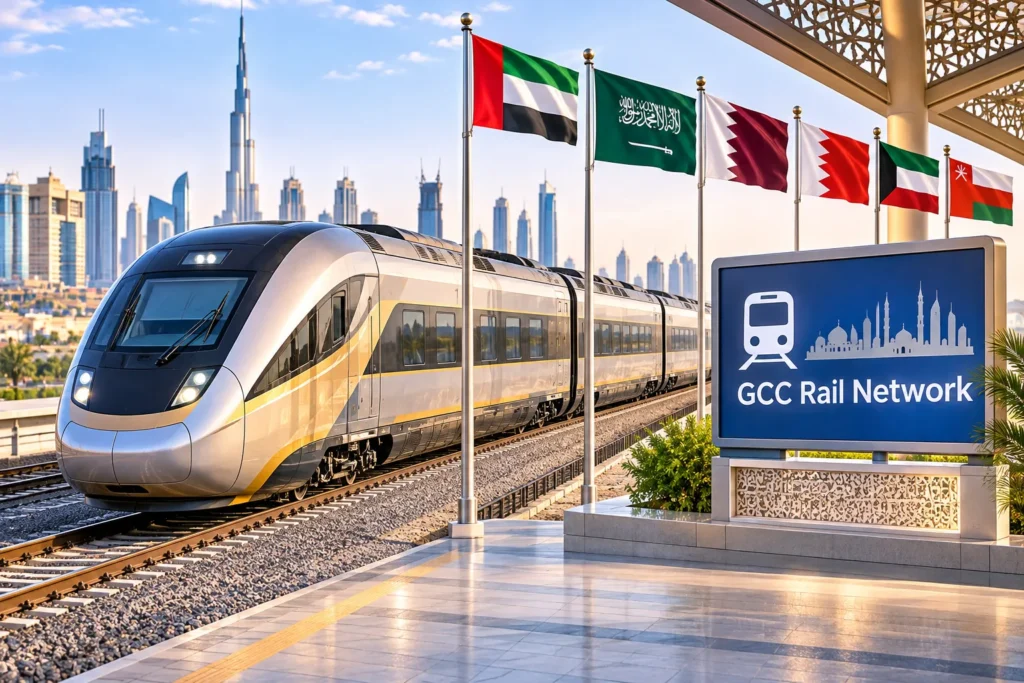
Official communiqués issued by the General Secretariat of the Gulf Cooperation Council confirm that transport authorities from across the Arabian Peninsula have convened in Manama, Bahrain, to sign the comprehensive General Railway Agreement. The landmark accord establishes unified operational governance, legislative harmony, and mutual administrative obligations across the six member nations: the Kingdom of Bahrain, the Kingdom of Saudi Arabia, the United Arab Emirates, the Sultanate of Oman, the State of Qatar, and the State of Kuwait. Designed to integrate over 2,100 kilometers of high-standard railway tracks, the cross-border initiative represents a major structural advancement for passenger transport, regional trade integration, and tourism facilitation.
The formal signing ceremony took place under Bahrain’s rotating GCC presidency, bringing together ministers of transport and telecommunications alongside the Secretary General of the Gulf Cooperation Council, Jassim Albudaiwi. The resulting agreement details statutory operating schedules, inter-state technical parameters, and dedicated coordination mandates directed by the GCC Railways Authority. By standardizing safety codes, customs protocols, and technical alignment, the treaty accelerates the delivery of an integrated, environmentally sustainable transport backbone targeted for network operations by December 2030.
Transformative Infrastructure and Passenger Connectivity Across the Arabian Peninsula
The multi-billion-dollar transit network links major metropolitan centers, economic development corridors, and international entry ports across the region. Starting from Kuwait City in the north, the rail line connects through Saudi Arabia’s Eastern Province industrial hub of Dammam, branches directly into the Kingdom of Bahrain across the proposed King Hamad Causeway, connects to Qatar through Salwa, traverses through the United Arab Emirates from Abu Dhabi and Dubai, and terminates along the coastal shores of Sohar and Muscat in Oman.
Passenger train services operating along the regional passenger railway network are engineered to run at speeds reaching 200 kilometers per hour, drastically shortening point-to-point transit times across historic travel routes. Journey durations between neighboring capital cities and commercial centers will drop significantly, enabling travel between Dammam and Doha in approximately an hour, while inter-city journeys connecting Riyadh and Abu Dhabi will drop to roughly five hours.
Official projections from regional infrastructure assessments indicate that the unified network will accommodate upwards of six million rail passengers annually by 2030, with broader long-term demand models forecasting steady growth toward eight million yearly riders as regional tourism corridors mature. Freight rolling stock, operating concurrently at speeds between 80 and 120 kilometers per hour, will handle tens of millions of tons of containerized cargo and industrial bulk goods, shifting high-volume logistics off arterial highways.
Catalyzing Tourism Connectivity and Unified Visitor Mobility
For tourism boards and municipal destination management authorities, the unified rail corridor represents a foundational shift in how international and domestic visitors explore the Arabian Peninsula. Regional tourism ministries have consistently emphasized that cross-border overland mobility serves as a primary pillar for the unified Gulf tourist visa, an administrative initiative designed to enable international holidaymakers to travel seamlessly between member states on a single authorization.
The advent of high-speed passenger rail creates viable multi-destination itineraries that blend urban cultural landmarks, desert eco-resorts, and coastal marine sanctuaries. A traveler arriving in the United Arab Emirates will be able to journey comfortably by passenger train to the historic architectural sites of Bahrain, the cultural quarters of Qatar, or the rugged coastal scenery of Oman without relying solely on regional flights or long automotive highway journeys.
Tourism authorities note that high-speed rail encourages visitor dispersal into secondary cities and regional heritage zones located along the rail corridor. By distributing tourism expenditures across regional hotels, independent dining establishments, and local guiding enterprises, the rail project broadens economic diversification and strengthens community-level tourism participation throughout the Gulf interior.
Environmental Sustainability and Logistics Security
In addition to expanding passenger transit, official statements from GCC transport ministries emphasize the strategic and ecological imperatives behind the rail network. Modern electrified and low-emission rail services significantly reduce the regional carbon footprint per passenger kilometer compared to private automotive travel and short-haul flights. The transition supports national climate commitments and clean mobility targets established under respective economic visions across the member states.
From a strategic logistics standpoint, developing comprehensive overland transport corridors insulates regional trade flows and tourism supply chains from external geopolitical vulnerabilities. High-capacity rail linkages provide dependable land transport channels that bypass constrained maritime bottlenecks, ensuring that essential goods, commercial materials, and traveler transit continue without disruption across sovereign borders.
Regulatory Oversight and Phased Implementation Toward 2030
The Manama agreement establishes precise regulatory mechanisms to manage inter-operability, safety compliance, and construction milestones. Working groups established under the GCC Railways Authority will oversee track gauge consistency, unified signaling technology, and harmonized ticketing platforms. Official timelines indicate that completed bilateral links between neighboring states may commence scheduled passenger operations ahead of the overall 2030 network deadline, providing early testbeds for cross-border passenger clearance.
Through sustained inter-governmental collaboration, coordinated infrastructure spending, and harmonized cross-border policies, GCC member states are building a connected transit network. The signing of the General Railway Agreement marks an essential turning point, positioning the region to realize balanced economic vitality, environmental modernization, and enhanced tourism mobility for decades ahead.
For more travel news like this, keep reading Global Travel Wire