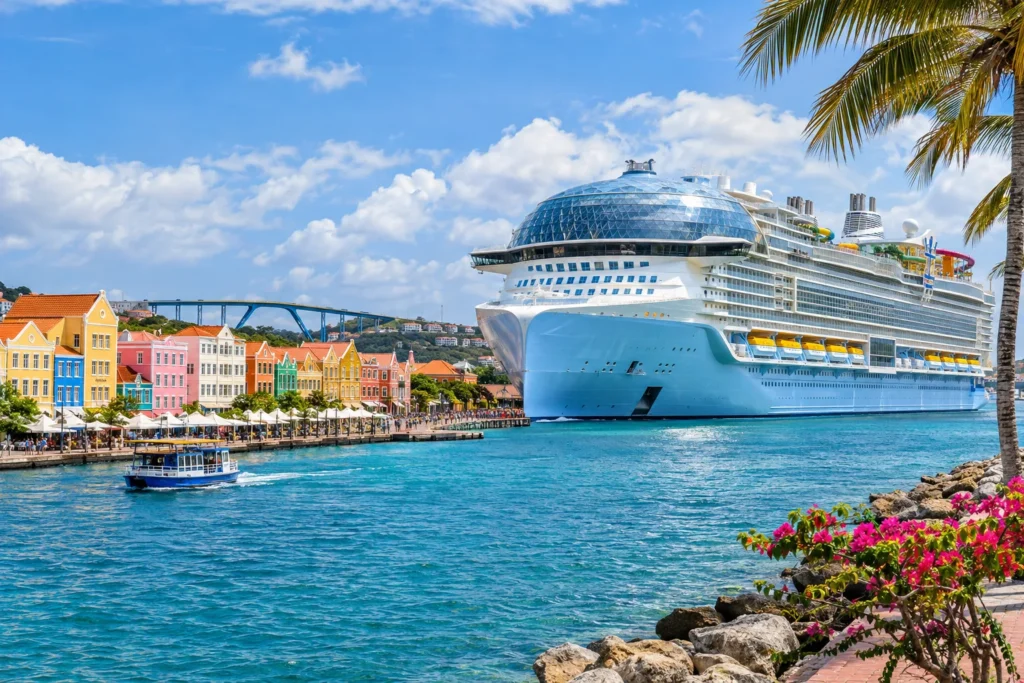
Curaçao cruise tourism is gearing up for a landmark chapter in maritime travel as port authorities prepare to welcome one of the largest passenger vessels ever engineered. On Tuesday, November 17, 2026, Royal Caribbean International’s massive liner, Legend of the Seas, is scheduled to make its inaugural port of call at the historic harbour of Willemstad. The scheduled docking marks the very first time an Icon Class vessel will navigate into Curaçao’s waters, highlighting the Southern Caribbean island’s expanding maritime capabilities and strengthening its position among premier Caribbean cruise destinations.
The arrival of next-generation mega cruise ship arrivals represents an important structural advancement for the Dutch Caribbean territory. Official destination reports compiled by the Curaçao Tourist Board and maritime logistics registers maintained by the Curaçao Ports Authority emphasize that cruise visitors form a major economic catalyst for local enterprise. With modern vessels expanding in scale and passenger capacity, regional port infrastructure has evolved to accommodate deeper drafts, wider beams, and rapid transit for thousands of international holidaymakers visiting the capital simultaneously.
Engineering Feat: The Arrival of the Icon Class Generation
The Icon Class is widely recognized across global maritime transportation as an architectural revolution in oceanic vacation design. Legend of the Seas ranks as the third commissioned vessel within this elite category, following its sister ships Icon of the Seas and Star of the Seas. Measuring roughly 365 metres in length and registering an immense gross tonnage of approximately 250,800, the vessel stands among the most formidable floating resorts ever constructed.
The ship is designed to transport approximately 5,600 passengers based on double-occupancy configurations, with maximum guest volume extending beyond 7,000 visitors alongside an international operating crew exceeding 2,000 professionals. Conceived as a multi-district oceanic complex, the ship features dedicated zones offering sprawling open-air water attractions, diverse global culinary venues, expansive family leisure centres, and multiple swimming facilities. The arrival of such a high-capacity vessel brings unprecedented single-day visitor volume directly to the entrance of Willemstad’s Santa Anna Bay.
Elevating the Local Visitor Economy and Merchant Community
According to official economic performance benchmarks from the Ministry of Economic Development and the Curaçao Tourist Board, tourism delivers billions of dollars in direct and indirect economic contributions to the island annually. Cruise ship passenger spending provides direct financial stimulus to independent merchants, artisanal markets, culinary establishments, cultural museums, and licensed ground transportation operators across the UNESCO World Heritage-listed historic district of Willemstad.
When an ultra-capacity vessel drops anchor, several thousand guests disembark into the harbourfront quarters of Punda and Otrobanda within hours. Passengers explore local architectural monuments, arrange guided nature excursions to coastal national parks, patronize duty-free retail boutiques, and sample regional Afro-Caribbean culinary traditions. Tour operators, water sports enterprises, and heritage attractions across the island experience immediate commercial benefits, reinforcing the role of maritime tourism as a major source of municipal employment.
Strengthening Southern Caribbean Cruise Corridors
The integration of Curaçao into high-profile itineraries operated by the world’s leading cruise lines underscores the destination’s strategic geographic advantage. Situated safely outside the primary Atlantic hurricane belt, the ABC islands—comprising Aruba, Bonaire, and Curaçao—provide dependable, year-round maritime access and tranquil waters that make them exceptionally attractive to international cruise planning committees.
Port investments overseen by the Curaçao Ports Authority have focused heavily on modernizing mega-berth terminals, upgrading deep-water quayside utilities, and ensuring swift, secure customs logistics for visiting passengers. By proving its operational capacity to handle the world’s most massive passenger ships, Curaçao demonstrates that its harbour facilities meet the rigorous technical and logistical demands imposed by cutting-edge commercial shipping.
A Spectacle for Residents, Enthusiasts, and Visitors Alike
The entry of Legend of the Seas into the port of Willemstad is expected to draw substantial crowds along the coastal boulevards, the Queen Emma pontoon bridge, and historical defensive ramparts overlooking the channel. The sight of a floating city gliding past the colourful 18th-century Dutch colonial facades of the Handelskade creates an iconic visual contrast between centuries-old maritime heritage and state-of-the-art twenty-first-century nautical engineering.
Local maritime circles and tourism advocates anticipate that this inaugural voyage will pave the way for recurring deployments of ultra-large vessels during subsequent peak winter sailing seasons. As global leisure travelers continue to seek immersive Caribbean adventures aboard revolutionary ocean liners, Curaçao’s successful hosting of the Icon Class confirms the island’s enduring prestige as a resilient, world-class hub for international marine leisure.
For more travel news like this, keep reading Global Travel Wire