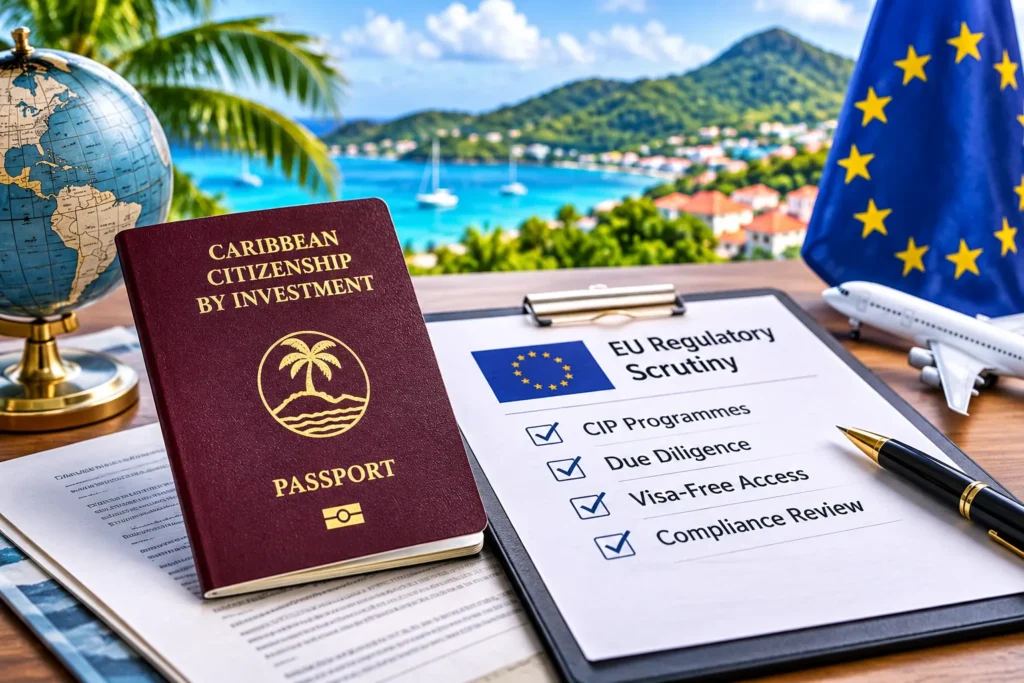
International mobility frameworks for global investors and frequent travelers are undergoing significant regulatory scrutiny as 2027 approaches. Official policy communications from the European Commission, alongside ministerial statements from Eastern Caribbean governments, indicate that long-standing visa-free travel privileges tied to Caribbean citizenship by investment programs are entering a decisive phase of diplomatic negotiation. For internationally mobile families, business owners, and retirees, evolving border rules across Europe and North America are reshaping strategic planning around second passports and residency options.
European Commission Seeks Phase-Out of Investor Citizenship Programs by June 2028
The primary catalyst behind the shifting landscape is a strengthened European Union regulatory framework governing short-stay visa waivers. Under Regulation (EU) 2025/2441, which entered into force on December 30, 2025, the European Union expanded its Visa Suspension Mechanism to explicitly designate the operation of investor citizenship schemes—programs that grant nationality without a genuine residential link to the issuing state—as formal grounds for suspending visa-free access to the Schengen Area.
Following its Eighth Visa Suspension Mechanism Report, the European Commission sent formal correspondence on June 25, 2026, to the five Eastern Caribbean nations operating citizenship by investment programs: Antigua and Barbuda, Dominica, Grenada, Saint Kitts and Nevis, and Saint Lucia. According to official government disclosures from Antigua and Barbuda, Dominica, and Saint Lucia, the European Commission requested that participating jurisdictions transition away from citizenship by investment programs by June 1, 2028, in order to preserve Schengen visa-free travel for their citizens. Brussels also requested interim measures, including the exclusion of individuals subject to European Union sanctions and reinforced security vetting across all applicant nationalities.
Eastern Caribbean Governments Advance Regional Oversight and Dialogue
In response to European regulatory pressure, Eastern Caribbean leaders have emphasized both the economic necessity of investment migration revenues—which fund public infrastructure, climate resilience, and national development—and their commitment to international security standards. Following a joint summit in Roseau, Dominica, in July 2026, regional heads of government issued a coordinated statement calling for balanced, negotiated solutions rather than unilateral program closures.
To address international compliance concerns, the five Eastern Caribbean states established the Eastern Caribbean Citizenship by Investment Regulatory Authority (ECCIRA), headquartered in Grenada and operational from late 2026. This regional regulatory body enforces harmonized baseline investment thresholds starting at 200,000 US dollars, mandatory applicant interviews, biometric data collection, a shared registry of rejected applicants, and proposed physical presence requirements. By mid-November 2026, governments including Saint Lucia confirmed submitting formal diplomatic responses to Brussels ahead of the European Commission’s upcoming December 2026 monitoring assessment. Crucially, all five programs remain open, and citizens of these nations continue to enjoy visa-free short stays of up to 90 days within any 180-day period across the Schengen Area while negotiations proceed.
Tighter United States Entry Rules and European Residency Shifts
Beyond European visa-waiver reviews, broader international border policies are altering how global travelers evaluate second nationality options. In the United States, a presidential proclamation signed in December 2025 and effective January 1, 2026, introduced partial visa and entry restrictions affecting nationals of several countries, explicitly citing citizenship by investment concerns in the case of Antigua and Barbuda. While Grenada, Saint Kitts and Nevis, and Saint Lucia were not included on that restriction list, the policy highlighted how bilateral security assessments can directly impact travel utility.
Simultaneously, European Union member states have tightened their own domestic investment migration frameworks. Following rulings by the Court of Justice of the European Union against direct investor citizenship schemes, member states have phased out passport-by-investment models and reformed golden visa residency programs—eliminating passive real estate routes in several jurisdictions in favor of productive capital investments, research contributions, or physical residency commitments.
Alternative Pathways for Global Travelers and Investors
As international border authorities place greater emphasis on genuine residential ties, standardized biometric screening, and multi-jurisdictional due diligence, prospective applicants are diversifying their mobility strategies. Rather than relying solely on rapid citizenship acquisition for visa-free transit, internationally mobile families are increasingly evaluating European residency-by-investment programs that provide direct legal residence rights within the Schengen Area, alongside long-term multi-entry business visas and digital nomad permits offered by national tourism and interior ministries worldwide.
As diplomatic discussions between Brussels and Eastern Caribbean capitals continue into 2027, official government advisories underscore that existing citizenships remain legally valid, while future short-stay travel privileges will depend on the outcome of ongoing regulatory negotiations.
For more travel news like this, keep reading Global Travel Wire