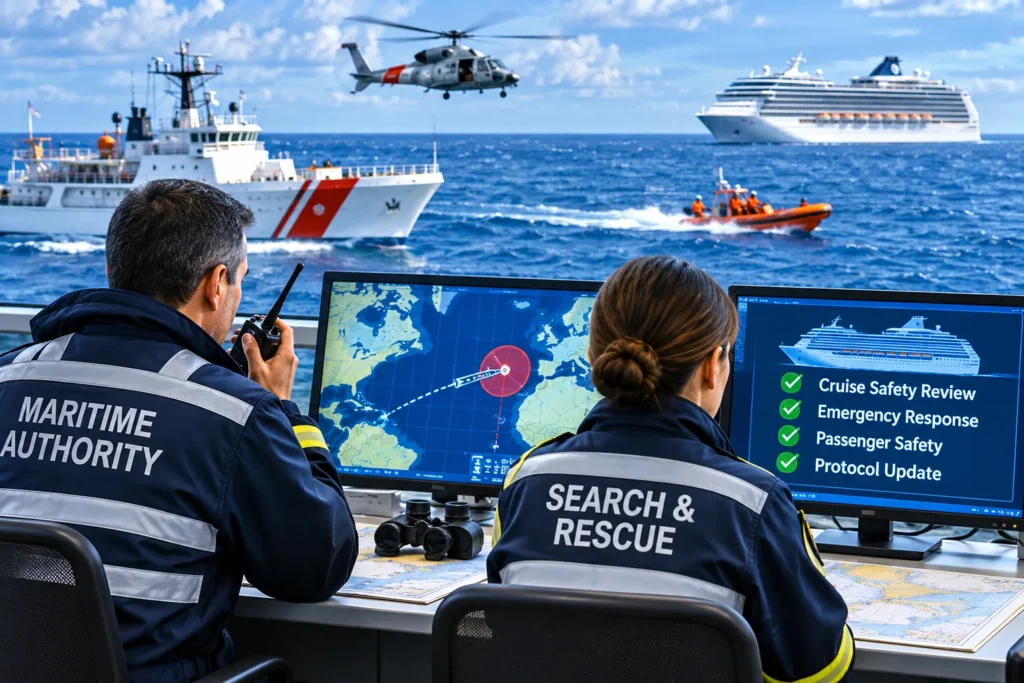
International maritime search and rescue authorities have concluded active open-ocean search efforts following the disappearance of a 72-year-old British passenger during a transatlantic voyage from Malaga, Spain, to the Caribbean. Official operational summaries released by the United States Coast Guard East District command center outline the multi-agency coordination required across remote Atlantic waters while highlighting critical operational realities governing long-distance passenger shipping and maritime cruise safety.
Chronology of the Mid-Atlantic Search and Rescue Coordination
According to official statements from the United States Coast Guard, watchstanders at the East District command center received a missing-person notification from the cruise vessel Marella Voyager at approximately 7:33 p.m. on Tuesday, November 10, 2026. The ship, operated by Marella Cruises, was conducting a scheduled transatlantic repositioning crossing carrying roughly 2,000 passengers and 800 crew members from southern Spain toward Caribbean ports of call.
Shipboard operational logs shared with rescue authorities indicated that the passenger’s absence was identified during routine stateroom housekeeping inspections after staff discovered her cabin and bed untouched. Crew members immediately initiated onboard missing-person protocols, conducting a vessel-wide search and passenger muster verification. Electronic cabin door access records established that the passenger’s last confirmed activity occurred around midday on Monday, November 9.
Because more than 24 hours had elapsed between the last recorded cabin entry and the formal alert to maritime authorities, the vessel had traveled approximately 500 nautical miles beyond the geographic coordinates where the passenger was presumed to have entered the water. Furthermore, vessel command reported to rescue coordinators that the ship lacked sufficient fuel reserves to reverse course across 500 nautical miles of open ocean and still safely reach its designated Caribbean port.
Multi-Agency International Maritime Response
Given the remote mid-Atlantic location of the incident, United States Coast Guard watchstanders activated cross-border maritime rescue protocols. Command centers coordinated directly with the Maritime Rescue Coordination Center Delgada in the Azores, Portugal, alongside the Joint Rescue Coordination Center in the United Kingdom. Rescue authorities issued urgent automated maritime safety broadcasts instructing all commercial merchant vessels and ships transiting the North Atlantic corridor to maintain heightened visual lookouts and report any sightings.
Following an exhaustive assessment of operational variables, the United States Coast Guard formally suspended active search efforts at 3:47 p.m. on Wednesday, November 11, 2026, pending any new factual developments. Official factors cited in the suspension decision included the vast geographic expanse of the drift area, the significant time elapsed prior to notification, the absence of dedicated aerial or surface rescue assets within range of the mid-ocean coordinates, prevailing Atlantic sea states, negative responses from regional merchant vessel broadcasts, and the low probability of survival in open-ocean conditions.
Regulatory Standards and Passenger Safety Protocols in Cruise Tourism
The incident underscores the strict international regulatory frameworks governing passenger vessels operating on long-haul ocean routes. Under the International Maritime Organization’s International Convention for the Safety of Life at Sea (SOLAS) and national maritime legislation—such as the United States Cruise Vessel Security and Safety Act—passenger ships are subject to rigorous structural, operational, and reporting mandates.
These maritime regulations require minimum railing heights across accessible exterior decks, standardized emergency muster procedures, mandatory bridge reporting of overboard incidents to the nearest Maritime Rescue Coordination Center, and the deployment of automated overboard detection technologies where mandated. In contrast to coastal incidents—such as a recent October 2026 rescue in the Ionian Sea near Zakynthos, Greece, where immediate detection and proximity to coastal patrol craft enabled a successful recovery after nearly 20 hours—mid-ocean crossings present unique logistical challenges due to vast distances from shore-based aviation and patrol stations.
Diplomatic Support and Ongoing Inquiries
Official consular representatives from the United Kingdom Foreign, Commonwealth and Development Office confirmed they are providing direct assistance to the family of the missing British national while remaining in contact with international maritime authorities. As the vessel continues its scheduled Caribbean itinerary toward Antigua, Dominica, and Barbados, maritime safety agencies and port state authorities are reviewing vessel logs and electronic access records in accordance with standard international marine investigation procedures.
For more travel news like this, keep reading Global Travel Wire