India’s maritime leisure sector has reached a major operational milestone as domestic passenger shipping expands into dual-homeport sailing across the Arabian Sea and the Indian Ocean. Official operational releases from Waterways Leisure Tourism Limited—the operator of Cordelia Cruises—confirm the launch of concurrent two-ship operations featuring Cordelia Sky sailing from Mumbai and Cordelia Empress homeported in Kochi. This private-sector fleet expansion aligns directly with national maritime policy under the Government of India’s Cruise Bharat Mission, which aims to position the country among the world’s premier cruise destinations by 2029.
Concurrent Sailings from Mumbai and Kochi Expand Passenger Capacity
According to official corporate disclosures, dual-vessel operations officially commenced following a coordinated Mumbai port turnaround on October 23, 2026, during which nearly 6,000 guests embarked and disembarked across both vessels. By establishing simultaneous homeports in Maharashtra and Kerala, the operator has significantly broadened regional accessibility for travelers across western and southern India while increasing total berth capacity along key coastal corridors.
Deployed out of Mumbai, Cordelia Sky accommodates up to 2,280 guests across 1,002 staterooms, encompassing 245 Mini Suites, 11 Penthouse Suites, and four Chairman’s Suites. The vessel combines international resort infrastructure—including multiple specialty restaurants, theatrical production venues, wellness centers, and open-deck leisure facilities—with culturally tailored programming featuring Indian gastronomy and live Bollywood entertainment. From Mumbai, the ship operates two- and three-night weekend voyages alongside four- and five-night coastal itineraries connecting Mumbai, Goa, and the Lakshadweep archipelago.
Simultaneously, Cordelia Empress has initiated its seasonal deployment from Kochi, serving southern Indian catchment areas with short coastal getaways, three- and four-night Lakshadweep sailings calling at Kavaratti and Minicoy, and five-night international voyages linking Kochi with Malé in the Maldives and Colombo in Sri Lanka. Corporate filings also confirm plans to introduce a third vessel, Cordelia Sun, in 2027 to further expand regional maritime capacity.
Cruise Bharat Mission Anchors National Maritime Infrastructure Growth
The expansion of domestic cruise fleets reflects sustained policy support from the Ministry of Ports, Shipping and Waterways. Launched on September 30, 2024, the Cruise Bharat Mission provides a structured five-year roadmap through March 31, 2029, designed to modernize port terminals, develop dedicated marinas, streamline immigration and customs clearance, and integrate regional cruise circuits across the Indian Subcontinent.
Official statistics released by the Ministry of Ports, Shipping and Waterways in November 2026 underscore the sector’s upward trajectory. During the 2025–26 fiscal year, Indian ports recorded 462,661 ocean cruise passengers and 212 cruise vessel calls—representing a 5.5-fold increase in passenger traffic and a 2.1-fold rise in vessel calls compared to 2013–14 levels. Under the phased benchmarks of the Cruise Bharat Mission, the government aims to double annual ocean cruise traffic to one million sea-cruise passengers and 500 vessel calls by March 2029, alongside expanding inland river cruise traffic across National Waterways to 1.5 million passengers and generating approximately 400,000 direct and indirect jobs.
Port Modernization and Coastal Connectivity Drive Demand
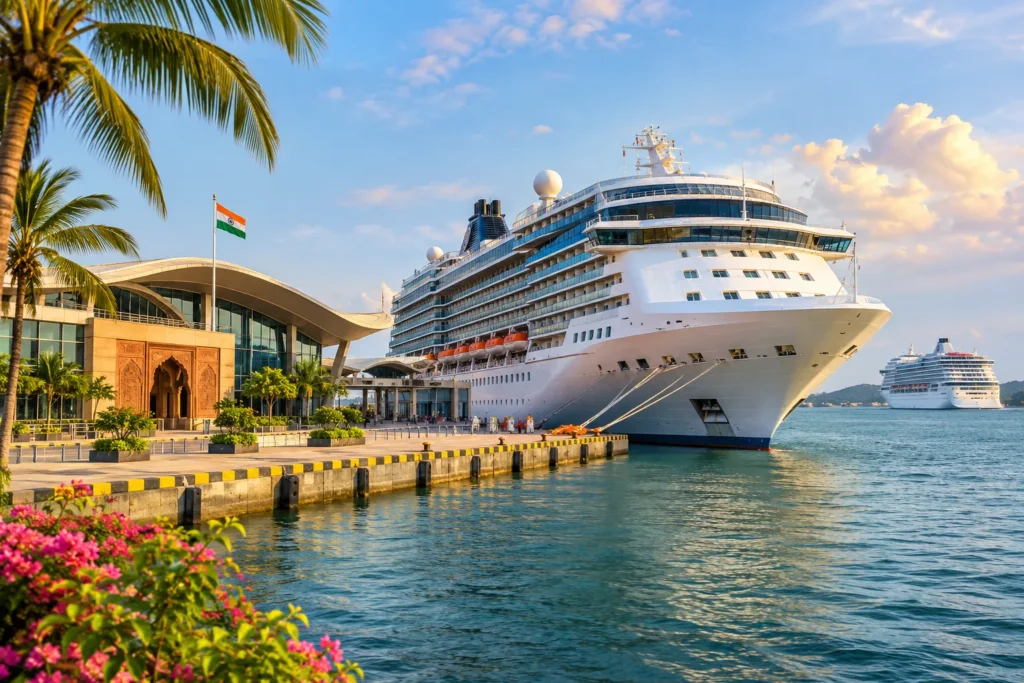
To accommodate larger ocean liners and multi-ship turnaround operations, major Indian port authorities have invested heavily in dedicated passenger infrastructure. International cruise terminals in Mumbai, Kochi, Goa, New Mangalore, Chennai, and Visakhapatnam have undergone capacity upgrades, complemented by newly announced coastal projects such as the planned Puri International Cruise Terminal in Odisha being developed by the Paradip Port Authority in partnership with the state government.
For domestic and international travelers, the availability of structured sea itineraries departing directly from Indian ports eliminates the need for long-haul international flights to experience full-scale ocean cruising. As terminal modernization, simplified e-visa facilitation for international cruise passengers, and multi-homeport fleet deployments converge, India’s coastline is rapidly evolving into a competitive year-round hub for regional maritime tourism.
For more travel news like this, keep reading Global Travel Wire