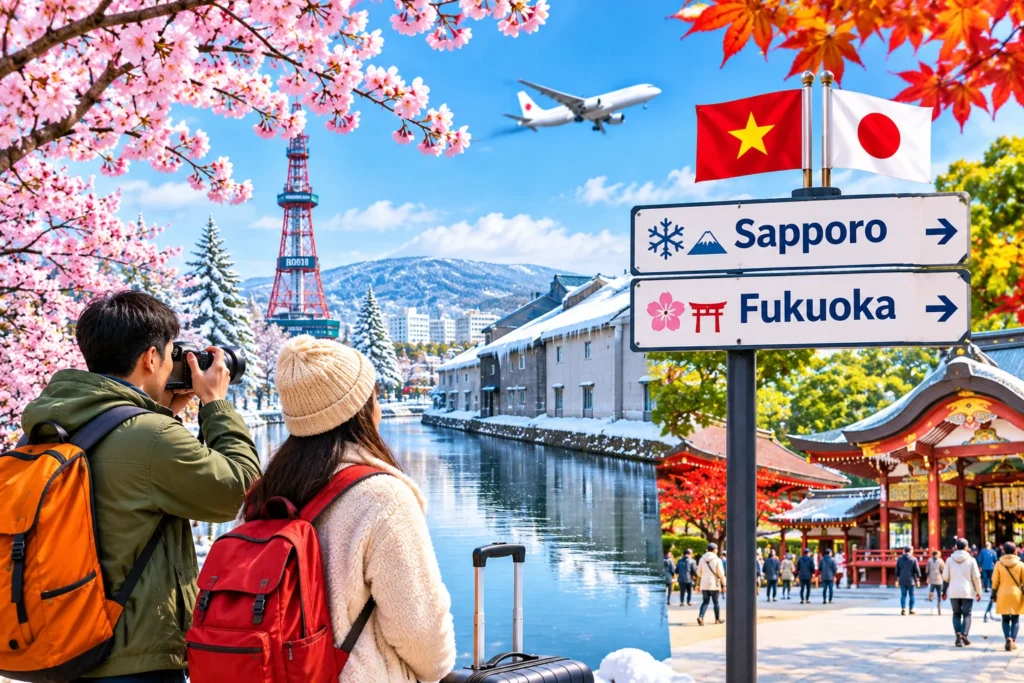
Bilateral travel exchanges between Vietnam and Japan are achieving remarkable momentum in 2026, underscored by a roughly 70 percent surge in third-quarter flight demand to the regional Japanese hubs of Sapporo and Fukuoka. Despite visa application procedures and higher relative travel budgets, Vietnamese holidaymakers continue to prioritize Japan for its accessible short-haul flight times, reliable public transit infrastructure, seasonal landscapes, and celebrated culinary heritage. At the same time, official statistics confirm that inbound Japanese arrivals to Vietnam have maintained steady double-digit growth throughout the year, reinforcing one of East Asia’s most resilient two-way tourism corridors.
Official Statistics Highlight Strong Bilateral Visitor Flows
According to official figures published by Vietnam’s National Statistics Office and the Vietnam National Authority of Tourism, Vietnam welcomed more than 757,000 Japanese visitors during the first ten months of 2026. That ten-month total already represents approximately 93 percent of the entire 814,000 Japanese arrivals recorded across all of 2025, marking an 11.6 percent increase compared with the same ten-month period a year earlier. In October 2026 alone, Vietnam received over 83,000 Japanese travelers, reflecting a 36 percent year-on-year jump and placing Japan sixth among Vietnam’s largest international source markets and fourth in overall arrival growth.
Outbound travel from Vietnam to Japan demonstrates similarly robust expansion. Official annual data from the Japan National Tourism Organization confirms that Japan welcomed a record 678,500 Vietnamese visitors in 2025, an increase of 9.2 percent over 2024 and approximately 37 percent higher than pre-pandemic 2019 figures. Combined bilateral tourist arrivals between the two nations reached nearly 1.5 million travelers in 2025, supported by elevated diplomatic cooperation under the Viet Nam–Japan Comprehensive Strategic Partnership and coordinated destination promotion campaigns.
Sapporo and Fukuoka Emerge as Leading Regional Favorites
While major metropolitan centers such as Tokyo, Osaka, and Kyoto remain perennial anchors for first-time visitors, aggregated aviation and accommodation booking trends for the third quarter of 2026 reveal a clear diversification toward regional Japanese destinations. Flight demand from Vietnam to both Sapporo and Fukuoka climbed by approximately 70 percent compared with the same quarter last year, reflecting growing appetite for cooler northern climates, scenic national parks, and regional gastronomy.
In northern Japan, Sapporo—the capital of Hokkaido—continues to draw Vietnamese visitors across all four seasons. Travelers gravitate toward the city’s renowned winter Snow Festival, vibrant autumn foliage, fresh seafood markets such as Nijo Market, and signature miso ramen. Meanwhile, on the southern island of Kyushu, Fukuoka has gained prominence through targeted destination showcases highlighting its open-air yatai street food stalls in the Tenjin and Nakasu districts, tranquil lakeside paths at Ohori Park, and coastal seafood dining in nearby Itoshima. Hospitality demand across other regional Japanese cities also expanded notably in the third quarter, with hotel bookings in Nagoya more than doubling and accommodation demand in Kyoto increasing more than 1.5 times year-on-year.
Broader East Asia Outbound Tourism Gains Momentum
Alongside Japan, neighboring destinations across East Asia—particularly China and South Korea—continue to capture strong demand from Vietnamese outbound travelers. Aggregated third-quarter travel sector indicators show substantial year-on-year increases in flight and accommodation bookings across key Chinese cultural and urban gateways, supported by expanded direct air connectivity between Vietnam and regional Chinese airports.
Hangzhou stood out among East Asian destinations during the third quarter, with flight bookings nearly tripling and hotel reservations more than doubling compared with the third quarter of 2025. Anchored by the scenic West Lake Cultural Landscape, a designated UNESCO World Heritage Site famed for its classical gardens, historic pagodas, and tea culture, Hangzhou has benefited directly from newly launched air routes linking Vietnamese cities with eastern China. Beijing recorded similarly strong performance, with flight demand more than doubling and hotel bookings climbing by nearly 50 percent year-on-year as travelers seek immersive historical monuments alongside modern urban experiences.
Together, the sustained rise in bilateral arrivals between Vietnam and Japan and the rapid expansion of regional flight demand across East Asia illustrate the maturing preferences of Vietnamese travelers. Supported by joint tourism authority initiatives, expanding aviation capacity, and rising interest in authentic cultural and culinary exploration, regional travel across Northeast and Southeast Asia remains firmly on an upward trajectory heading into the final quarter of 2026.
For more travel news like this, keep reading Global Travel Wire