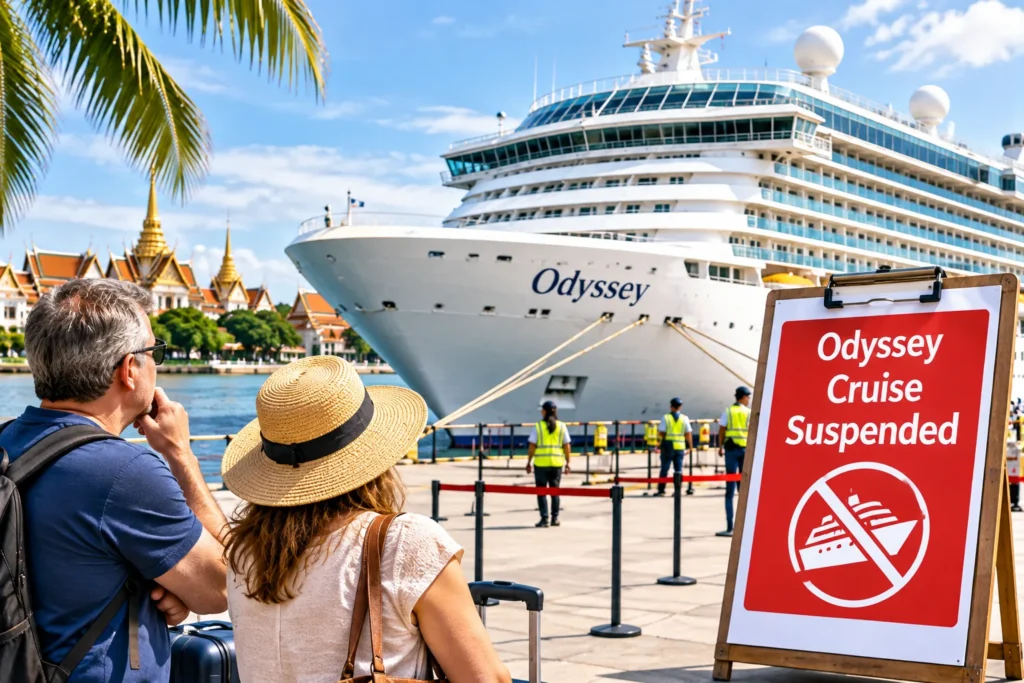
Residential cruise travel has entered a pivotal moment of scrutiny across the international maritime tourism sector following the abrupt operational suspension of the passenger vessel Odyssey in Cambodia and its subsequent judicial arrest in Singapore. Marketed as a multi-year floating community offering extended port stays and slow-paced global exploration for retirees and remote professionals, the voyage came to an unexpected halt in late October 2026 when operator Villa Vie Residences announced it could no longer sustain escalating marine fuel costs.
According to official port disclosures from Cambodia’s Sihanoukville tourism department and Singapore’s Maritime and Port Authority, more than 200 onboard residents were instructed to disembark at the Cambodian port of Sihanoukville within hours after operations were suspended on October 27, 2026. The vessel subsequently departed Cambodia on November 4 with roughly 50 crew members and no passengers aboard, arriving in Singapore where it was placed under formal court-ordered arrest at Changi General Purpose Anchorage on November 8, 2026.
Operational Pressures and Soaring Marine Fuel Expenses
Public statements issued by the operator and maritime port authorities highlight the severe financial vulnerabilities inherent in fixed-fee, multi-year cruise models. Unlike conventional seven-to-fourteen-day ocean voyages where ticket pricing adjusts dynamically to seasonal demand and bunker fuel surcharges, residential cruise programs typically lock in multi-year suite purchases or fixed monthly maintenance fees well in advance.
In official operational notices explaining the suspension, Villa Vie Residences stated that monthly fuel expenses per cabin had surged dramatically—climbing from an average of $1,800 per month at launch in 2024 to between $6,000 and $8,000 per month across Asian waters in 2026 amid geopolitical disruptions in the Middle East and elevated global marine fuel markets. Compounding those operating costs, the vessel had originally launched from Belfast, Northern Ireland, in October 2024 following a four-month technical delay and operated well below its full 650-passenger residential capacity, leaving fewer monthly fee contributors to absorb fixed port, crew, and propulsion expenses.
Port Authority Response and Maritime Legal Proceedings
Local tourism and maritime authorities in both Cambodia and Singapore moved quickly to monitor passenger welfare and crew safety as legal proceedings unfolded. In Sihanoukville, provincial tourism officials confirmed that approximately 100 disembarked residents remained temporarily in Cambodia while coordinating onward flights and regional accommodations, while others traveled independently to neighboring Southeast Asian destinations.
In Singapore, the Maritime and Port Authority confirmed in an official statement that the Odyssey was detained pursuant to a Singapore High Court admiralty arrest order filed by secured creditors. Port authorities noted that no passengers remained aboard during the detention and verified that the vessel’s crew members were safe and well, with arrangements for crew salaries and onboard welfare assumed by the ship’s creditors while court proceedings determine whether the vessel will be released or sold via judicial auction.
Lessons for Long-Term Maritime Tourism and Consumer Protection
The Odyssey’s sudden halt underscores the stark contrast between established global cruise operators and niche residential start-ups. While traditional ocean and river cruise lines operate under strict financial bonding, passenger repatriation insurance, and transparent regulatory oversight across major maritime jurisdictions, emerging multi-year residency ventures often rely heavily on upfront cabin sales and ongoing capital infusions to fund daily operations.
For travelers drawn to the appeal of slow travel—uninterrupted coastal exploration without repetitive airport transfers, hotel check-ins, or constant packing—the incident serves as a sobering reminder to evaluate operator liquidity, escrow protections, and maritime flag-state safeguards before committing life savings or selling primary residences. As port authorities and admiralty courts in Singapore oversee the next phase of the Odyssey’s disposition, international tourism regulators continue to emphasize consumer transparency and financial resilience across all segments of passenger shipping.
For more travel news like this, keep reading Global Travel Wire