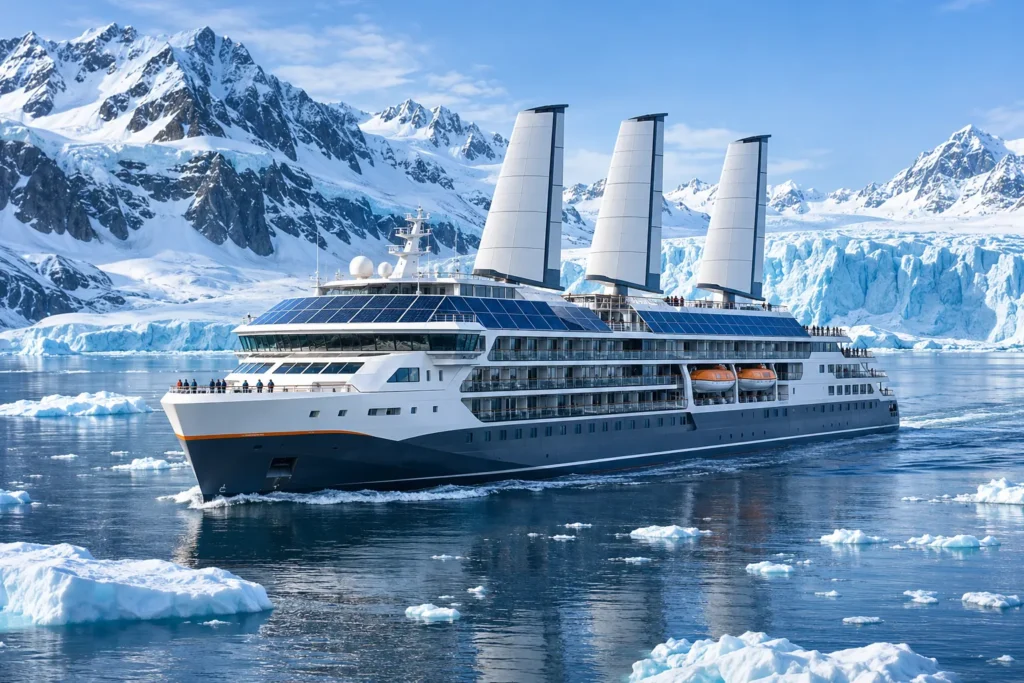
As polar travel attracts unprecedented international demand, Arctic destinations and maritime regulators are scrutinizing how expedition vessels interact with fragile ecosystems and remote northern communities. According to official tourism monitoring by Visit Svalbard and Norway’s Ministry of Trade, Industry and Fisheries, strict environmental regulations—including heightened limits on heavy fuel oil, vessel emissions, and shore landing group sizes in protected fjords—are actively reshaping polar expedition operations across the High North. Against this backdrop, French polar cruise company Selar is preparing to introduce a radically different model for sustainable Arctic cruises when its inaugural vessel, Captain Arctic, enters service in early 2027.
Founded and led by French-Swedish polar captain and ice pilot Sophie Galvagnon alongside co-founders Julia Bijaoui and Quentin Vacher, Selar was conceived to address two fundamental challenges facing conventional polar cruising: the disruption caused by large passenger crowds in small settlements and the carbon footprint of traditional diesel-powered expedition ships.
Smaller Scale Fosters Authentic Cultural Exchange on Shore
For Galvagnon, who has spent years navigating polar waters as an expedition captain, the case for building a markedly smaller ship begins on land rather than at sea. When vessels carrying several hundred passengers disembark into remote coastal villages across northern Norway, Svalbard, or Greenland, the sheer logistics of managing large crowds frequently overshadows genuine cultural interaction.
Galvagnon has emphasized that meaningful exchange and authentic human contact become nearly impossible when visitors arrive en masse. By limiting capacity aboard Captain Arctic to just 36 passengers supported by 24 crew members, Selar ensures that shore excursions remain intimate, unhurried, and respectful of local infrastructure. Rather than adhering to rigid, pre-packaged port schedules, voyages are designed dynamically around prevailing winds, sea ice conditions, and wildlife activity, allowing extended shore landings, guided hikes, kayaking, and ski touring without overwhelming delicate tundra habitats.
Five Rigid Solar Sails Pioneer Low-Emission Polar Navigation
Beyond its human-scale capacity, Captain Arctic distinguishes itself through clean propulsion engineering tailored specifically for polar conditions. Measuring approximately 70 meters in length with a Polar Class 7 (PC7) ice-strengthened hull, the vessel underwent sea trials off Mauritius in November 2026 following hull construction and specialized outfitting ahead of its 2027 inaugural Arctic season.
Instead of conventional fabric rigging, Captain Arctic features five 35-meter rigid aluminum wing sails capable of rotating 180 degrees to capture shifting Arctic winds and folding down smoothly when entering port. Nearly 2,000 square meters of solar photovoltaic modules are integrated directly across the surfaces of the rigid sails, converting polar sunlight into electrical energy stored within onboard battery banks.
By pairing wind propulsion with solar energy storage and efficient auxiliary hybrid systems, Selar aims to reduce carbon dioxide emissions by up to 90 percent compared with conventional expedition vessels operating on similar polar routes. While real-world performance will be closely monitored across its maiden 2027 deployments, the hybrid wind-and-solar architecture directly supports emerging maritime decarbonization standards enforced across Norwegian World Heritage fjords and Arctic conservation zones.
Expedition Experience Built Around Discovery and Environmental Stewardship
Life aboard Captain Arctic reflects the same philosophy of purposeful simplicity and scientific engagement. Designed with Scandinavian-inspired interiors, the vessel features 18 outward-facing guest cabins, an observation lounge with panoramic forward windows, a library, a sauna with an outdoor cold plunge, and a dedicated 15-square-meter onboard science lab where expedition specialists and visiting researchers conduct environmental monitoring alongside guests.
Selar’s 2027 expedition calendar spans 14 curated departures across northern Norway, the Lofoten archipelago, Tromsø, Svalbard, and Greenland. Seasonal itineraries range from winter voyages focused on observing orcas and the Aurora Borealis in Norwegian fjords to high-summer expeditions exploring glaciers and polar wildlife under Svalbard’s midnight sun. By combining small-group exploration, renewable propulsion, and flexible wind-guided routing, Selar illustrates how next-generation operators are aligning sustainable Arctic cruises with the environmental and cultural realities of the modern polar frontier.
For more travel news like this, keep reading Global Travel Wire