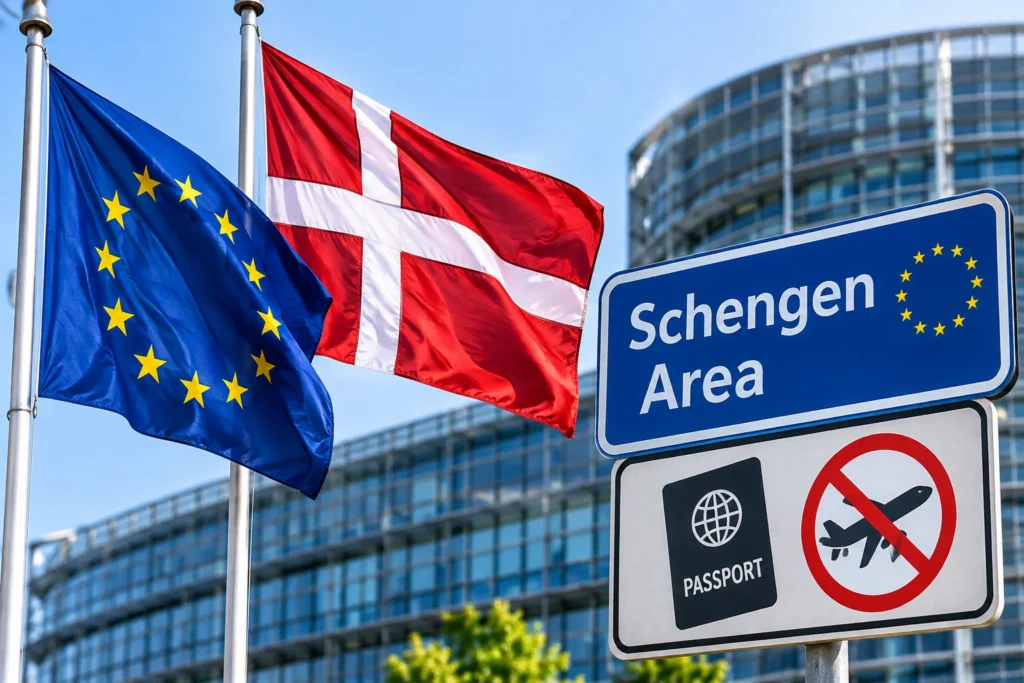
European border policy and cross-border mobility across the 29-nation Schengen free travel zone face major potential changes after Denmark formally urged fellow European Union member states to adopt unified, stricter entry rules for Russian nationals. Circulated to senior European diplomats in a formal government memorandum ahead of a scheduled meeting of EU ambassadors in Brussels, the Danish proposal calls for suspending tourist visas for Russian citizens and ending recognition of Russian non-biometric passports across the entire European bloc.
The diplomatic initiative follows an announcement by Danish police, security officials, and the Ministry of Foreign Affairs that authorities averted an alleged assassination plot orchestrated by Russian intelligence services in September 2026. According to official statements from Danish law enforcement and prosecutors, suspects acting on behalf of foreign intelligence were intercepted while heading toward a concert venue north of Copenhagen, preventing a planned attack on a visiting US-Ukrainian musical performer prior to the show.
Speaking on the security incident, Danish Foreign Minister Lars Løkke Rasmussen condemned the plot as an unacceptable transgression and announced the expulsion of Russia’s defence attaché from Copenhagen, alongside summoning the Russian ambassador to the Foreign Ministry. In response, the Russian Embassy in Copenhagen issued an official statement rejecting Denmark’s allegations and maintaining that the accusations were unsupported by evidence.
Key Measures Proposed for the Schengen Free Travel Zone
In its memorandum distributed to European capitals, the Danish government argued that individual national entry bans and fragmented border controls leave vulnerabilities across Europe’s passport-free travel area. Currently, while several member states—including Denmark, France, Germany, Poland, the Czech Republic, the Baltic states, and the Benelux countries—have already introduced national restrictions on non-biometric Russian passports or tightened visa issuance, rules remain uneven across the wider Schengen zone.
To establish a uniform framework across all participating European nations, Denmark’s diplomatic note outlines four primary measures for immediate consideration by EU ambassadors:
Suspension of Tourist Visas: Halting the issuance of short-stay Schengen tourist visas to Russian citizens across all EU consular missions, effectively closing leisure travel pathways into the bloc.
Non-Biometric Passport Ban: Ceasing bloc-wide recognition of older Russian non-biometric external passports, requiring biometric electronic travel documents for any authorized entry.
Territorially Limited Visas: Expanding the use of restricted-validity visas that permit entry only into the specific issuing member state rather than granting unrestricted movement throughout all 29 Schengen countries.
Stricter Vetting for Military Personnel: Implementing tighter border screening and entry prohibitions for current and former Russian military combatants.
In the official diplomatic note, Danish authorities stated that member states must take concrete actions projecting European strength and decisiveness, urging counterparts to seize the current momentum to replace a patchwork of national rules with a cohesive EU-wide policy.
Broader European Security Strategy and Sanctions Alignment
Denmark’s push to harmonize Schengen travel restrictions coincides with wider security and policy deliberations underway in Brussels. European Commission President Ursula von der Leyen expressed full solidarity with Denmark and all EU member states targeted by hybrid threats, noting that the European Commission will soon unveil a new European Security Strategy designed to reinforce preparedness, border resilience, and deterrence across the continent.
Simultaneously, European Union institutions are preparing additional restrictive measures as part of the bloc’s upcoming 22nd sanctions package, where tighter visa guidelines, cross-border mobility rules, and restrictions affecting international sporting cooperation are under active review by member state representatives.
Implications for European Border Management and International Travel
For the European travel, aviation, and hospitality sectors, a bloc-wide suspension of tourist visas and mandatory biometric passport enforcement would mark one of the most comprehensive adjustments to Schengen entry governance since the EU suspended its visa facilitation agreement with Russia in 2022. Under existing Schengen Border Code rules, once a traveller clears external border control in one participating country, routine passport checks are absent when crossing internal borders between member states.
Consequently, security officials and policymakers in Copenhagen and Brussels have emphasized that uniform consular standards and harmonized document verification at external entry points are essential to maintaining the integrity of internal free movement for European citizens and legitimate international visitors.
As EU ambassadors convene in Brussels to examine the Danish memorandum, tourism authorities, airlines, and border agencies across Europe will closely monitor whether member states reach consensus on transforming national travel restrictions into a unified Schengen-wide framework.
For more travel news like this, keep reading Global Travel Wire