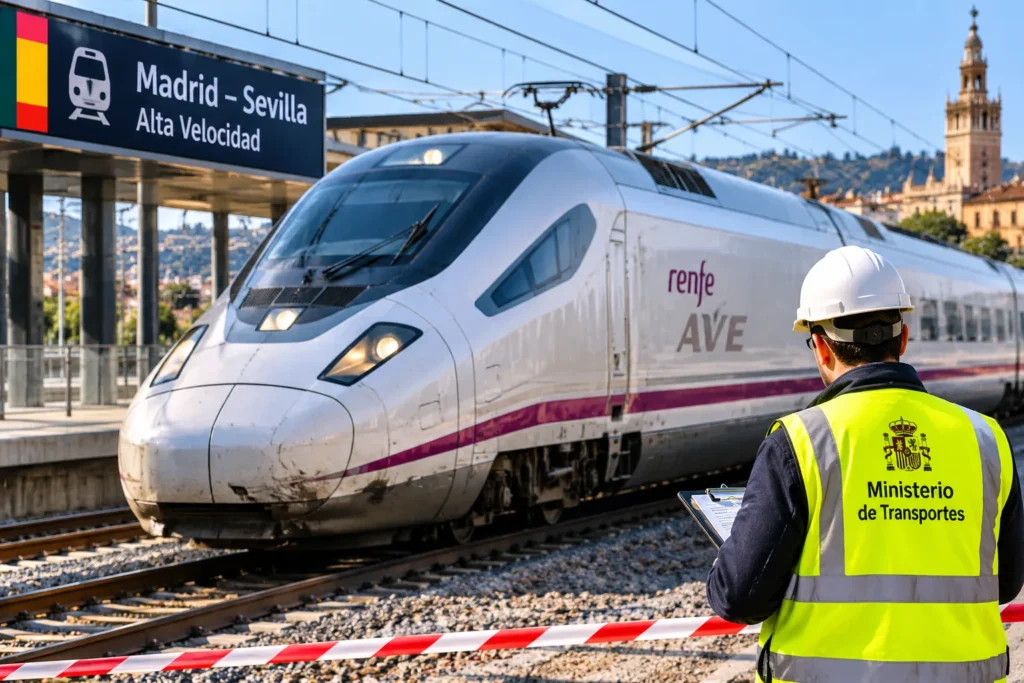
Spain’s Ministry of Transport and Sustainable Mobility has launched a comprehensive technical investigation and introduced stricter operational safeguards along the Madrid–Seville high-speed rail corridor following a deadly collision near Urda in the province of Toledo on October 28, 2026. The accident, which claimed 69 lives and injured more than 200 passengers, occurred at kilometre marker 118 when a southbound Renfe high-speed service collided with the rear of a stationary Iryo train travelling along the same route from Madrid Atocha to Seville Santa Justa.
For domestic commuters and international visitors travelling between central Spain and Andalusia, the Madrid–Seville line serves as one of the country’s primary tourism arteries. Opened in 1992 as Spain’s inaugural high-speed railway, the corridor links major cultural and leisure hubs including Madrid, Córdoba, and Seville, carrying millions of holidaymakers and business travellers annually. Following the collision, rail infrastructure manager Administrador de Infraestructuras Ferroviarias temporarily suspended high-speed services between Madrid and Andalusia while emergency crews, forensic investigators, and engineering teams secured the site and restored track integrity.
Preliminary Ministry Findings on Signalling and Control Procedures
Addressing parliament and official briefings in Madrid, Transport Minister Óscar Puente outlined the preliminary technical findings gathered by railway safety investigators. According to the Ministry of Transport, an automated computer and signalling fault initially brought six moving trains along the corridor to a controlled halt, including both the Iryo service and the following Renfe train.
Under standard railway operating protocols, when an automated signalling system experiences a technical failure, traffic management transfers to central rail controllers in Madrid. Preliminary investigation records indicate that control centre personnel authorized the Renfe train to resume travel without speed restrictions despite the Iryo train remaining stationary on the track ahead. Minister Puente described the authorization order as inexplicable, noting that system displays inside the control centre showed the status of the trains on the line.
The collision marks the second severe railway accident on the Madrid–Seville corridor in 2026. Earlier in January, a derailment and subsequent collision between Renfe and Iryo services near Adamuz in the province of Córdoba resulted in 46 fatalities. Official government statements confirmed that preliminary evidence indicates the January and October incidents stemmed from distinct operational causes, though both have prompted an urgent review of infrastructure modernization and human-factor protocols across Spain’s high-speed network.
Casualty Figures and Emergency Response in Castilla-La Mancha
Official figures verified by the Office of the President of the Government and the Ministry of Transport confirmed 69 fatalities—54 Spanish nationals and 15 international visitors—after reconciliation of initial emergency hospital and forensic reports. Among the deceased, 24 victims were aboard the Renfe train and 45 were aboard the Iryo service.
Emiliano García-Page, President of the regional government of Castilla-La Mancha, detailed the emergency response during official briefings in Toledo. More than 900 Civil Guard personnel, regional firefighters, medical teams, and canine search-and-rescue units were deployed to assist passengers and clear the wreckage. Over 200 people received medical attention, with 58 admitted to regional hospitals and 15 treated for serious injuries. Dedicated family assistance centres were established at railway stations in Madrid, Toledo, Seville, and Córdoba to support affected relatives and international travellers.
New Safety Safeguards and Leadership Accountability
In response to the tragedy, the Ministry of Transport announced immediate procedural reforms designed to strengthen redundancy and restore public confidence in Spain’s railway network. Under the new operational directives:
Dual-Operator Verification: Whenever an automated signalling system is degraded or offline, any manual authorization issued by a rail traffic controller to allow a train to proceed must be independently verified and co-signed by a second controller before transmission.
Accelerated Signalling Rollout: The ministry ordered an expedited transition toward the standardized European Rail Traffic Management System across the Madrid–Seville line to phase out legacy signalling components.
Control Centre Audits: Enhanced staffing standards, technical monitoring protocols, and working condition reviews have been initiated across national rail traffic control centres.
On November 3, 2026, six days after the Urda collision, Transport Minister Óscar Puente announced his resignation during an address to the Congress of Deputies, stating that taking political responsibility was necessary following two major rail tragedies within a single year. Prime Minister Pedro Sánchez accepted the resignation while reaffirming the government’s commitment to full transparency, independent technical investigation, and rigorous enforcement of Spain high-speed rail safety across all national travel corridors.
For more travel news like this, keep reading Global Travel Wire