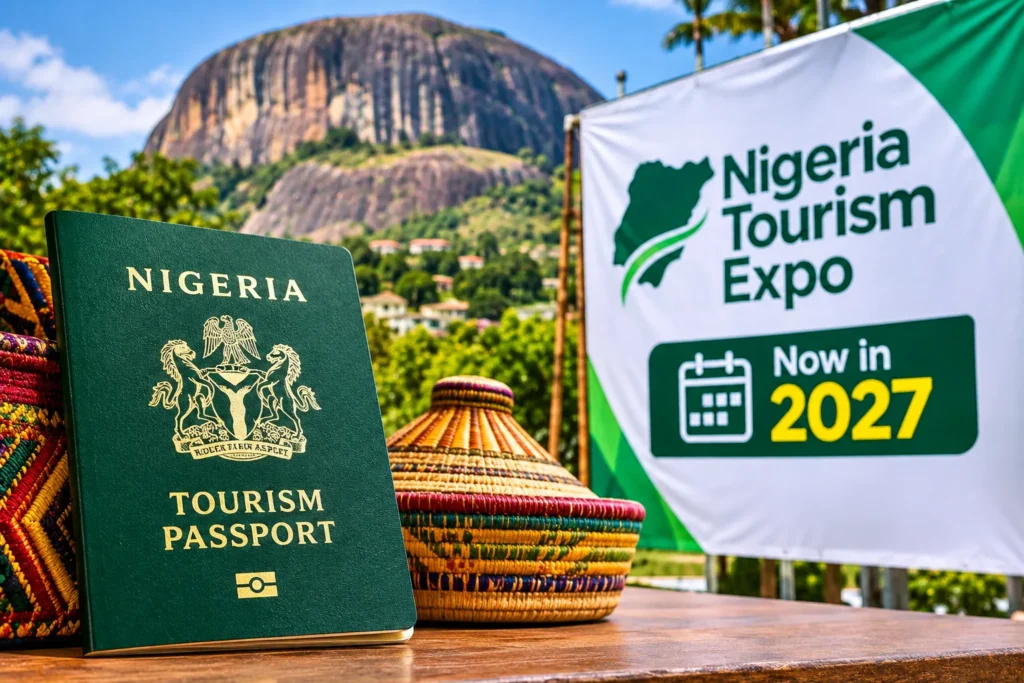
Nigeria’s inaugural national tourism exhibition, originally scheduled to open on November 21 and 22, 2026, has been formally postponed to 2027 following an official announcement by the Nigerian Tourism Development Authority. Confirmed by the agency’s Director-General, Olayiwola Awakan, the rescheduling of the Naija Flavour International Tourism Expo coincides with a parallel institutional clarification regarding official destination branding and the launch of a privately produced tourism brochure.
Together, the postponement of the national trade showcase and the regulatory clarification over who holds statutory authority to issue national tourism instruments underscore ongoing governance questions within Nigeria’s travel and hospitality sector. At the heart of both developments is the balance between federal regulatory mandates and private-sector marketing initiatives aimed at positioning Nigeria as a competitive international destination.
Rationale Behind Rescheduling the Maiden Tourism Expo
In an official statement issued on November 10, 2026, Director-General Olayiwola Awakan explained that the decision to move the Naija Flavour International Tourism Expo to 2027 was prompted by heightened political and electoral activities across the country, which created competing schedule demands for the presidency, senior government officials, and invited dignitaries.
Federal tourism leadership emphasized that having President Bola Tinubu formally inaugurate the maiden edition remains a central priority to signal high-level national commitment to economic diversification through travel and culture. Postponing the event to 2027 provides additional preparation time to enrich the exhibition programme, deepen engagement with state tourism boards, and mobilize stronger private-sector investment.
Designed as an annual business-to-business marketplace rather than a conventional trade display, the expo aims to connect Nigerian destinations, cultural heritage sites, creative industries, and hospitality ventures with domestic and international investors. While thanking state governments, corporate sponsors, and registered exhibitors for their early support, the authority noted that revised dates for 2027 will be announced once finalized.
Regulatory Clarification on the Nigeria Tourism Passport
Alongside the expo rescheduling, the Nigerian Tourism Development Authority issued an official policy clarification addressing a publication unveiled earlier in November during World Travel Market London at ExCeL. During the international travel trade event held from November 3 to 5, the Nigerian Association of Tour Operators presented a destination brochure titled the Nigeria Tourism Passport.
As explained by tour operator representatives, the booklet functions strictly as a promotional destination guide rather than an official travel document or visa substitute. It showcases major natural landmarks and cultural festivals across the federation, including Obudu Mountain Resort, Ibeno Beach, Yankari Game Reserve, the Osun-Osogbo Sacred Grove, the Argungu Fishing Festival, and the Calabar Carnival.
While commending private-sector enthusiasm for promoting Nigerian attractions internationally, the Nigerian Tourism Development Authority stated formally that Nigeria does not currently have an established or officially recognized national tourism passport. The federal regulator clarified that the private brochure was neither developed, approved, nor adopted by the agency, adding that the authority is independently developing its own official national tourism instrument.
Statutory Mandates and Sector Governance Under the 2022 Acts
The distinction between private promotional initiatives and federal branding authority reflects broader structural discussions surrounding Nigeria’s tourism legislation. Both the Nigerian Tourism Development Authority Act and the National Institute for Hospitality and Tourism Act were signed into law on February 14, 2022, establishing the legal framework for destination marketing, enterprise registration, and hospitality regulation.
Industry umbrella bodies, including the Federation of Tourism Associations of Nigeria led by Aliyu Badaki, have highlighted overlapping provisions within the 2022 statutes. Under its statutory mandate, the Nigerian Tourism Development Authority oversees national tourism development, international destination promotion, and the classification and registration of hospitality and travel enterprises, alongside commercial operational provisions. Following regulatory friction in late 2025—when the federal government suspended nationwide enforcement operations by the National Institute for Hospitality and Tourism pending legislative review—stakeholders have called for clearer statutory boundaries between public regulators and private operators.
Balancing Domestic Growth and International Promotion
Outlining the authority’s strategic priorities moving forward, Director-General Awakan detailed a resource allocation framework dedicating 70 percent of agency efforts toward strengthening domestic tourism infrastructure, security, and visitor experience, and 30 percent toward international visibility and investment attraction.
Defending Nigeria’s participation at global trade platforms such as World Travel Market London, federal tourism officials maintained that structured cultural presentation and international business networking are essential to converting global awareness into tangible partnerships and visitor arrivals. In particular, the Nigerian diaspora across the United Kingdom and Europe remains a primary target segment for heritage journeys, annual cultural festivals, and return tourism.
As industry stakeholders await the announcement of revised 2027 dates for the Naija Flavour International Tourism Expo and the completion of the government’s own official tourism instrument, aligning public regulatory oversight with private-sector innovation remains central to advancing Nigeria tourism development.
For more travel news like this, keep reading Global Travel Wire