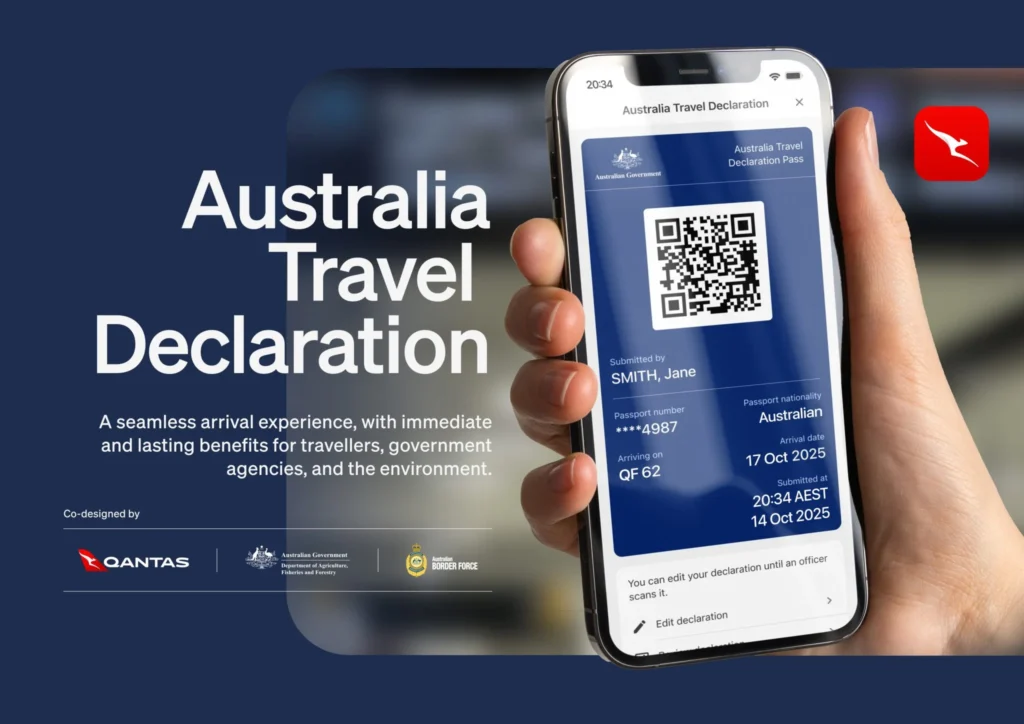
Australia has extended its digital arrival declaration pilot to Adelaide Airport, allowing eligible passengers to complete border paperwork before landing.
The expansion began on 20 November 2026 and covers invited passengers travelling on Qantas flight QF176 from Auckland. Participants can complete the Australia Travel Declaration through the Qantas app instead of filling out a paper Incoming Passenger Card.
Travellers can submit their information up to 72 hours before travel. After completing the process, they receive an emailed digital pass containing a unique QR code.
The development offers greater convenience for participating passengers while giving authorities information before arrival. However, the Adelaide arrangement remains restricted to eligible services rather than covering every international flight.
How the Adelaide Declaration Process Works
Eligible passengers receive an invitation to complete the declaration through the airline’s application.
The form collects information used for immigration, customs and biosecurity processing. Once submitted, the resulting digital pass must be presented to border and biosecurity officers after landing.
Passengers should ensure they can retrieve the pass when required, particularly if connectivity becomes limited during their journey.
The electronic process replaces specified paperwork but does not remove inspections or other arrival checks.
Travellers remain responsible for answering questions accurately and declaring relevant goods.
For visitors, the main change is when and how information is provided. Border officers retain responsibility for assessing passengers and their declarations.
Eligibility Remains Flight-Specific
The Adelaide launch does not mean every passenger arriving at the airport can use the digital service.
Its initial scope covers invited travellers on the participating Auckland–Adelaide Qantas flight. Customers on other services should follow the instructions applicable to their booking.
This distinction matters for travel agents arranging journeys involving multiple airlines or connecting flights.
Advice describing Adelaide as entirely paperless could leave passengers uncertain about their obligations.
Travellers changing their itinerary should also review any declaration instructions again. A different flight or arrival airport may involve another process.
Checking the operating service is therefore more useful than assuming eligibility from the destination alone.
A Wider Programme Supports Airport Modernisation
The Adelaide expansion forms part of Australia’s broader investment in modernising traveller processing.
More than A$56 million has been allocated over four years towards improvements across the airport arrival experience.
The Qantas-linked declaration pilot began in October 2024. Australia subsequently outlined a phased national rollout covering international airports and seaports before the end of 2027.
Nearly 900,000 passengers have completed digital declarations during the broader pilot, according to the supplied government announcement.
That cumulative figure indicates participation across the programme. It does not measure Adelaide usage or establish how much time individual passengers save.
Actual arrival experiences continue to depend on queues, staffing, inspections and airport operations.
Digital Access Models Are Developing Differently
Australia’s transition includes both airline-integrated and airport-based approaches.
The Qantas pilot uses invitations and the airline app. A separate web-based arrangement at Western Sydney International Airport demonstrates another way to provide access.
The distinction highlights a practical issue for international travellers: similar-looking digital services can have different eligibility rules.
An application available for one airport should not automatically be used for another arrival point.
For travel businesses, this requires precise guidance rather than generic instructions to complete an Australian digital form.
Clear explanations can help customers identify the correct process without confusing declaration services with visas or travel permissions.
Accessibility Remains Important for Visitors
Digital systems can simplify administration, but passengers have different levels of confidence with mobile applications and online forms.
Some may need help entering information, retrieving an emailed pass or understanding questions about their belongings.
The supplied programme information states that paper Incoming Passenger Cards remain available for travellers outside relevant digital arrangements and those requiring an alternative.
Maintaining accessible options matters for families, older passengers and visitors without reliable device access.
Airlines and tourism businesses can support these travellers through straightforward instructions and clear explanations of available assistance.
The success of digital processing therefore depends on usability as well as technical availability.
What Travellers Should Check Before Departure
Passengers invited to participate should complete the declaration within the applicable window and keep their digital pass accessible.
They should also distinguish arrival paperwork from separate travel-document requirements.
For travel agents, confirming the flight, arrival airport and relevant submission method should remain part of pre-departure preparation.
Adelaide’s expansion represents another step towards electronic arrival administration across Australia.
As the programme develops, accurate passenger communication will remain essential to making the process understandable, accessible and useful throughout the journey.
For more travel news like this, keep reading Global Travel Wire