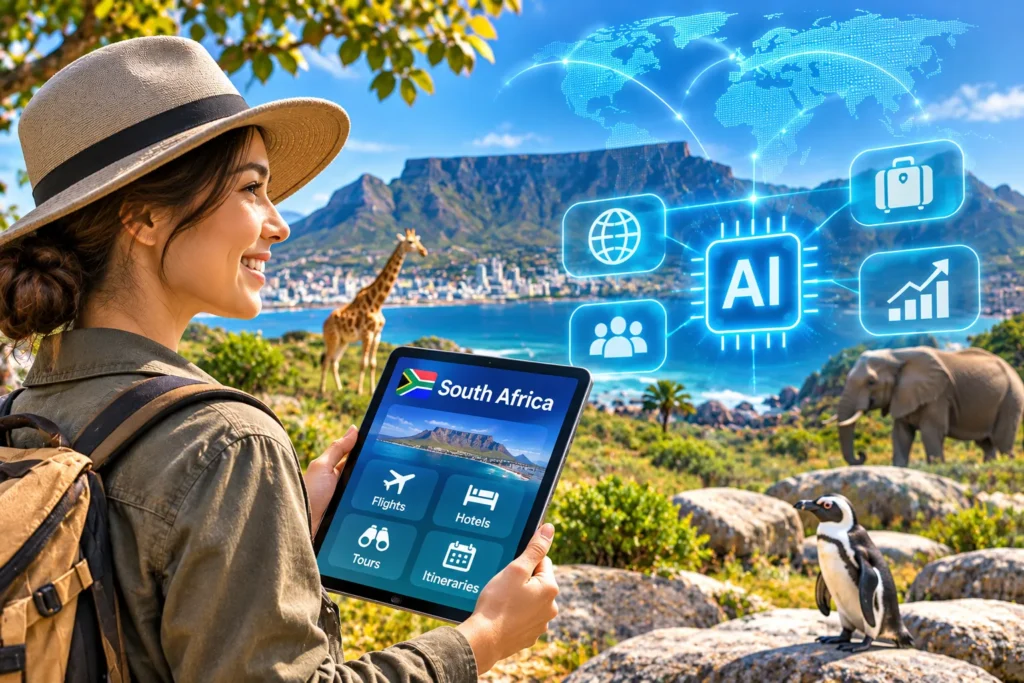
Pretoria, South Africa, November 25, 2026 — South Africa’s tourism and hospitality sector is entering a new phase of digital expansion, leveraging artificial intelligence and streamlined online entry systems to convert surging visitor demand into higher economic yields and broader community participation. With international arrivals climbing steadily through 2026, smart tools such as personalised itinerary builders, multilingual conversational assistants, and dynamic pricing engines are enabling both established hospitality groups and emerging local enterprises to reach global travellers more effectively.
Official figures released by Statistics South Africa and the Department of Tourism confirm the strong momentum behind the country’s visitor economy. Following a record-breaking 10.5 million international arrivals in 2025, South Africa welcomed 7,581,455 international tourists between January and August 2026—an increase of 11.7% compared to the same eight-month period the previous year. Domestic travel has shown parallel resilience, with South Africans taking 21.2 million overnight trips in the first half of 2026, including 5.2 million holiday journeys.
National Digital Agenda Aligns with Global Tourism Priorities
To ensure the sector capitalises on rapid technological shifts, the Department of Tourism anchored Tourism Month 2026 around the theme “Growing South Africa’s Tourism Sector in the Digital Era.” Officially launched by Minister of Tourism Patricia de Lille on August 13 in Durban, the month-long initiative culminated on September 27 in celebration of World Tourism Day under the global banner “Digital Agenda and Artificial Intelligence to Redesign Tourism.”
Addressing industry stakeholders and provincial leaders at the Durban launch, Minister de Lille emphasised that artificial intelligence is already transforming how international and domestic travellers research destinations, assemble custom itineraries, compare experiences, and complete bookings. She stated that policymakers and industry operators cannot afford to ignore this shift, stressing a collective responsibility to harness digital transformation to strengthen South Africa’s visitor economy and generate sustainable livelihoods.
The digital drive has been reinforced by concrete border modernisation reforms, including the rollout of South Africa’s Electronic Travel Authorisation (ETA) system in August 2026. By digitising visa processing and reducing administrative friction for international visitors, the government aims to complement private-sector digital marketing with a faster, more welcoming arrival experience.
Empowering SMMEs and Rural Enterprises Beyond Traditional Routes
A central pillar of the Department of Tourism’s digital strategy is ensuring that technological adoption widens economic inclusion rather than concentrating benefits among major hotel chains and tour operators. Minister de Lille underscored that digital tools must lower barriers to market entry for small, medium, and micro enterprises (SMMEs), rural operators, women-owned businesses, and youth entrepreneurs.
Historically, smaller tourism enterprises located outside primary urban hubs and established safari circuits struggled to gain visibility in international source markets. Today, AI-driven discovery platforms, automated translation tools, and digital booking marketplaces allow a boutique guesthouse in Limpopo, a cultural heritage guide in KwaZulu-Natal, or a community restaurant in a township to connect directly with travellers seeking authentic local experiences.
For this digital transformation to deliver lasting results across all nine provinces, industry planners highlight three foundational enablers: expanding reliable broadband connectivity in rural destinations, improving structured digital data so local businesses appear accurately in AI search recommendations, and investing in practical digital literacy training for small hospitality operators.
Balancing Smart Technology with Authentic Human Hospitality
While artificial intelligence streamlines back-office administration, revenue management, and pre-trip discovery, South African tourism leadership continues to stress that technology serves as a gateway rather than a replacement for personal connection. Minister de Lille noted that although digital platforms help visitors find and book South Africa, travellers ultimately remember the warmth, interpersonal engagement, and service excellence they encounter on the ground.
Grounded in the national spirit of Ubuntu, South Africa’s hospitality workforce remains its strongest competitive advantage. By allowing automated systems to handle routine enquiries and scheduling, tourism employees and small business owners gain more time to deliver memorable, high-touch cultural and wildlife experiences. Combined with ongoing investments in aviation connectivity and tourism infrastructure, responsible AI adoption positions South Africa to diversify its source markets and sustain inclusive tourism growth well into the future.
For more travel news like this, keep reading Global Travel Wire