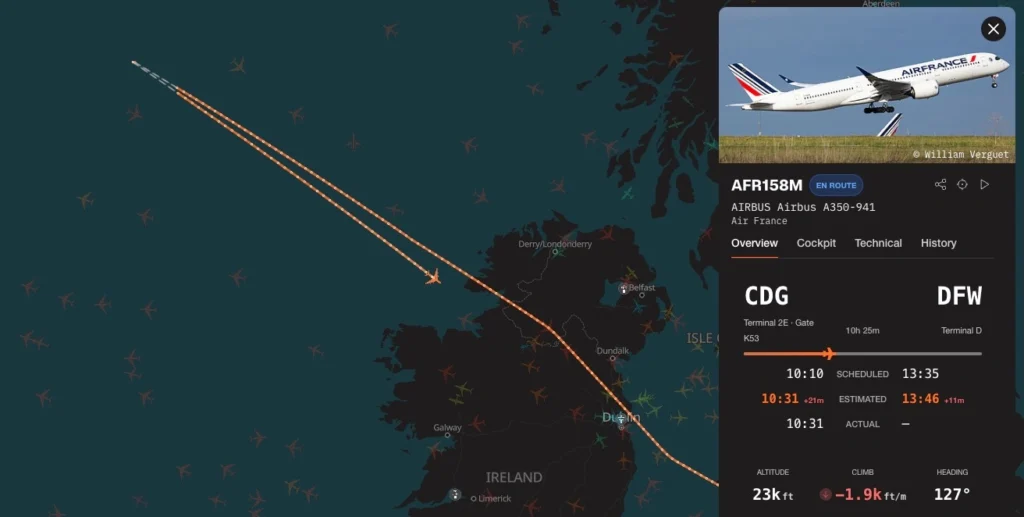
Air France flight AF158 diverted safely to Dublin Airport on June 22 after reversing course over the Atlantic during its scheduled journey from Paris Charles de Gaulle Airport to Dallas Fort Worth International Airport.
The Airbus A350 had been travelling west towards the United States when its crew made a mid-air U-turn and redirected the aircraft towards Ireland. The flight transmitted the internationally recognised 7700 emergency transponder code while approaching Irish airspace, giving the aircraft priority handling from air traffic control.
The exact reason for the diversion had not been officially disclosed at the time of publication. Without confirmation from Air France or the relevant aviation authorities, it remains unclear whether the decision involved a technical concern, a medical situation or another operational issue.
The incident caused an unexpected interruption for passengers travelling between France and Texas. However, the decision to divert illustrates how airline crews can alter long-haul journeys quickly when safety or onboard conditions require further assessment.
Aircraft Reversed Course Over the Atlantic
AF158 departed Paris Charles de Gaulle for its scheduled transatlantic service to Dallas Fort Worth before changing direction more than two hours into the journey.
The aircraft had reached its long-haul cruising phase when the crew abandoned the westbound crossing and began flying back towards Europe. Dublin was selected as the diversion point because of its accessible position on the eastern side of the North Atlantic and its capacity to accommodate widebody aircraft.
A diversion does not by itself indicate that an aircraft was in immediate danger. Pilots may redirect a flight whenever continuing to the original destination is no longer considered the safest or most practical option.
The priority is to reach a suitable airport where passengers can receive assistance and where airline, airport, medical or engineering teams can evaluate the situation.
What the 7700 Emergency Code Means
The 7700 transponder code is used by aircraft experiencing a general emergency. Once selected, it helps alert air traffic controllers and ensures that the flight receives the necessary coordination and priority.
The code does not identify the cause or seriousness of an incident. It can be used in different circumstances, and its appearance should not be treated as proof of a specific technical failure, medical event or threat.
In the case of AF158, the emergency transmission accompanied the aircraft’s diversion towards Dublin. The crew subsequently completed the landing, allowing the airline and ground teams to manage the operational consequences away from the transatlantic route.
For passengers, such an event can be stressful, particularly when limited information is available in the cabin. Clear communication from crew members and coordinated ground support become essential to maintaining confidence and assisting travellers after arrival.
Dublin Supports Major Transatlantic Operations
Dublin Airport is Ireland’s principal international aviation gateway and an established centre for flights linking Europe with North America. Its terminals, runways and aircraft stands regularly support long-haul operations, including services using widebody aircraft.
Its geographical position also makes Dublin an important option for flights operating across the North Atlantic. An aircraft returning towards Europe can reach the airport without continuing significantly farther east to Paris or another continental hub.
Once a diverted flight lands, operational teams may inspect the aircraft, support passengers and determine whether the journey can continue. Depending on the circumstances, an airline may resume the flight, substitute another aircraft, return passengers to the original departure point or arrange alternative connections.
Air France had not publicly confirmed the onward arrangements for AF158 passengers when the initial details of the diversion emerged.
Passenger Disruption Extends Beyond the Aircraft
An unscheduled landing can create significant logistical challenges for travellers. Passengers may face missed connections, altered hotel bookings, delayed ground transportation and uncertainty over their revised arrival time.
Airlines must also coordinate aircraft parking, crew duty limits, refuelling, maintenance support, baggage handling and possible rebooking. These requirements can extend the disruption even when the aircraft lands without further incident.
For Dallas-bound passengers, the diversion meant that a direct journey from Paris became an unplanned stop in Ireland. The final impact would depend on the length of the delay and the travel arrangements provided after the aircraft reached Dublin.
The incident could also affect subsequent services if the aircraft or operating crew cannot continue according to the original schedule.
Safety Procedures Take Priority Over Schedules
The Air France AF158 diversion demonstrates the precautionary approach built into international aviation. Flight crews are trained to evaluate changing conditions and use the safest suitable airport when continuing a journey presents uncertainty.
Although emergency declarations often attract considerable attention, they are also part of a structured system designed to give pilots rapid access to air traffic control assistance and airport resources.
Until Air France or an aviation authority releases further information, the cause of the diversion should remain described as undisclosed. Speculation could create unnecessary concern and misrepresent the crew’s decision.
For the passengers travelling from Paris to Dallas, the event brought disruption to a major international journey. Nevertheless, the safe arrival in Dublin showed that the aircraft, crew, controllers and airport teams were able to coordinate an effective response while placing passenger welfare ahead of the original schedule.
For more travel news like this, keep reading Global Travel Wire