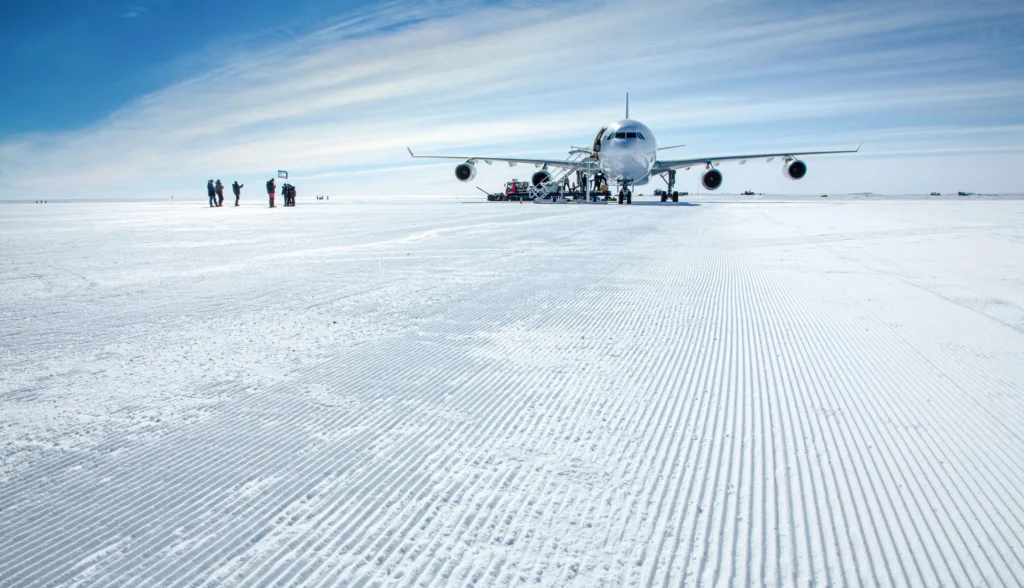
Universal Sky Carrier has landed an Airbus A340-600 on glacial ice in Antarctica, marking the first flight under a five-year partnership with expedition operator White Desert. The charter departed Cape Town and touched down at Wolf’s Fang Runway in Queen Maud Land.
The agreement pairs the airline’s widebody aircraft with White Desert’s expedition operations. It gives the operator a framework for moving guests, staff, equipment and supplies between South Africa and Antarctica over five years. For travellers, the flight offers a route into the Antarctic interior, with departure and return times shaped by weather and conditions on the ice.
Ground Crews Prepare a Runway on Blue Ice
Wolf’s Fang Runway stretches approximately three kilometres across a natural blue-ice surface. Crews use specialised grooming equipment to prepare the runway for aircraft, while the flight and ground teams coordinate the arrival around a suitable weather window.
The work starts well before the aircraft leaves Cape Town. Dispatchers plan fuel and payload for a journey across the Southern Ocean, while the team in Antarctica assesses local conditions. A decision to postpone departure can affect the timing of passenger movements and the delivery of supplies to camps further inland.
The A340-600 brings widebody capacity to the programme. The weight available for passengers, baggage and freight depends on what the aircraft needs to carry for each flight, including its fuel load. That makes the passenger manifest and cargo plan part of the same operational decision.
Cape Town Serves as the Expedition Staging Point
Cape Town links commercial air travel with the Antarctic charter. Guests can reach the city on regular airline services before joining the expedition, while the operator can assemble staff, equipment and supplies in one place.
This staging role creates opportunities for South African hotels, transfer companies and logistics providers. Visitors may spend time in Cape Town before departure or after returning, while suppliers help prepare the equipment and provisions needed on the ice. The partnership establishes a role for these services without quantifying how much additional business it will generate.
The city is also where a change in the polar itinerary can affect the rest of a holiday. A delayed departure can shift planned hotel nights in Cape Town. On the return leg, a weather hold in Antarctica can affect a separately booked flight home.
Remote Camps Depend on Coordinated Supply Flights
White Desert’s Antarctic operations include Whichaway Camp and Echo Base. Reaching the runway is one stage of a journey that also involves getting guests and their belongings to camp. Behind that passenger movement sits a supply operation that brings in staff, provisions and equipment during the Antarctic summer.
Widebody capacity gives the partners room to plan passenger and supply movements together. The cargo mix can vary from one flight to the next, depending on camp needs, baggage loads and operating conditions. A shipment of equipment or provisions may need to arrive before guests, making the order of flights as important as the space available on board.
The same transport arrangements can accommodate specialist personnel or equipment when required. The inaugural flight marks the start of the charter partnership, with future movements determined by the needs of individual expeditions and camps.
What the Charter Means for Expedition Travellers
Travellers booking an Antarctic expedition through Cape Town should check how the operator handles a weather delay in either direction. Package terms can clarify who arranges revised transport, how extra accommodation is handled and what happens if the Antarctic departure moves to another day.
Baggage allowances also deserve a separate check. An allowance on a commercial flight into Cape Town may differ from the one on the polar charter. That distinction matters when packing cold-weather clothing, boots and camera equipment. Guests should also check the operator’s insurance requirements, including any provisions for medical evacuation.
Preparation extends to the gear visitors take onto the ice. Cleaning footwear, clothing and equipment before departure helps reduce the chance of introducing seeds or other material into the Antarctic environment.
For travellers with a fixed onward booking, the most consequential date may be the flight out of Cape Town. Leaving time between the planned return from Antarctica and that departure gives the itinerary room to absorb a weather delay at Wolf’s Fang.
For more travel news like this, keep reading Global Travel Wire