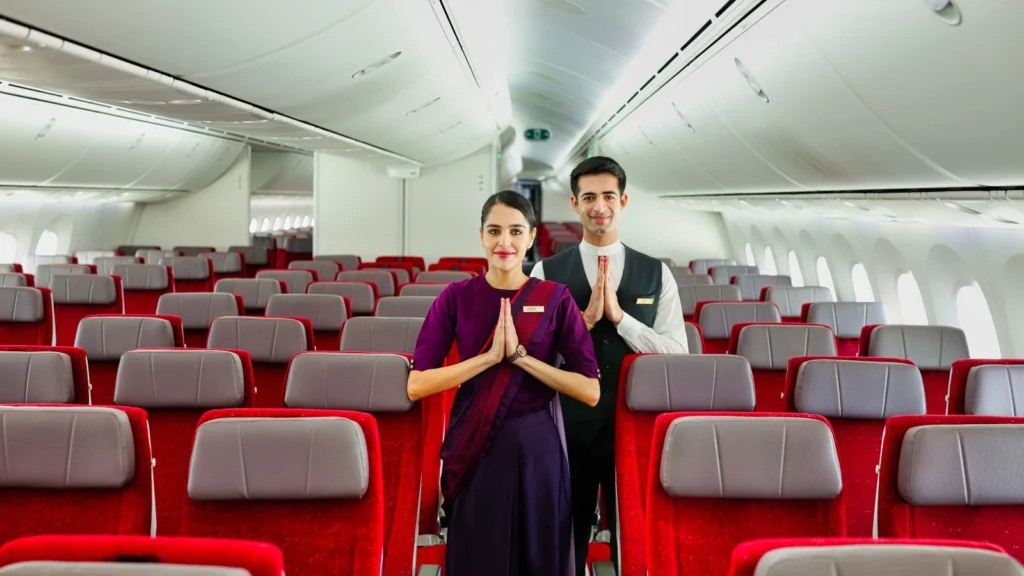
International air travel is entering a major fleet transformation as Delta Air Lines, Air India and Lufthansa invest heavily in next-generation wide-body aircraft, bringing travelers closer to newer cabins, expanded premium seating and more efficient long-haul connectivity.
Delta has placed a firm order for 30 Boeing 787-10 Dreamliners, with options for another 30 aircraft. Deliveries are expected to begin in 2031, marking the introduction of the Dreamliner as a completely new aircraft type in Delta’s fleet. The airline says the jets will initially support high-demand transatlantic and South American markets.
Meanwhile, Air India and Lufthansa Group are pursuing large-scale fleet modernization using aircraft from both Airbus and Boeing, demonstrating how major global carriers are combining multiple aircraft families to support growth, replacement needs and changing passenger expectations.
Delta brings Dreamliner into its future
Delta’s decision to order the Boeing 787-10 represents an important change in its long-haul fleet strategy.
The airline already operates Airbus A330 and A350 wide-body aircraft. Adding the 787-10 will give Delta another next-generation platform as it replaces older aircraft and expands international capacity.
Delta says the 787-10 is expected to provide approximately 25% better fuel efficiency per seat than the aircraft it will replace. The airline also plans large premium cabins, making the aircraft particularly significant for travelers seeking upgraded experiences on longer international journeys.
For passengers, newer aircraft can mean more than simply flying on a different jet.
Fleet renewal gives airlines opportunities to introduce updated seats, entertainment technology, connectivity and cabin layouts. Delta’s future Dreamliners could therefore become an important part of its premium international strategy.
Air India builds massive global fleet
Air India is undertaking an even broader transformation.
Its landmark 2023 aircraft agreement covered 470 firm orders from Airbus and Boeing. The original package included Airbus A350 aircraft, Boeing 787 Dreamliners and Boeing 777X wide-body jets alongside hundreds of narrow-body aircraft.
Air India later expanded its Airbus commitments, taking its total aircraft orders to 570 by late 2024. In January 2026, it also added another 30 Boeing 737 MAX-family aircraft to its firm order book.
The scale of this modernization could significantly reshape travel to and from India.
New aircraft can support additional international frequencies, improved nonstop connectivity and more modern passenger cabins as Air India strengthens links with Europe, North America, Asia-Pacific and other global markets.
The airline’s mixed Airbus-Boeing strategy also provides different aircraft capabilities for different network requirements.
Lufthansa combines A350 and Dreamliner growth
Lufthansa Group is similarly building its long-haul future around several next-generation aircraft families.
The group already operates Airbus A350-900 and Boeing 787-9 aircraft, while its order pipeline includes additional A350s, Dreamliners and Boeing 777X aircraft.
In May 2026, Lufthansa Group announced another order for ten Airbus A350-900s and ten Boeing 787-9s, with the aircraft intended to replace older, less-efficient long-haul jets from 2032.
Its current long-haul order portfolio demonstrates how deeply both manufacturers will remain embedded in the group’s future fleet strategy.
For travelers, Lufthansa’s fleet modernization is closely linked with new premium cabin investment, including the continuing rollout of its Allegris passenger experience across newer long-haul aircraft.
Aircraft shortages reshape airline decisions
Behind these enormous fleet investments lies a major challenge: airlines are struggling to obtain new aircraft quickly enough.
The International Air Transport Association said in June 2026 that the global aircraft order backlog had exceeded 18,000 jets. It also reported delivery shortfalls of more than 5,000 aircraft and an average global fleet age reaching 15.2 years.
These shortages have important implications for travelers.
When deliveries are delayed, airlines may need to operate older aircraft longer than originally planned. Fleet shortages can also limit how quickly carriers add frequencies, launch routes or introduce new cabin products.
Diversifying aircraft orders across Airbus and Boeing can provide airlines with additional strategic flexibility, although maintaining multiple aircraft families also introduces training, maintenance and operational complexity.
Premium cabins become more important
The next generation of long-haul competition will increasingly focus on the passenger experience.
Business travelers are seeking greater privacy, improved connectivity and better sleep environments. Premium leisure demand is also encouraging airlines to expand business-class and premium-economy capacity.
New aircraft such as the Boeing 787 and Airbus A350 give airlines opportunities to redesign cabins around these changing expectations.
Travelers should still remember that booking a particular flight does not always guarantee a specific aircraft. Airlines can change equipment for operational reasons, even after passengers have selected seats.
Global travelers enter a new aviation era
Delta, Air India and Lufthansa illustrate the enormous transformation now underway across international aviation.
Delta’s 787-10 order introduces a new Dreamliner chapter from 2031. Air India is building one of the industry’s most ambitious fleet modernization programmes, while Lufthansa continues combining Airbus and Boeing aircraft with major premium cabin upgrades.
At the same time, unprecedented aircraft backlogs mean the transition will happen gradually rather than overnight.
For passengers, however, the direction is clear. The coming decade will bring more next-generation Dreamliners and A350s, expanded premium cabins and increasingly sophisticated long-haul aircraft connecting major tourism and business markets worldwide.
The future of flying will therefore be shaped not simply by Airbus versus Boeing, but by how effectively airlines use new aircraft to deliver better connectivity, greater comfort and more resilient international networks.
For more travel news like this, keep reading Global Travel Wire