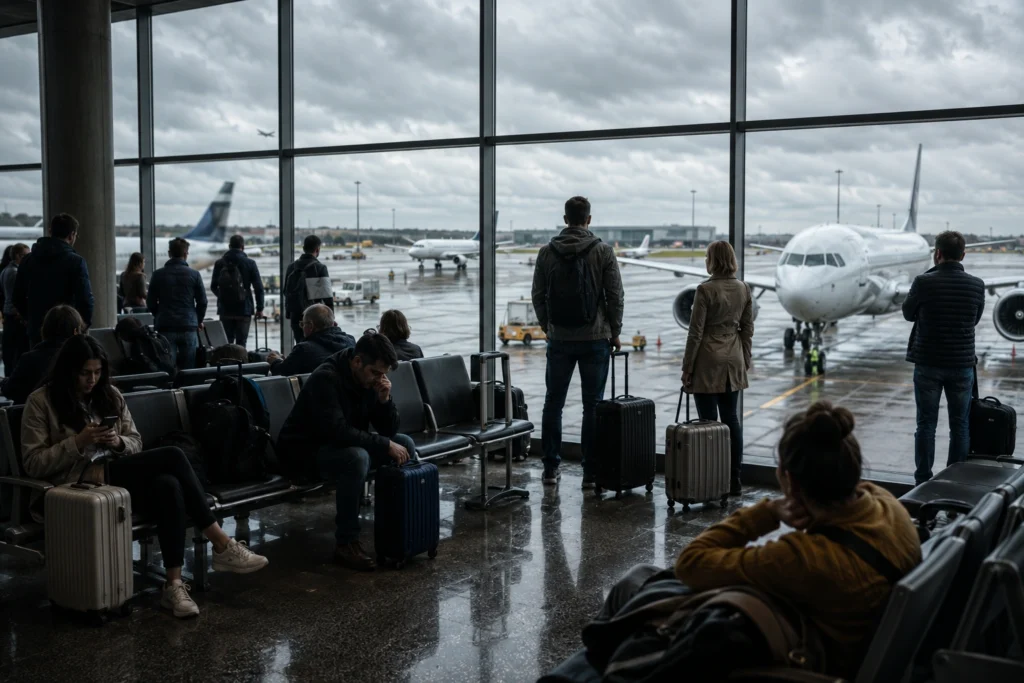
Thousands of passengers faced disrupted travel plans across Europe on June 4 as major airports recorded a combined 216 flight cancellations and 2,342 delays, creating significant pressure on airlines, terminals and onward transport connections.
The operational disruption affected major aviation markets including Portugal, the United Kingdom, Germany, France, the Netherlands, Italy, Switzerland, Norway, Iceland and Russia. Lisbon recorded the highest cancellation total, while London Heathrow reported the largest number of delays.
The widespread disruption arrived as airports prepared for busy summer travel demand. Travelers heading to hotels, cruise ports, conferences and major tourism destinations faced missed connections, longer waiting times and the possibility of revised itineraries.
Lisbon, Porto and Faro Face Severe Disruption
Portugal experienced some of the most serious operational challenges. Lisbon Humberto Delgado Airport recorded 59 cancellations and 50 delays, making it the most heavily affected airport for canceled flights in the dataset.
Porto Airport reported 26 cancellations and 75 delays, while Faro Airport recorded 21 cancellations and 80 delays. Together, the three Portuguese airports accounted for 106 cancellations.
The disruption followed strike-related pressure affecting Portuguese aviation and transport operations. Passengers using Portuguese airports were advised to check their flight status before traveling and allow additional time for airport procedures, particularly for international journeys.
The impact was especially important for the tourism sector. Lisbon, Porto and Faro are major gateways for city breaks, cultural tourism and Algarve holidays. Disruption at these airports can affect hotel arrivals, resort transfers, car rentals and connections to cruise departures.
Heathrow Reports the Highest Number of Delays
London Heathrow Airport recorded 321 delays and 15 cancellations, the highest delay total among the affected airports. British Airways, Virgin Atlantic, Aer Lingus, American Airlines, KLM and SAS were among the carriers operating services through the hub.
London Gatwick Airport also experienced disruption, with 184 delays and two cancellations. The pressure at both airports created uncertainty for passengers connecting through London or beginning holidays from the United Kingdom.
Germany faced similar challenges. Frankfurt Airport recorded 291 delays and 17 cancellations, while Munich Airport reported 191 delays and eight cancellations.
Frankfurt’s disruption affected a major European connecting hub, where delayed flights can quickly create knock-on problems across domestic and international routes.
Paris, Amsterdam and Rome Record Heavy Delay Totals
Paris Charles de Gaulle Airport recorded 265 delays and 20 cancellations, while Paris Orly reported 126 delays and six cancellations. The disruption affected travelers using Air France, easyJet, KLM, Delta Air Lines, United Airlines and Transavia France services.
Amsterdam Schiphol Airport recorded 277 delays and nine cancellations. As one of Europe’s most important connecting airports, Schiphol’s operational pressure had the potential to affect passengers traveling across multiple countries.
Rome Fiumicino Airport registered 258 delays and four cancellations. The disruption arrived during a busy travel period for Italy, with Rome serving as a key gateway for cultural tourism, Mediterranean cruises and onward domestic travel.
Additional disruption was reported at Moscow Sheremetyevo, Oslo Gardermoen, Geneva, Nantes and Keflavik airports.
Lufthansa and easyJet Among the Most Affected Airlines
Lufthansa recorded the highest airline cancellation total, with 38 canceled flights and 194 delays. easyJet reported the highest airline delay figure, with 241 delays and 10 cancellations.
British Airways accumulated 202 delays and 15 cancellations, while Air France recorded 110 delays and 24 cancellations. KLM reported 135 delays and 13 cancellations.
Other affected carriers included Ryanair, ITA Airways, Transavia France, Swiss, Iberia, Icelandair, Vueling Airlines, SAS, Norwegian Air Shuttle, Aer Lingus, Delta Air Lines, United Airlines, American Airlines and Air Canada.
For passengers, airline disruption can extend beyond a single canceled or delayed flight. Missed connections may affect hotel bookings, rail transfers, airport transport and cruise embarkation times.
Travelers Should Check Flights Before Leaving for Airports
Passengers traveling through affected European hubs should monitor airline applications, airport departure boards and official communication channels before starting their journeys.
Travelers should keep booking confirmations and boarding documents accessible, review available rebooking options and allow additional time for connections. Those facing extended delays should also check hotel, transfer and ground transportation arrangements.
Passengers traveling through Portugal should be particularly cautious because strike-related disruption and longer waiting times may continue to affect some airport procedures.
Europe’s Tourism Industry Faces Another Busy Travel Test
The disruption highlights the pressure facing Europe’s aviation network during periods of high passenger demand. Airports, airlines, hotels and tourism businesses rely on smooth transport operations to move travelers efficiently between destinations.
While individual flight statuses may change throughout the day, the scale of the June 4 disruption shows the importance of flexibility. Travelers planning European journeys should continue checking their schedules and prepare alternative arrangements when necessary.
For more travel news like this, keep reading Global Travel Wire