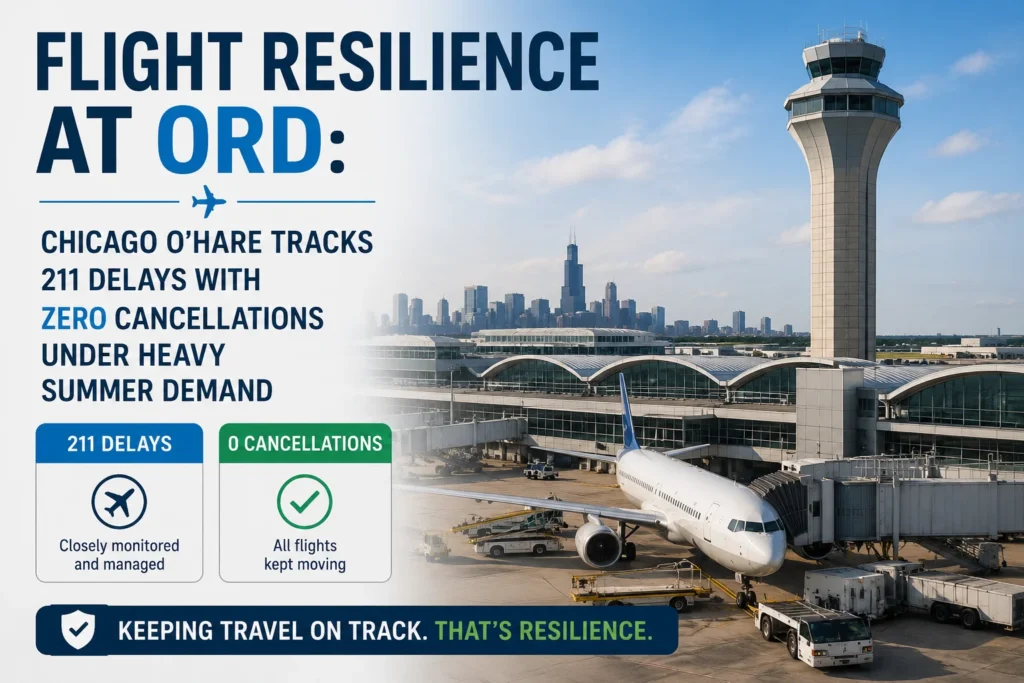
Chicago O’Hare International Airport recorded a high-volume travel day marked by 211 flight delays but achieved an operational milestone with zero cancellations. According to flight monitoring logs from the major midwestern aviation hub, the disruptions impacted prominent domestic and international routes operated by United Airlines, American Airlines, Delta Air Lines, and Southwest Airlines.
Despite the widespread scheduling adjustments, passengers traveling to major global business and leisure destinations—including New York, Los Angeles, London, Toronto, Tokyo, and Frankfurt—retained their original bookings. While the delays tested traveler patience across terminals, the complete absence of cancelled flights indicated that airlines, local airport authorities, and the Federal Aviation Administration successfully kept every scheduled aircraft in active service.
Evaluating the Operational Pressure on a Major Aviation Hub
Chicago O’Hare functions as one of the most critical connecting facilities within the United States National Airspace System, processing thousands of aircraft movements daily. Because of its structural role as a primary dual-hub for multiple legacy carriers, operational efficiency at the airport relies on an intricate, interconnected network of arrival and departure slots.
Data from federal traffic management logs indicate that several recurring structural factors contribute to these persistent delay patterns during peak summer travel windows. High air traffic volumes frequently push the limits of available runway capacity during concentrated morning and evening departure banks. Furthermore, regional weather variations, necessary air traffic control spacing protocols, and stringent federal crew duty-time regulations require constant real-time adjustments by airline dispatchers.
Because an arriving aircraft at O’Hare quickly transitions into a departing flight for a subsequent leg, minor delays early in the day regularly compound. For example, a minor morning arrival delay from an East Coast hub can quickly translate into a departure delay for a westbound transpacific flight bound for Tokyo, creating a ripple effect across global airline networks.
Federal Air Traffic Management Strategies in Effect
To mitigate broader disruptions when demand approaches maximum airport capacity, the Federal Aviation Administration utilizes specialized traffic management initiatives. On high-volume travel days, federal air traffic controllers may implement Ground Delay Programs. These programs temporarily hold departing aircraft at their origin airports to prevent excessive, fuel-consuming airborne holding patterns in the airspace surrounding northern Illinois.
The regulatory agency has also integrated predictive scheduling software and modern air traffic flow management tools designed to give controllers better visibility into emerging infrastructure bottlenecks. At Chicago O’Hare specifically, authorities have utilized temporary scheduling frameworks during the busiest seasonal travel weeks. These administrative limits help regulate the total number of scheduled arrivals and departures during constrained operational windows, preserving overall system reliability.
Compounding these capacity limits is the ongoing execution of the O’Hare Modernization Program. The long-term infrastructure project includes extensive runway reconfigurations and terminal expansion work. While these capital improvements are designed to significantly increase the airport’s long-term capacity, the active construction phases occasionally limit taxiway flexibility, reducing the airport’s overall operational headroom during peak traffic periods.
System Resilience Benefits Long-Distance and International Travelers
The decision by airline operations centers to manage delays rather than cancel flights represents a significant logistical effort. In commercial aviation, cancellations typically occur when progressive delays cause flight crews to reach their maximum legal duty hours, or when aircraft miss mandatory maintenance windows. Avoiding cancellations entirely demonstrates that airlines successfully managed crew rotations and gate availability without crossing critical operational thresholds.
For international and domestic tourists, navigating a delayed flight is significantly more manageable than a wholesale cancellation. Delayed passengers maintain their confirmed seat assignments, avoid the necessity of rebooking through crowded customer service lines, and bypass the logistical challenges of securing emergency hotel accommodations or alternative transit routes.
As elevated summer travel volumes continue to put pressure on the global transportation sector, federal aviation data suggests that structural delays remain a persistent characteristic of high-demand hubs. The operational outcome at Chicago O’Hare demonstrates that while American aviation infrastructure remains under constant strain, real-time coordination between federal regulators and airline dispatch units can maintain total network connectivity without triggering systemic cancellations.
For more travel news like this, keep reading Global Travel Wire