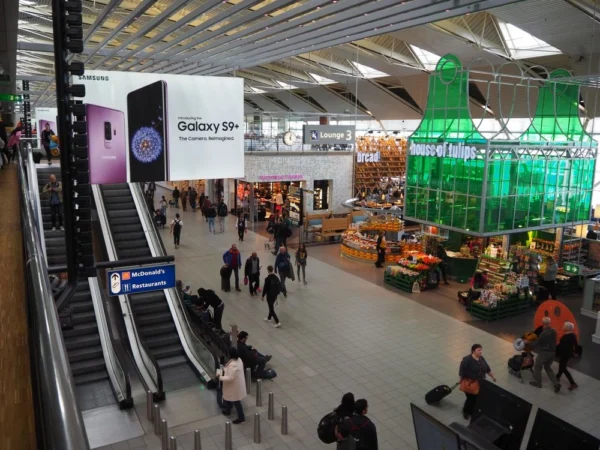
Fourteen reported departure cancellations at Amsterdam Schiphol Airport disrupted major international and European routes, affecting passengers traveling to destinations across North America, South America, Asia and Europe.
The affected schedule included KLM services to New York, Minneapolis, Portland, San Diego, Washington, Rio de Janeiro, Taipei and Bristol. Flights operated by easyJet, Vueling and airBaltic were also listed among the cancellations, reducing connectivity to Manchester, Glasgow, Milan, Barcelona and Tallinn.
The scale of the disruption placed additional pressure on passengers using Schiphol as a connecting hub. Travelers booked on long-haul itineraries faced the possibility of missed onward services, limited replacement capacity and extended stays in Amsterdam, while short-haul cancellations affected city breaks, business trips and regional feeder journeys.
No single officially confirmed cause was provided for all the reported cancellations. Passengers should therefore avoid assuming that the disruption resulted from one airport-wide incident and check their individual flight status directly with the operating airline.
KLM Long-Haul Routes Carry the Widest Impact
KLM accounted for most of the reported intercontinental cancellations, including flights KL643 to New York John F. Kennedy International Airport, KL655 to Minneapolis-Saint Paul, KL615 to Portland, KL639 to San Diego and KL651 to Washington Dulles.
Additional reported cancellations included KL705 to Rio de Janeiro and KL807 to Taipei. These routes normally support a mixture of tourism, business travel, visiting friends and relatives, and connecting traffic through Amsterdam.
Long-haul cancellations generally create greater recovery challenges than short regional disruptions because fewer daily alternatives may be available. Wide-body aircraft also carry large passenger volumes, meaning one cancelled departure can create immediate demand for seats on later services or alternative routings through other hubs.
The affected North American routes connect Amsterdam with important tourism and commercial markets. New York, Washington, San Diego, Portland and Minneapolis also provide access to broader domestic networks, increasing the risk of missed connections for passengers continuing beyond their arrival airport.
The reported Rio de Janeiro cancellation affected a major leisure and business corridor between Europe and Brazil, while the Taipei service disruption reduced direct connectivity with an important Asian aviation and technology center.
European Flights to Britain, Italy and Spain Cancelled
Short-haul operations were also affected, with reported easyJet cancellations to Manchester, Glasgow and Milan Linate. These services play an important role in point-to-point travel and can also support passengers connecting through Amsterdam on separate bookings.
Vueling flight VLG8308 to Barcelona was included in the cancellation list, alongside another listed Barcelona service. The Barcelona route supports year-round tourism demand, weekend travel, cruise connections and business traffic between the Netherlands and Spain.
The reported cancellation of airBaltic flight BTI858 to Tallinn disrupted access to the Estonian capital, while KLM flight KL1083 to Bristol affected another important Netherlands-United Kingdom connection.
Although European routes often operate more frequently than intercontinental services, cancellations can still create significant disruption during busy travel periods. Remaining departures may fill quickly, particularly when several airlines are attempting to rebook passengers at the same time.
Connecting Passengers Face Added Pressure
Schiphol functions as a major transfer point, meaning the effect of a cancellation can extend far beyond the destination shown on the departure board. Many passengers use Amsterdam to connect between European cities and long-haul markets in the Americas or Asia.
A cancelled feeder flight may prevent travelers from reaching an onward intercontinental departure. Conversely, the cancellation of a long-haul service can leave passengers arriving from regional airports without a practical same-day alternative.
Travelers using separate tickets may face additional difficulties because the airlines involved may not be responsible for protecting the full journey. Passengers should review every segment of their itinerary and confirm whether checked baggage will be transferred or returned.
Tourism and Hospitality Operations Feel the Effects
The Amsterdam Schiphol flight cancellations may also influence hotels, airport transport providers and tourism businesses. Passengers unable to depart could require last-minute accommodation, while delayed arrivals may affect hotel check-ins, attraction reservations, rail journeys and cruise connections.
For destinations such as New York, Rio de Janeiro, Barcelona and Milan, reduced capacity can also affect inbound visitor flows. Even temporary disruption may influence tourism spending when travelers lose part of a trip or abandon plans because suitable replacement flights are unavailable.
Airlines may attempt to stabilize their schedules by consolidating passengers onto later services, using alternative aircraft or routing travelers through partner hubs. However, recovery becomes more complex when cancellations affect several regions and aircraft types simultaneously.
What Affected Travelers Should Do
Passengers should confirm their flight status before traveling to Schiphol and rely on instructions from the operating airline. Those already at the airport should monitor departure screens, airline applications and direct rebooking messages.
Travelers should keep receipts for reasonable expenses, document any revised itinerary and confirm their baggage status before leaving the terminal. They should also avoid booking non-refundable replacement travel until the airline has explained the available options.
The 14 reported cancellations demonstrate how quickly disruption at a global hub can affect international mobility. With KLM, easyJet, Vueling, airBaltic and other operations involved, the impact extended from short European routes to some of Schiphol’s most important long-haul markets.
For more travel news like this, keep reading Global Travel Wire