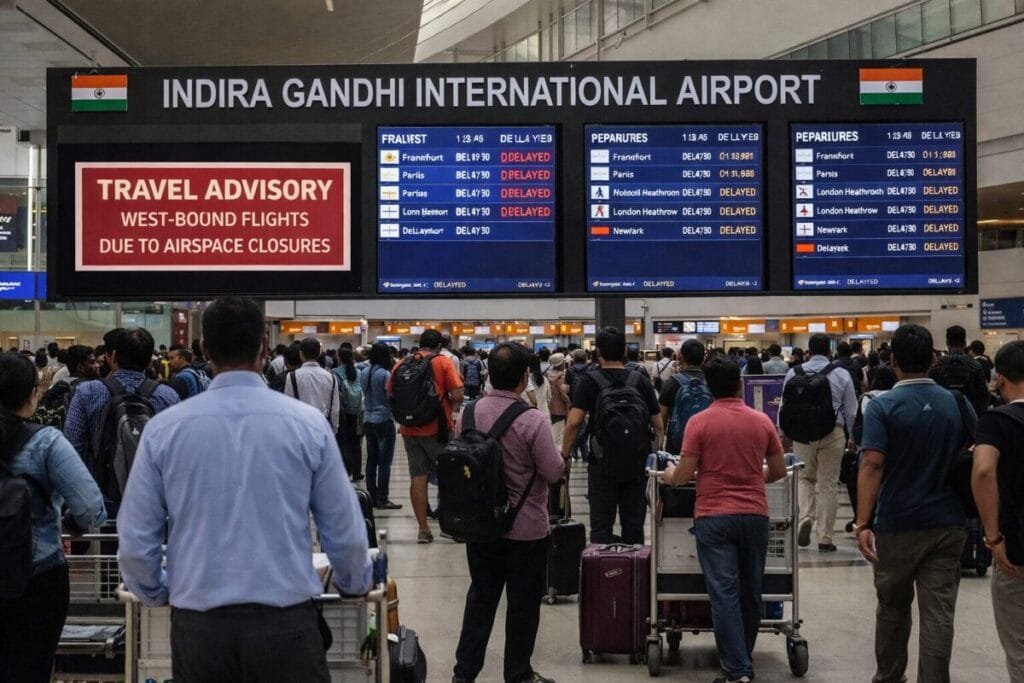
India’s busiest aviation hub, Indira Gandhi International Airport (IGI) in Delhi, has issued an official travel advisory for passengers flying westbound toward Europe and North America. The notification comes in response to evolving international airspace closures that are affecting traditional flight corridors used by airlines departing from the Indian capital.
Airport authorities clarified that while operations at the Delhi terminal remain normal, certain geopolitical developments have led to restrictions in parts of international airspace. As a result, carriers operating long-haul routes are being required to adjust flight paths, potentially increasing journey times and causing minor schedule changes.
The advisory was shared through official communication platforms to ensure that international travelers remain well informed and prepared for possible disruptions.
Why Westbound Flights Are Affected
Modern aviation relies on carefully planned air corridors that allow aircraft to travel efficiently between continents. For flights departing Delhi toward Europe, the United Kingdom, and North America, the most direct routes often pass over regions that are currently subject to temporary airspace restrictions.
When such restrictions are imposed by national aviation authorities or international regulators, airlines must reroute aircraft to avoid those zones. These detours may add several hours to flight duration, depending on the alternative path selected.
The airport administration emphasized that these changes are precautionary measures rooted in safety considerations. Airspace restrictions are implemented to protect civilian aircraft from potential risks, and airlines are required to comply immediately with updated advisories.
Impact on Flight Duration and Scheduling
Because alternative routes are longer, airlines may experience operational ripple effects. Extended flying time can increase fuel consumption and affect crew scheduling limits. In certain cases, long-haul aircraft might require technical refueling stops if the new route exceeds the aircraft’s standard nonstop range under full load conditions.
Passengers traveling to cities such as London, Paris, Frankfurt, New York, Toronto, or Chicago may notice adjustments to departure or arrival times. However, airport officials have reassured travelers that IGI Airport itself remains fully operational, and all services at the terminal are functioning as normal.
The advisory is intended to prepare passengers for these potential shifts, rather than signal any disruption within Delhi’s airport infrastructure.
Coordinated International Aviation Response
Rerouting long-haul flights is not a simple logistical change. It requires coordinated efforts among air traffic control authorities across multiple countries. Each revised route must be approved and integrated into the global aviation network to ensure safe separation between aircraft.
India’s Ministry of Civil Aviation and aviation regulators are closely monitoring developments in coordination with international agencies. The objective is to maintain uninterrupted connectivity while prioritizing passenger safety.
Industry experts note that global aviation is highly interconnected. A closure in one region can influence schedules thousands of kilometers away. As one of Asia’s largest international gateways, Delhi naturally experiences the downstream impact of such changes.
Guidance for International Travelers
Delhi Airport authorities have outlined practical recommendations for passengers booked on westbound flights:
- Check flight status several hours before leaving for the airport.
- Monitor airline mobile apps and official communication channels for real-time updates.
- Arrive at the airport well in advance of departure to accommodate possible procedural changes.
- Ensure contact information is updated in booking records to receive alerts promptly.
Travelers connecting onward from European hubs to North America are also advised to review connection times, as extended flight durations could impact transfer windows.
Airport officials stress that staying informed is the most effective way to reduce stress during periods of schedule adjustments.
Airline Operational Planning
Airlines operating out of Delhi are conducting daily assessments of route feasibility. Flight operations teams evaluate fuel requirements, alternate airports, and crew duty time regulations before finalizing schedules.
While rerouted services may incur higher operating costs, airlines remain committed to maintaining service continuity. Safety compliance remains mandatory, and adherence to revised airspace guidance is non-negotiable.
Airport management has confirmed ongoing collaboration with carriers to ensure smooth passenger flow at check-in, security screening, and boarding gates.
Broader Aviation Context
Airspace restrictions are typically introduced in response to geopolitical developments or security assessments. Such measures are common in global aviation when conditions warrant precaution.
The current situation highlights the resilience of India’s aviation sector. Despite external challenges, Delhi Airport continues to handle thousands of daily departures and arrivals without interruption to core services.
India has steadily expanded its international connectivity in recent years, with Delhi serving as a key hub for both inbound tourism and outbound travel. Maintaining operational stability under shifting global conditions demonstrates the strength of the airport’s infrastructure and crisis-response planning.
Looking Ahead
Authorities indicate that the duration of the airspace adjustments remains uncertain and will depend on international developments. Once restrictions are lifted, airlines are expected to revert to shorter, more direct routes, restoring standard flight durations.
Until then, flexibility will be essential for travelers. The advisory is not intended to discourage travel but to provide clarity about temporary adjustments affecting certain long-haul services.
Delhi Airport management has reiterated its commitment to transparency and passenger welfare. By issuing timely guidance, officials aim to ensure that travelers can plan accordingly and minimize inconvenience.
Summary of Travel Advisory
In summary, westbound passengers departing from Indira Gandhi International Airport should anticipate possible longer travel times due to international airspace closures. The airport itself remains fully functional, and all precautionary measures are being implemented to uphold safety standards.
By checking flight updates, arriving early, and staying connected through official airline channels, passengers can navigate these temporary changes smoothly. As global conditions evolve, Delhi Airport continues to adapt, reinforcing its role as a resilient and reliable international aviation hub.
For more travel news like this, keep reading Global Travel Wire