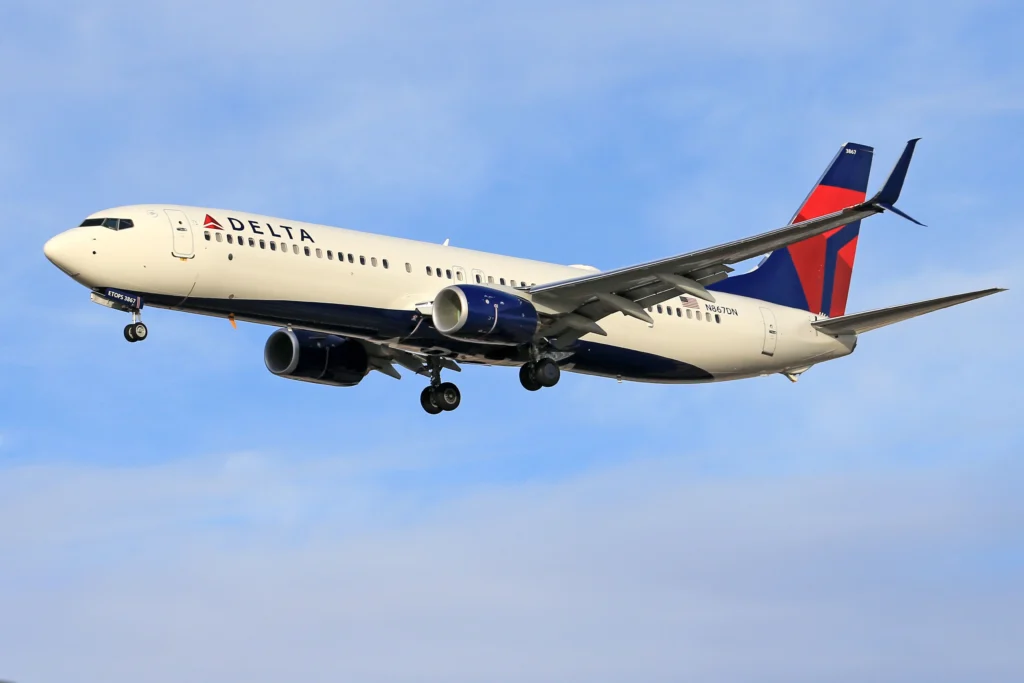
A major legal battle is unfolding in the aviation world as twenty passengers have officially filed a lawsuit against Delta Air Lines. The legal action stems from a violent, midair turbulence incident aboard Flight 56, an international journey scheduled from Salt Lake City to Amsterdam. According to the court filings, the carrier allegedly disregarded multiple weather alerts, leading to a harrowing experience that resulted in severe passenger injuries and an emergency diversion.
The incident occurred less than an hour after the Airbus A330-900 departed from Salt Lake City International Airport. The flight path quickly intersected with an area of severe convective weather, sending the aircraft into a period of extreme instability. Following the violent shaking, the flight crew was forced to divert the plane to Minneapolis-St. Paul International Airport, cutting the transatlantic journey short and triggering an immediate emergency response on the ground.
Severe Injuries and Alleged Negligence in the Cabin
According to the official complaint filed in the Third Judicial District Court for Salt Lake County, the sudden and violent drops in altitude caught everyone on board completely off guard. Plaintiffs in the lawsuit allege that the airline failed to illuminate the cabin’s seatbelt sign and permitted the standard beverage service to continue, despite entering an area with highly volatile weather forecasts.
When the severe turbulence struck, the cabin descended into chaos. The sudden gravitational shifts threw passengers, flight attendants, heavy service carts, and unsecure luggage toward the ceiling and across the aisles. The legal complaint details an array of serious physical injuries suffered by those on board, including concussions, broken bones, spinal trauma, and severe head wounds. Beyond the immediate physical damage, passengers report lasting psychological distress from the terrifying ordeal.
Because the incident occurred on an international flight, the plaintiffs are seeking financial damages under the Montreal Convention. This international treaty establishes a strict liability framework for airlines when passengers suffer injury or death while onboard an aircraft, making it a pivotal element of global airline passenger safety protocols.
Official Reports Detail Pre-Flight Weather Warnings
The core of the legal argument rests on the claim that the airline and its flight crew possessed ample data indicating that the flight path was unsafe. Official public records and meteorological data indicate that the National Weather Service had issued significant meteorological advisories (SIGMETs) warning of embedded thunderstorms and dangerous convective activity along the route.
Furthermore, aviation tracking and official communications reveal that regional air traffic controllers had flagged moderate to extreme convective weather patterns approximately 20 minutes before Flight 56 entered the storm zone. The lawsuit asserts that while air traffic control had proactively authorized a route deviation to bypass the cell, the aircraft remained on its original trajectory.
Plaintiffs argue that through internal meteorological teams, predictive turbulence software, and electronic flight bag systems, the flight crew had all the necessary tools to anticipate the danger. The legal team representing the passengers emphasizes that the primary issue was not an unpredictable act of nature, but rather a failure to utilize available weather intelligence to prioritize passenger comfort and security.
Questions Raised Over the Diversion Protocol
The controversy extends past the turbulence itself to how the airline handled the immediate aftermath. Court documents reveal that after pilots regained manual control of the aircraft—which had briefly seen its autopilot system disengage during the violent shifts—the plane bypassed closer major hubs, such as Denver International Airport.
Instead, the aircraft continued flying for an additional 90 minutes before touching down in Minneapolis. The plaintiffs allege that this decision delayed critical medical care for the injured individuals trapped inside the cabin. The lawsuit suggests the extended flight plan was financially motivated, designed to position the aircraft at a major hub to minimize Delta’s operational costs regarding aircraft maintenance, passenger rebookings, and fleet displacement.
During this extended portion of the flight, passengers claim they received minimal communication or updates from the flight deck, heightening anxiety in a cabin filled with injured travelers. Upon arrival at Minneapolis-St. Paul International Airport, local emergency medical teams met the aircraft on the tarmac. Over thirty individuals required immediate medical evaluation, with many being transported to regional hospitals for advanced treatment.
As the legal proceedings move forward in Utah, this case puts a massive spotlight on standard operating procedures regarding convective weather management. The outcome could influence how major carriers interpret real-time weather data and balance operational efficiency with strict adherence to passenger safety protocols.
For more travel news like this, keep reading Global Travel Wire