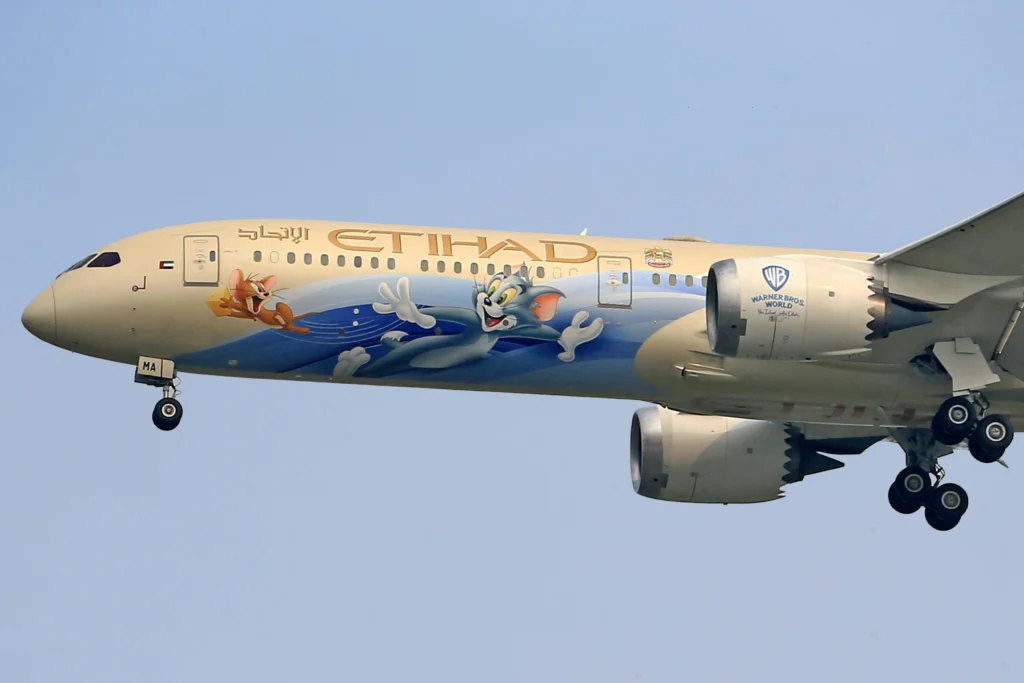
The international aviation capacity grid is experiencing a major alignment ahead of the busy seasonal travel window, driven by tactical adjustments from premier network carriers. Etihad Airways, the national airline of the United Arab Emirates, has filed a comprehensive revision to its upcoming summer schedule, systematically reallocating its flagship superjumbo aircraft to match evolving traffic concentrations on core long-haul sectors.
Under the updated operational plan, the airline will remove the iconic double-decker Airbus A380 from its daily rotation between Zayed International Airport in Abu Dhabi and Singapore Changi Airport. In its place, the airline will deploy its premium-configured Boeing 787-9 Dreamliner. The freed-up superjumbo capacity will be heavily redirected toward the European continent, reinforcing the carrier’s high-demand route into Paris Charles de Gaulle Airport with an aggressive double-daily superjumbo service.
Analyzing the Capacity Drop on the Southeast Asian Vector
The transition from the mega-capacity Airbus A380 to the smaller Boeing 787-9 marks a notable reduction in seat availability on the Abu Dhabi-Singapore corridor. Aviation operational data outlines the specific structural variations between the two aircraft types:
Airbus A380-800 Configuration: Features an expansive multi-cabin architecture carrying between 484 and 494 passengers, supported by 9 luxury First Class suites, 70 Business Class studios, and up to 415 Economy seats.
Boeing 787-9 Dreamliner Configuration: Features a streamlined premium layout equipped to seat a total of 226 passengers, dividing capacity across 8 First Class suites, 28 Business Class units, and 190 Economy slots.
This operational shift results in an overall passenger capacity drop of roughly 53 percent on the daily Singapore flight. The reduction is felt most acutely within the premium travel brackets, where premium business inventory drops by 60 percent per flight, decreasing from 70 available seats down to 28. Despite the substantial structural shift in available inventory, flight timing profiles remain entirely unchanged. Service EY498 will continue its standard late-evening departure from Abu Dhabi at 9:40 PM, landing at Changi Airport at 9:40 AM the following morning, while the reciprocal leg maintains its standard late-evening schedule out of Singapore.
Changi Airport Mainatains Unparalleled Global Appeal
The strategic decision to reduce capacity on the Singapore route comes even as the city-state records remarkable tourism milestones. According to official performance statistics released by the Singapore Tourism Board, international visitor arrivals surged to a record 16.9 million, generating unprecedented economic momentum across local hospitality, leisure, and major events sectors.
Holding a consistent position as an essential financial crossroads and a primary multi-continental transit hub, Singapore remains highly insulated from minor capacity fluctuations. Tourism administrators note that while specific carrier updates alter localized seat inventories, the city’s overall aviation ecosystem continues to see steady demand, drawing millions of premium holidaymakers and high-value corporate delegations from major global markets.
Superjumbo Magic: Doubling Down on the French Capital
The core driver behind the fleet modification is Etihad’s intent to aggressively scale up operations in Western Europe. According to the airline’s official commercial network projections, Paris has emerged as one of the fastest-growing premium travel destinations within the carrier’s global matrix. By reassigning the superjumbo assets, the airline will escalate its presence at Paris Charles de Gaulle Airport to a triple-daily operation starting July 1, with two of those daily flights operated completely by the double-decker aircraft.
This development drastically lifts premium cabin options for travelers moving between the Middle East and Europe. Passengers traveling on the upgraded Paris flights will gain expanded access to the airline’s most exclusive inflight products, including the world-renowned “The Residence”—a three-room private luxury apartment in the sky—alongside the signature First Apartments and expansive business spaces. Commercial executives note that doubling down on the French capital represents a clear vote of confidence in the long-term strength of the transcontinental leisure and luxury retail market.
Broader Structural Trends in the Superjumbo Market
The network adjustments taking place in Abu Dhabi reflect broader aviation capacity challenges facing multi-continental network airlines. Because the global fleet of Airbus A380s is relatively concentrated among a small number of premium operators, slight scheduling adjustments can signal significant changes in seasonal regional demand.
Wider industry tracking indicates that Singapore’s aviation hub is experiencing multiple superjumbo scheduling movements this summer. While some regional carriers have temporarily adjusted their A380 plans for the season, others, including British Airways and home carrier Singapore Airlines, continue to utilize the double-decker aircraft to support major trunk routes into Europe and Australia.
For international passengers planning their summer itineraries, these verified fleet assignments are now fully integrated into official electronic reservation databases, allowing corporate and leisure travelers to plan their long-haul connections in accordance with current operational frameworks.
For more travel news like this, keep reading Global Travel Wire