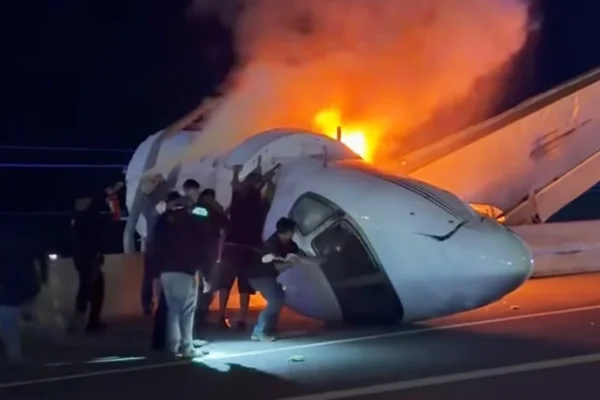
A deadly plane crash on a major Texas highway has intensified concerns over air travel safety in the United States after a private aircraft came down in Laredo, killing one person and triggering a large emergency response across a key regional transport corridor.
The crash occurred on Loop 20, also known as State Loop 20, near the Saunders Street and Clark Boulevard area. Public safety officials confirmed that six people were aboard the aircraft and that one fatality was reported. The aircraft also struck a vehicle on the highway, adding a ground transport dimension to an aviation emergency that quickly disrupted traffic and emergency operations.
The incident has drawn attention far beyond South Texas because it involved aviation activity over a busy road network near Laredo International Airport, one of the city’s important gateways for business, cross-border travel, and regional mobility. For travelers, tourism operators, airport users, hotels, and ground transport providers, the crash highlights how aviation incidents can affect not only passengers but also road users and local visitor movement.
Emergency Response Secures Laredo Crash Zone
Emergency crews moved rapidly after the aircraft came down on the highway. Police, fire, medical, and transport authorities secured the crash zone, managed traffic, and worked to prevent further danger from fire, smoke, fuel, and debris.
The Laredo Police Department requested photos, videos, and dashcam footage from the public to support the investigation. That appeal shows how modern emergency response increasingly depends on cooperation between public agencies, travelers, motorists, and local communities after major transport incidents.
Several responders were treated after exposure to smoke during rescue and containment work, according to public safety updates. Their actions underscored the high-risk nature of aviation emergencies that occur in road corridors, where responders must manage aircraft wreckage, injured passengers, moving traffic, fire hazards, and public safety at the same time.
Traffic disruption followed immediately. Authorities warned motorists to expect delays and detours as emergency crews and investigators worked at the site. For a city such as Laredo, where highways support residents, visitors, business travelers, logistics operators, and cross-border movement, even a localized closure can create wider mobility pressure.
Aviation Safety Investigation Moves Forward
Federal aviation authorities are expected to examine the aircraft’s operational condition, communications, flight path, and the circumstances leading to the crash. The National Transportation Safety Board normally leads civil aviation accident investigations in the United States, while the Federal Aviation Administration supports aviation safety review and regulatory oversight.
The investigation is likely to assess whether mechanical, operational, environmental, or navigational factors contributed to the crash. Because the aircraft came down on a public roadway, investigators will also need to consider the interaction between aviation infrastructure and ground transportation systems.
This type of crash raises difficult questions for aviation planning in growing urban and semi-urban regions. Airports often sit near highways because both require strong regional access. However, when low-altitude flight paths overlap with busy road corridors, emergency planning becomes more complex.
For the travel sector, safety confidence remains essential. Business aviation, regional airports, charter flights, and private aircraft movements all support tourism, investment, conventions, medical travel, and cross-border commerce. Any fatal incident can therefore influence traveler perception, especially when images of highway disruption and emergency rescue circulate widely.
Tourism and Mobility Impact in South Texas
Laredo plays a distinctive role in Texas travel because of its position on the United States-Mexico border. The city supports cross-border tourism, cultural travel, retail visits, business trips, and road-based itineraries through South Texas. Its highways and airport connections are central to that visitor economy.
Aviation incidents near transport corridors can affect hotel arrivals, airport transfers, rental car schedules, tour planning, and local business activity. While the crash was an isolated event, the operational impact shows how quickly a safety emergency can move across multiple parts of the tourism ecosystem.
Travelers using Laredo International Airport or nearby road routes may face temporary changes during emergency operations and investigations. Local hospitality businesses, transport providers, and visitor services often depend on predictable mobility. Road closures, detours, and uncertainty can therefore influence check-in times, meeting schedules, and same-day travel plans.
At the same time, the response also demonstrates the importance of preparedness in destination management. Cities that serve visitors need emergency systems capable of protecting residents and travelers during unexpected events. Clear public messaging, coordinated traffic management, and fast rescue operations help limit wider disruption.
Air and Road Networks Face New Scrutiny
The Texas highway crash has renewed attention on how aviation and ground transport systems interact in expanding regions. As airports, roads, commercial zones, and residential areas develop closer together, public authorities face growing pressure to coordinate safety planning across sectors.
Improved surveillance, stronger emergency access planning, clearer public communication, and careful zoning around aviation corridors may become more prominent in future policy discussions. These measures matter not only for aviation safety but also for the reliability of tourism and travel infrastructure.
For airlines, airports, charter operators, hotels, and local tourism agencies, traveler confidence depends on visible safety standards. Even though commercial aviation remains one of the safest modes of transport, incidents involving smaller or private aircraft can still shape public concerns.
The confirmed fatality in Laredo has made the incident a serious case for investigators and public authorities. Until official findings are released, the cause remains under review. However, the crash has already become a reminder that aviation safety, emergency response, highway management, and destination resilience are deeply connected in modern travel systems.
As Texas authorities continue their work, the priority remains clear: determine what happened, protect the public, support those affected, and strengthen confidence in the transport networks that carry residents, visitors, and businesses across the United States.
For more travel news like this, keep reading Global Travel Wire